skip to main |
skip to sidebar
My wife feels depressed. She didn't get the job she was counting on, and she wonders if anyone will ever hire her in that field. She spent six months training intensively for it, passed her certification test, and no one will hire her. Why didn't the instructor tell her from the outset that she would almost certainly not find work in that field unless and until she improved her English? Why didn't we figure this out ourselves and go in a different direction? And if she can't find work in that field, what field can she work in where she can earn half-way decent pay with half-way decent benefits? She was raised by parents who always worked hard and expect their children to do the same, and good Thai children do what their parents expect of them.
As for me, my self-confidence diminishes by the day. I grow more convinced with each day that I am profoundly defective in an overwhelming number of ways cognitively and that my career prospects are bleak at best, and I don't know what to do about it. Get up off my ass and do something? Do what? Do it how?
I wish I had never married my wife. I love her, but she deserves better than she'll ever have with me. I've done some bad things in my life, but marrying her was the worst thing I've ever done because it has tied a precious human life with so much beauty, intelligence, and promise to someone abysmally lacking in almost every way.
People who read this blog have commented before that I'm not seeing myself realistically. But they judge only by what I write or by what they know of me from superficial interaction in person. They don't begin to know me as well as I know myself. They don't see the things I struggle to understand and do every day that normal people understand and do without effort. Writing is just about the ONLY thing I can do with any proficiency at all. But I don't begin to do it well enough to make up for all of the other things I can't do or can hardly do at all.
I won't always feel as gloomy as I do now. At least not in the forefront of my consciousness the way I do now. But these thoughts and feelings are always beneath the surface to fill my mind and heart whenever I'm able or compelled to take a look at reality as it is rather than how I would like it to be.
I feel lost,and so does my wife because she's stuck in a foreign country married to a loser. That is my naked reflection for today.
I've known about Google Video for some time, but I never truly appreciated just what a wonderful resource it is until yesterday when I followed someone's blog link to a two-part series on religion vs reason hosted by evolution theorist Richard Dawkins. I'll probably have more to say about that program in a future entry. But right now, I just want to mention that I found amazing free videos featuring great musicians, philosophers, scientists, sages, and martial artists.
One such video featured the renowned scholar of comparative religion Huston Smith dialoguing with legendary sage Krishnamurti on whether it's possible to view life with total "lucidity." Krishnamurti defined "lucidity" as seeing and understanding reality not just intellectually but with all of one's being. When Smith asked him "how" one is to do this, Krishnamurti replied that it can't be done through any mechanical "method" or technique handed down by alleged authorities. It must simply be done directly, as in the Nike commercial "Just do it."
But how does one do it, asked Smith, to which Krishnamurti replied that he was asking the wrong question. A better question would be, What are the "obstructions" standing in the way of lucidity? The implication seemed to be that if we understood the nature of those obstructions, they would disappear and lucidity would be left in their wake.
When I was younger, I took this argument--advanced as it was by Krishnamurti, Alan Watts, and other sages I respected--very seriously and used it as a rationale for not engaging in any formal spiritual practice. But today, I'm inclined to take more seriously the arguments of people such as Ken Wilber that there are time-honored methods for progressing in spiritual realization and overall consciousness development, and that the vast majority of us have no hope of accomplishing this any other way. The kind of direct seeing that Krishnamurti advocated just won't work for most human beings.
Still, I found the dialogue intriguing, and I think it's wonderful that one can see videos of these celebrated figures free on demand and gain a sense of what they were like. There are numerous other Krishnamurti videos available that you might also want to check out.
Right now, I'm going to watch a great old video on "the art of meditation" featuring Alan Watts talking over beautiful scenes from nature.
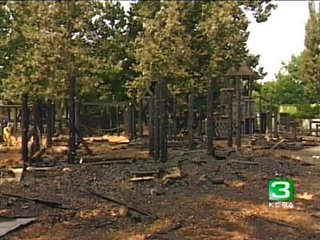 Yesterday, my wife and I went out for our evening walk. We immediately saw smoke pouring into the sky from somewhere nearby and heard the wail of sirens. We walked toward the smoke and discovered that a fire was raging at the local park, consuming the extensive wooden playground equipment that was a source of pride to the community and great pleasure to countless children since 1992. It was clear even then that the fire was too big and had spread too rapidly to have happened by accident, and the Sacramento Bee this morning confirms that it was, indeed, a case of arson.
Why would someone do that? What should happen to him if he's caught? The massive playground was the first community playground in Sacramento and had been built by hundreds of volunteers at the cost of $111,000. At the very least, the person responsible for burning it down should have to foot the cost of rebuilding it and pay for deploying firefighters and police to the scene, even if his paycheck has to be garnished for the rest of his life to do it. Two other arson fires also happened close by around the same time, and a pickup truck was seen speeding away from one of them. I hope they catch this person before a house burns or someone gets hurt.
As my wife and I continued our walk, we passed by the mayor's house. She was out watering in the front yard. We said "Hi" to each other. I wanted to tell her about the fire, but I didn't. I told myself that she either already knew about it or would find out soon enough, and that, in any case, she didn't want to talk with a nobody like me. But I wish I had told her anyway.
Before I went to bed, I checked my e-mail and read a shocking and very sad message from a friend about her mother having died recently and with unexpected suddenness from a ruptured brain aneurysm. My friend lost her father to a heart attack in May of last year, was diagnosed with lymphoma eight months later, and has now lost her mom. How can life deal some people so much misfortune over such a short time? And how can those individuals get through it? Some don't. It's just too much for them. But I think my friend will make it. She's a strong, wise, and good person with family and friends who love her and are there for her.
But, still, it ain't gonna be easy.
I bowled better last night than I have in a long time. I scored better too. I attribute it to being true to my new bowling ideal. My ideal is not to be concerned with how I score or with whether I win. My ideal is to focus strictly on mindful execution of my approach and delivery. My ideal is for bowling to be meditation in motion.
Last night it was just that much of the time. I began my first game with eight strikes in a row. Interestingly, I lost my focus a little in the ninth frame, as thoughts of a perfect 300 game began dancing in my head, and I threw a bad shot and ended up with an open frame. After that, I regained my focus and struck twice in the tenth for a 260 game. I began the next game well and had a chance at another high score. And, once again, I threw some bad balls when I became more concerned with my score than I did with my execution and ended up with a 221 game after opening in the tenth frame with a split. I was able to stay focused on execution the third game and bowled a 277 game. That gave me a 758 series for the night. By not trying to score well, I scored my best league series of the year. By not trying to win, our team won all three games. Alan Watts had two names for this intriguing phenomenon: "the law of reversed effort," and, more simply, "the backwards law."
I accomplished this by focusing on execution instead of score, and also by giving up trying to throw the ball hard with a lot of revolutions the way I did when I was younger. Instead, I tried to be smooth and steady with my approach and release. And what I lost in power and in the exciting explosiveness of my ball at the pins, I more than made up for in the consistency of my ball reaction and by outstanding carry on a variety of different ball entrances to the pocket.
I think last night's experience helped to make me a wiser, better bowler.
I was supposed to take my medical coding certification test this morning. I cancelled after taking a practice test a few days ago. I scored well on the test. But I took far longer to complete it than the allotted five hours, and I hurried through it at that. There's no way I could pass it now, and, thus, no go reason to take it now. I did well in the coding course I recently completed. I thought I was ready. But my problem is that I'm too slow. Accurate, but slow. I'm not sure how I'm going to build my speed. Practice, I guess. Practice and more practice, pushing myself every step of the way to go faster...faster.
I don't know why there's such an emphasis placed on speed. We're hurrying through life, trying to do more and more in less and less time. A vital aspect of Eknath Easwaran's spiritual path is to "slow down." But how can we when everyone and everything is pushing us to go fast? Even a certification exam for a profession in which accuracy is paramount seems to be asking for impossibly fast performance. Well, it's obviously not impossible for everybody. Lots of people have passed the exam. I hope I can find a way to make myself one of them in September. In the meantime, I will try to follow the famous advice of the immortal John Wooden: "Be quick but don't hurry."
Last night, I watched Chris Angel's show Mindfreak for the first time. It won't be my last. He did some amazing things. In fact, "amazing" is a huge understatement. He "levitated" in a number of settings both indoor and out including from the roof of one tall buidling to another with people standing below him watching in awestruck disbelief. How did he do it? I don't really want to know. I want to be able to entertain, in the perpetual child portion of my mind, the fantastic notion that there really IS magic that overrides the laws of physics and that some extraordinary human beings among us are capable of performing it. But how DID he do that levitation trick?My wife went for a job interview today, and it looks like she may get the job. I'm so proud of her! She's self-conscious about her English and was very nervous going to that interview. But she sucked it up and went in there and did a great job. I couldn't imagine myself doing the same in Thai in Thailand, even if I spoke Thai at the same level that my wife speaks English.As we were driving to her interview, I saw a restaurant-bar named "The Plantation," and below the name were the words, "Where soul food was created." I couldn't help but think of how it would be for a restaurant for Jews to be called "The Concentration Camp." I'm watching Bill Moyers and his wife on Charlie Rose talking about their upcoming series on religion. I'm now looking more forward than ever to seeing it. And I'm more grateful than ever that Charlie Rose is back with us.It was 102 in Sacramento today, and it's supposed to be hotter tomorrow and hotter still Saturday and Sunday. I'm glad I don't mind the heat more than I do.
Last night I dreamed that I was in a train station with my grandmother. Sitting across from us was a man holding a big live bird that appeared to be his pet. Suddenly, the man pulled out a meat cleaver and began hacking away at the bird. At first, I couldn't believe that he was actually slicing the bird. I thought he must be hitting it with the dull end as some kind of sick joke. But when I saw bloody cuts in the bird and saw the bird flap its wings and heard it cry out in pain, I was beside myself. At one point, the bird just looked at the man as though it were saying: "I loved you and trusted you. Why are you doing this terrible thing to me?" And there was a mixture of fear and helpless resignation in its eyes.
I couldn't bear to watch any more of this, so I jumped up and began to leave the terminal when the man said to me, in a British or Australian accent, something like, "What's wrong? Why are you leaving?" I don't recall my exact words of reply, but I do remember that I told him off for committing such a barbaric act against that poor bird and in front of all of us. People in the terminal cheered me. And then I stepped outside. My grandmother followed me out. I felt angry toward the man, profoundly sad for the bird, and proud of myself for being strong enough to speak up against that man's cruelty.
What would I do in real life?
Speaking of barbarous acts, it appears as though the two American soldiers captured by insurgents last weekend in Iraq were tortured to death. It wasn't reported exactly how they died, but their recovered bodies were said to have been mutilated beyond recognition and there was strong evidence that they had died in a "barbaric" way. A statement from a group believed to be linked to al Qaeda crowed, "We announce the good news to our Islamic nation that we executed God's will and slaughtered the two crusader animals we had in captivity."
Part of me wants to find those responsible and subject them (and their families) to the most protractedly excruciating deaths the human mind can devise. The better part of me looks at their language of having "slaughtered" the "animals" and thinks that we must not give in to the impulse to dehumanize these individuals or anyone else. That may not stop others from dehumanizing us and ours, but, at least, we can do unto others as we would have them do unto us, and maybe, just maybe if we did that consistently, an increasingly wide circle of other people would do the same over time.
But whether they did or didn't, WE would be doing the right thing. But, instead, we and our leaders will call these individuals "evil monsters," and the cycle of violence will continue indefinitely, perhaps spinning completely out of control. And not only will we harm, mutilate, and destroy each other with our violent thoughts and deeds. We will also harm, mutilate, and destroy ourselves.
I just read a local news story of a young man "with an extensive criminal history" being detained by the California Highway Patrol for speeding and drunken driving and suddenly bolting from the officers, jumping over a concrete divide along the freeway, and being struck and killed by an SUV. And you know the first thought that came to my mind?GOOD! THE STUPID FUCK GOT WHAT HE DESERVED! I'm not proud of thinking this way. But how should I feel about what happened to this man or about my first reaction to learning of it?I watch "Cops" and "World's Wildest Police Videos" from time to time, and both programs abound with drunken or drug-crazed drivers fleeing police and being chased along crowded freeways and busy city steets imperiling themselves, the police who chase them, and innocent citizens. I often want to see these people caught, dragged out of their cars, and Rodney Kinged to within an inch of their lives, or see them shot if they run after the officer tells them to "Freeze!" Why do I feel these things? Is it hatred for my own "shadow"? If so, what exactly is this shadow of mine?When I was younger, oh so much younger than today, I once ran from the police after being told to "Stay where you are!" A friend of mine and I were in Riverside, California at the state junior bowling tournament, had been doing some underage drinking that night in our motel room, and wandered outside for a moment only to be seen by a cop down the hall who shouted at us and we reflexively took off running. In what seemed like a millisecond, the cop was right there, his gun pointing at us, shouting, "Freeze!" We froze.It turned out that this cop was investigating reports of break-ins to that motel complex by a couple of guys who looked a lot like us, and he happened to see us right after we stepped outside our room. We ran because we didn't want to get in trouble for drinking, and we didn't take the time to consider how much more trouble or worse we could get in for running from a police officer. We were let go with a stern reprimand. It could have been worse. Much worse. I found out later that the Riverside police were notorious for their "Shoot first, ask questions later" policy. What if I had been more addled by alcohol or something stronger than I was and had continued to run after being told to "Freeze!"? I wouldn't be here now blogging about the anger if not hatred part of me feels toward people who defy and flee the police.
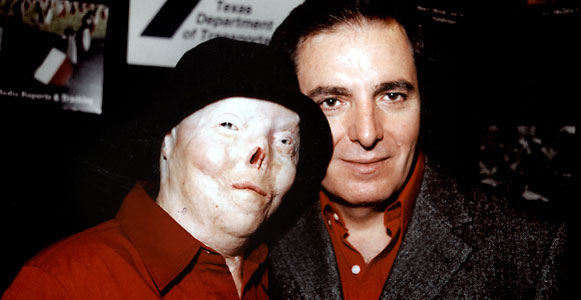
 I've just received two disturbing e-mails. One is about a guy I used to know who's been arrested for murdering an elderly couple in the Bay Area. At least, I suspect it's the same guy I used to know, although I hope it isn't, or that, if it is, he's innocent. I admit that I knew him a long, long time ago and that people can change a lot over time or not be what you think they are in the first place. But I can't imagine the guy I used to know doing what this man is accused of.The second e-mail tells the profoundly disturbing story of a young woman named Jacqui Saburido who came here from Venezuela when she was nineteen to study English and was hit in her vehicle by a drunken teen driver and burned horribly. She lived, but this once vibrant and gorgeous young woman has been mutilated almost beyond comprehension, and I feel such deep sadness for her and such anger and even hatred for the young man who did it to her. By all accounts, he too is suffering for his deed not only because he's serving time for it in prison, but also because he feels deep remorse for the suffering he inflicted on Jacqui and for the deaths of two of her friends who were in the vehicle with her. But is that suffering enough?The fact of the matter is that there but for the grace of God go many of us who have had a few drinks and then gotten behind the wheel and driven away. I've been pretty good about this, but only because I have the ability to know when I've had too much to drink to be able to drive safely. Alcohol seems to rob some people of this ability to monitor and assess themselves.I can't imagine being Jacqui or the young man responsible for her awful plight. But I pray that no one else has to stand in either of their shoes ever again, although I know that my prayer will not be answered.
From my diary.I have the feeling that I dreamed last night of sitting here now typing this. Did I really dream this? An old psychology professor of mine once explained deja vu as the result of part of our brain unconsciously experiencing an event a fraction of a second before another part of our brain consciously experiences it. Sometimes, for some reason, the conscious part becomes aware of the prior unconscious experience of the other part and interprets that prior experience as having arisen much earlier--e.g., in a dream the night before--than it actually did. Her explanation kind of made sense to my bored mind at the time. But when I think about it now, it raises more questions than it answers.I decided not to go bowling this morning. Instead, I watched it on TV. One was a classic match between Mark Baker and Dave Ferraro in which Baker won 279 to 278. Ferraro's was the highest losing score ever on TV at that time. But then I watched another old bowling show after that in which Mike Aulby beat David Ozio 300 to 279. What great bowling by two of the greatest bowlers ever! And what a shame that somebody had to lose! I wish I had Ozio's style. It's the sweetest style I've ever seen. By contrast, my style is hopelessly awkward and ugly. But it's too late to change now in any significant way. What else is it too late to change?My wife went to the temple today while I started this blog and brought some food home from it. She wants to return to it this evening, and she wants me to go with her and eat dinner with her there. I'm sure the food is very good. But I don't want to go. Yet, I also don't want to be a stick in the mud all the time. I don't do enough with my wife as it is, and I know it bothers her and that she feels bored either doing nothing or doing too many things without me by her side. I called Mom and invited her to a 4th of July gathering at my wife's uncle's house. I didn't expect her to be free that day, but she said she will be. It will be nice if that doesn't change and she can finally meet part of my wife's family besides her sister.
After I talked with Mom, I called my ex-girlfriend. At one point we talked about language learning software, and she mentioned the Rosetta Stone programs. She thought the English version might be good for my wife, but I said I think my wife's English skills are already beyond the scope of that course. What she needs more than anything now is practice in pronunciation and fairly advanced listening comprehension. But a course like that in Thai or some other language might do me some good.**********My wife and I took our nightly walk and then watched a TV movie called "Touching the Top of the Sky" or something like that about the only blind man to ever climb Mt. Everest. His was an impressive feat to be sure, but I wish the movie telling his story had been more impressive. Still, it was good for someone like myself who's afraid to try anything new to watch someone like that do something like that.
Gagdad Bob recently hinted that he might discontinue his blog. It sounds like he might be feeling a little burned out and underappreciated. I can't say that I understand most of what he writes much less agree with it, but I'm glad he's out there, and I hope he stays, even if he stops posting every day and does it only once or twice a week. It's supposed to heat up as the week wears on, climbing into the 100's by the end of the week. That's OK. We've got fans and, if we really need it, we've got air conditioning.
From my diary.It was hot yesterday, almost a hundred. But that's the norm for this area this time of year. I don't mind it much. We have air conditioning when we need it, but we mostly use just the fans. Fortunately, the air is usually pretty dry. That makes the heat easier to live with, even if my wife disagrees. My wife hails from a much balmier clime, and she despises the crackling dry heat of places like Las Vegas. Fortunately, we don't live in Vegas. I used to think that high humidity makes us sweat more and low humidity makes us sweat less. But what I learned recently is that we sweat pretty much as much no matter what the humidity. But when the humidity is higher, the air is so moist already that it can't draw as much sweat from our skin as it can when it's drier. So the sweat just stays on the skin and makes us feel uncomfortable instead of evaporating and making us feel better. I say I learned this "recently." Actually, I learned it a long time ago. But then I forgot it. I forget a lot of things. Most of us do, I suppose. But I think I forget more than most. This can be very discouraging. I have a stockpile of books I've never read because, even though I want to learn what's in them, I'm convinced that if I read them, I'll forget what's in them, and the time I spent reading them will have been wasted.
Yesterday, my heart continued to bother me. Perhaps not quite as bad as the previous couple of days, but it still wasn't fun. I have Wolff-Parkinson-White syndrome. It's a heart condition I was diagnosed with in my late teens. It sounds worse than it usually is, and very few people die from it. I take medication for it that keeps it very well controlled most of the time. But the last few days I've been having palpitations that have me a little on edge. I've gone through this before and things always returned to normal on their own. But I'm getting older, and I may not be as resilient as I used to be. But I still hate going to doctors and will probably ride this out unless I decide that I just can't, or my body decides for me. Actually, it's much better today. I've had very few palpitations. I hope it continues that way. Wouldn't you know it? Just after I wrote that, I began having more palpitations.Yesterday, my wife and I went to the local humane society to look at cats. We already have one cat, but why settle for only one when we can have two? We saw a beautiful boy cat who looked a bit like the cat we have already, and I was really tempted to take him. But then I read on his papers that his owner gave him up because of "inappropriate urination." Now that is something my wife and I just don't need. Our own cat has been known to manifest this problem too, although he's been pretty good lately, and I don't want to deal with it in another cat or have it draw the same problem out of dormancy in my cat. Still, I felt sad when I walked away from that cat, because he's slated to be put down anytime, and I'm quite certain that this will be his fate, since nobody who reads what I read and understands it is likely to adopt a cat that pisses on the rug or furniture. This cat is only a year old and appears alert and intelligent and sweet. The more I write about him and think about him, the sadder I feel. I also think about all the kittens I saw there yesterday who will probably die before they've even begun to live. At least I hope they die painlessly and fearlessly. If they do, they might be better off than the ones who live. At least that's what I try to tell myself to assuage my sadness and guilt over not taking them all home with me.We watched a little of the replay of the World Cup match between Italy and the USA. The final score was 1-1, which, I suppose, was something of a minor triumph for the USA team. I don't care for soccer. But my wife grew up with it, and love means trying to share interests with the person one loves.Last night, we watched "Cops." I probably shouldn't, but I really like watching that show. I like watching all kinds of cops deal with all kinds of people in all kinds of circumstances and feeling that no matter how bad I may think I have it sometimes, I'm infinitely better off than some of the poor souls I see on that show. But then I feel sad that some people are so hopelessly lacking in intelligence and wisdom that they could live essentially like subhuman animals bent on virtually nothing more than drinking, taking drugs, fucking, and committing crime. Wouldn't they and the whole world be better off if they just crawled into a hole somewhere and died? But is that how I really want to think?
Frank Visser has finally addressed on his blog his recent run-in with Ken Wilber. He suggests that if criticism of Wilber's system may be partly the result of people attacking their own shadows, it may also be motivated by valid observations, and Wilber's response may be an attack on his own shadows. Furthermore, says Visser, it might be more profitable to address the whole dynamic of the conflict in terms of a "conflict resolution strategy (pioneered byDaniel Ofman)" employing the concept of "core qualities.""The idea," explains Visser, "is that each mental quality has an extreme version (its "pitfall"), but also its opposite quality (or "challenge"), which in turn has its extreme version (or "allergy").For example: The quality of eloquence has the pitfall of being talkative, the challenge of knowing when to be quiet, and the allergy of never speaking up. Now an eloquent person will typically have an allergy for people who never speak up -- and a quiet person hates those who are talkative. When allergies escalate, a conflict is born. The trick of conflict resolution is to acknowledge and affirm both qualities in each other, while avoiding their pitfalls, c.q. allergies."I'm no psychologist, but it seems to me as though there might be something to this approach.
"Can religion and reason peacefully coexist? From a scan of the headlines it doesn't seem so. The world appears polarized, incapable of even agreeing to disagree on matters of faith."--David Ian MillerBill Moyers will be hosting a new seven-part series called Bill Moyers on Faith and Reason coming to a PBS station near you this Friday. After each episode airs, it will be available for free viewing on demand on the PBS website. Each episode will feature Moyers conversing with a writer who recently attended the PEN World Voices festival in New York. Salman Rushdie will be one of those writers. The discussions will focus on reconciling religious faith with reason at a time when they seem to be increasingly at odds. Says Moyers, "I want my audience to see that they're not alone -- there are people like them who don't live polarized, one-sided lives. Most of us move back and forth in the twilight zone where faith and doubt stroll together like old lovers, once estranged, now reconciled, conducting a quiet, respectful and intimate conversation in the hope of understanding each other better."I don't know how good this series will be, but I suspect that it will be a lot better than most TV fare this summer.
Gagdad Bob says that Noam Chomsky’s ideas are so “bizarre” that it would be “a waste of time” to analyze them. Perhaps he’s right, but I wouldn’t know, because he doesn’t explain how they’re bizarre. He says Chomsky has made a long career of being “wrong about everything,” but, again, I wouldn’t know, because he doesn’t give examples and explanations of why they’re wrong. This is unfortunate, because if Chomsky really is wrong about something, I’d like to know it and understand why it’s wrong. But it looks like I may never find out from Gagdad Bob, because he says that Chomsky is “much more of a religious cult figure and should be regarded as such. He cannot be discredited.”
For the record, I don’t worship Chomsky or reflexively accept everything he says about U.S. foreign policy as being true. But I have great respect for his tremendous intellect and awesome erudition, and it seems to me that many of his observations regarding this nation’s actions abroad ring of some degree of truth. Maybe not the whole truth, but at least part of it.
Bob says that according to Chomsky, “it always comes out looking the same: U.S. bad, enemies of U.S. good.” I respectfully disagree. I think Chomsky has credited the U.S. with good deeds and “enemies” of the U.S. with bad ones. Furthermore, I think he’s been realistic in saying that virtually any country in the U.S.’s position of power would do at least as many bad or questionable things to preserve that power as this country has. He says that every nation looks out for its own interests first and foremost and will exercise as much power as it has to serve those interests. Nothing “bizarre” about this that I can see.
I think a more compelling case might be made for saying that Gagdad Bob’s behavior is the antithesis of what he falsely accuses Chomsky’s of being. For Gagdad Bob, it always comes out looking the same: U.S. good, enemies of the U.S. bad. He probably wouldn’t even deny this. But what I’m afraid he would do is fail to satisfactorily explain how his assertion is true.
That’s too bad, because I think Gagdad Bob is a brilliant man and a great writer. I’d like to think he can do better.
I said I was going to stop posting to my blog unless and until I experienced some kind of profound transformation of my being and writing. But I thought about it some more and realized that no profound transformation is likely to occur no matter what I do or don’t do. What’s more, if I undergo any transformation whatsoever, it’s likely to come about at least partially as the result of my using writing as an instrument to clarify and organize my and other people’s ideas and insights into useful patterns.
So, I’ve decided to resume posting here far, far sooner than I anticipated when I announced my hiatus. However, I don’t expect to post almost every day like before. It will probably be more like almost every week, when there’s something I really want to say rather than my conducting a dutiful exercise. I say “probably” because who knows how often it will end up being?
I hope we can find out together.
I've been posting pretty regularly to this blog since January of 2005. I'd like to continue doing it. But I've decided that I can't give this blog the time, effort, and, most importantly, the quality it deserves unless and until I read more, contemplate more, live more, learn more, and have more to say about things worth saying, and more discipline and skill to say them the way I want to say them.I don't know when that will be or if it will ever be. I'm trying not to be negative about myself and pessimistic about my future, but I am. I don't feel depressed. I have in the past. I know very well what depression feels like, but I don't feel that now. I just feel a sense of futility in going on the way I'm going. I feel the need to either go a different way, or to resign myself to a life in which the best I can hope for is to earn a modest living, be a decent husband and decent person overall, and stop trying to figure out what it's all about and stop trying to write about it. Because as long as I go on the way I'm going now, I'm not really going to figure anything out or have anything to say that's worth saying. And more or less just going through the motions of posting to this blog the way I'm doing now is stealing incalculably precious time away from the practical necessities of life that I've been neglecting AND from the kind of disciplined study and integral life practice in which I need to engage in order to produce the kind of blog I want to produce and write the kinds of books I want to write if I really have what it takes to do it and haven't merely been deceiving myself all along into thinking I have what I don't have. At times like these, I suspect that I HAVE been deceiving myself. I suspect that I bring too little intelligence, talent, and willpower to the table to create anything that isn't less than mediocre, and if I can't be better than less than mediocre at something, I'd rather not do it at all. But the fact of the matter is that I just don't know what I have the capacity to do with my learning and writing, because I've never really given myself the chance to find out. During my time away from this blog, I hope to find out. And if I discover that I have anything to say that seems to be truly worth saying, I'll be back to say it here just as soon as I can.I don't know how many people read this blog regularly or even semi-regularly and truly give a damn about anything I've written here, but I thank you for spending time here with me, and I hope that if I come back, you will too.Namaste,Steve
"Any premodern spirituality that does not come to terms with both modernity and postmodernity has no chance of survival in today's world." The quote above is from Ken Wilber's essay From the Great Chain of Being to Postmodernism in Three Easy Steps. If Wilber is, in this instance, using "spirituality" to mean "religion," I disagree with him. It seems to me that premodern religion divorced from modern and postmodern understandings is not only surviving but flourishing and will probably continue to do so indefinitely. However, speaking for myself, I cannot embrace the teachings and practices of any premodern religion cut off from modern and postmodern understandings of self, culture and nature stemming from such varied disciplines as the physical, biological, psychological, and social sciences, linguistics, philosophy, and theology. Yet, many who claim to agree with this also continue to call themselves Jewish, Christian, Muslim, Hindu, Buddhist, Taoist or whatever and to adhere faithfully to the teachings and practices of those premodern traditions. I don't know how they do it, and, until I do, I can't do it myself.But then, what SHOULD I do?
Frederick Crews is a Professor of English Emeritus at U.C. Berkeley, has written several books, and is perhaps best known for his controversial essays about Freudian theory and recovered memory. His latest book, Follies of the Wise, is a collection of skeptical essays about everything from psychology to UFO’s to literary theory to religion. In the Introduction to his book, he stresses the importance of “unsparing empirical review, the tools we need to forestall another such outbreak of mass irrationality” in science, religion, and popular culture.
Crews begins his introductory essay by addressing problems with theodicy—the attempt to rationally reconcile God’s alleged omniscience, omnipotence, and omnibenevolence—in order to call attention to a “clash between two intellectual currents.” These conflicting currents are “scientific empiricism” and “traditional authority” of religious and other kinds. Crews comes down strongly in favor of the former and believes that it leads to “metaphysical naturalism,” which Wikipedia explains as the supposition that “the fundamental constituents of reality, from which everything derives and upon which everything depends, is fundamentally mindless. So if any variety of metaphysical naturalism is true, then any mental properties that exist (hence any mental powers or beings) are causally derived from, and ontologically dependent on, systems of nonmental powers, properties, or things.”
I think my own outlook pretty much meets this definition. I know that many people believe in some kind of transcendent Spirit that is the matrix or ground if not also the goal of manifold Reality, but I have not yet been able to understand how any kind of “spiritual” mind, intelligence, agency, or force could arise or exist independently of “systems of nonmental powers, properties, or things” or be the “telos” we are intrinsically motivated to fulfill. When people from traditional religionists to Ken Wilber insist that if there were no universe, there would still be Spirit or God, part of me wants to believe them, but I can’t honestly say that I do, for I just don’t understand how it could be true. What and where would this Spirit be?
Says Crews, “Metaphysical naturalism may be undiplomatic, then, but it is favored by the totality of evidence at hand. Only a secular Darwinian perspective, I believe, can make general sense of humankind and its works. Our species appears to have constituted an adaptive experiment in the partial and imperfect substitution of culture for instinct, with all the liability to self-deception and fanaticism that such an experiment involves. We chronically strain against our animality by inhabiting self-fashioned webs of significance—myths, theologies, theories—that are more likely than not to generate illusory and often murderous “wisdom.” That is the price we pay for the same faculty of abstraction and pattern drawing that enables us to be not mere occupiers of an ecological niche but planners, explorers, and, yes, scientists who can piece together facts about our world and our own emergence and makeup.”
I suppose that philosophers from Bob Godwin to Ken Wilber would contend that our “myths, theologies, [and] theories” and our “faculty of abstraction and pattern drawing” arise from more than a strictly “natural” substratum and aim at more than merely killing time between the maternity ward and the crematorium. If I’m not mistaken, they would argue that these human products and traits can be understood fully only as immanent instantiations of transcendent Spirit seeking to know and harmonize with Itself.
Crews tangentially addresses this when he writes: “Here it may be objected that myths, theologies, and theories themselves, as nonmaterial things that can nevertheless set in motion great social movements and collisions of armies, confound a materialist or metaphysically naturalist perspective. Not at all. We materialists don’t deny the force of ideas; we merely say that the minds precipitating them are wholly situated within brains and that the brain, like everything else about which we possess some fairly dependable information, seems to have emerged without any need for miracles. Although this is not a provable point, it is a necessary aid to clear thought, because, now that scientific rationality has conclusively shown its formidable explanatory power, recourse to the miraculous is always a regressive, obfuscating move.”
By “recourse to the miraculous,” Crews seems to be talking about, among other things, the notion of a transcendent Spirit that philosophers such as Godwin and Wilber would say we cannot know by strict empirical observation or “scientific rationality” but must apprehend by a deeper, more direct, and more intuitive means. But, says Crews, “there is no such thing as deep knowledge, in the sense of insight so compelling that it needs no validation. There is only knowledge, period. It is recognizable not by its air of holiness or its emotional appeal but by its capacity to pass the most demanding scrutiny of well-informed people who have no prior investment in confirming it. And a politics of sorts, neither leftist nor rightist, follows from this understanding. If knowledge can be certified only by a social process of peer review, we ought to do what we can to foster communities of uncompromised experts. That means actively resisting guru-ism, intellectual cliquishness, guilt-assuaging double standards, and, needless to say, disdain for the very concept of objectivity.”
This resonates with me. I’m wary of the alleged certitude of the “deep knowledge” of intuition or mystical insight, even if part of me wants to believe in it. It seems to me as though all proposed truths need to be validated by a community of people qualified to validate them. But how do people who have “no prior investment” in confirming alleged spiritual insights become qualified to confirm them? Don’t most, if not all, who undertake rigorous spiritual discipline to the point where they become “qualified” to validate alleged truths do it with great “investment” in doing so? That is, aren’t they strongly biased in favor of confirming those insights from the very beginning? If so, how reliable are their validations?
Finally, Crews outlines what we should be on the lookout for when we weigh the claims of different “schools of thought”: “The question, of course, is how an outsider can be sure that one school of thought is less entitled to our trust than a rival one. In many instances such confidence would be unwarranted. Certain indicators of bad faith, however, are unmistakable: persistence in claims that have already been exploded; reliance on ill-designed studies, idolized lawgivers, and self-serving anecdotes; evasion of objections and negative instances; indifference to rival theories and to the need for independent replication; and “movement” belligerence. Where several of these traits are found together, even a lay observer can be sure that no sound case could be made for the shielded theory; its uncompetitiveness is precisely what has necessitated these indulgences.”
As I was reading this, I couldn’t help but think of one increasingly controversial “school of thought” that I won’t name. I hope Crews’ cautionary words don’t really apply to it even if, unfortunately, it seems as though they might.
What should one do when one's own moral sense tells him an act is wrong; yet, he believes in levels of moral and spiritual wisdom, and someone he's considered to be at higher levels of moral and spiritual wisdom than himself is the person who committed the act and insists that what he did stemmed from his higher wisdom and was right? Does one abandon one's own moral sense in this instance and accept what the other person says as true and what the other person did as right? Or does one trust one's own moral sense in this instance and reject what the other person says as false and what he did as wrong?
If one does the former, concluding that his own moral sense in this instance is wrong, when can he ever trust his own moral sense to be right? And if he can't trust his own moral sense, can he trust his sense of what's true in other respects, including his sense that someone else is wiser than he is and offers a "map" of reality that is worth studying in depth and detail? On the other hand, if one does the latter, concluding that the other person's moral sense in this instance is wrong even though he continues to insist that it's right, when can one ever trust the other person's moral sense to be right when it disagrees with one's own? And, once again, when can one ever trust anything else that person says to be true?
Anyone who's been reading this blog lately knows what and who I'm alluding to, but I don't want to mention any particular incidents or names, because I'm talking now about more, much more than just one particular incident or person. I'm talking about general issues of morality and truth. How do we know what is right and wrong? How do we know what is true and false? I've always been inclined to say that we need to listen closely to our "inner voice" that tells us when something is or is likely to be right or true on the one hand or wrong or false on the other. But what is this inner voice, and how reliable is it, especially if there really ARE different lines and levels of cognitive, interpersonal, moral, and spiritual development, and the inner voice of people at higher levels or of those we believe to be at higher levels than ourselves disagree with what our own inner voice says?I used to ask these kinds of questions all the time and systematically try to reason my way to definitive answers. But I pretty much gave up when I came to the provisional conclusion that no definitive answers were forthcoming. Since then, I've managed to become pretty comfortable with uncertainty while continuing to place considerable trust in my intuition or inner voice to steer me right most of the time. But times like these give me pause and have me wondering, at least for the time being, how much I can trust my own inner voice or anyone else's and how to proceed in the absence of trust.
I'm reading a piece in What is Enlightenment?. In the introduction, Ken Wilber says to the crowd gathered before him:One of my favorite exercises from Quaker prayer gatherings is: “Let the next sentence out of your mouth be from your very highest self.” Everybody gets quiet at that point! But that’s the kind of attitude we want to bring to these dialogues. New structures in consciousness are being laid down right now—they are just faint footprints on the face of the cosmos. So your behavior, to the extent that you live up to your highest, is actually creating structures that future humanity will inhabit. Therefore, choose your acts very, very carefully. Make sure that the next action you take comes from your highest self. Make sure that the next thing that you say comes from your highest self. Then there’s hope for the future. Those structures are already being laid down. God is laying them down; Spirit is laying them down—through us. So we have to become appropriate vehicles for Spirit to lay down the very structures that humanity is going to inhabit. And if we don’t, that is a guilt we will carry with us for eternity.These are beautiful words. I agree with them completely. However, I have a simple and sincere question for Ken Wilber and his devoted followers: Does Ken's recent, controversial post to his blog truly come from his "highest self" and truly help to create the kind of structure we want humanity to inhabit?