Sunday, February 18, 2007

What to Do About Tim Hardaway?

Tim Hardaway was a superb point guard when he played in the NBA. He was noted for his excellent passing, shooting, and "killer crossover" dribble that left men guarding him glued to the floor as he flashed past them for an easy open shot, assist, or dunk. Unfortunately, he has recently achieved notoriety of a more dubious nature. During a recent radio interview in Miami, he had some unflattering things to say about homosexuals in the wake of ex-NBA journeyman John Amaechi's recent coming out as a gay man who remained in the closet during his brief tenure in a decidedly gay-unfriendly NBA. Hardaway said that if he knew a gay player was on his team, he would have asked that the player be traded because:

"First of all I wouldn’t want him on my team. Second of all, if he was on my team I would really distance myself from him because I don’t think that’s right and I don’t think he should be in the locker room when we’re in the locker room. Something has to give. If you have 12 other ballplayers in your locker room that's upset and can't concentrate and always worried about him in the locker room or on the court or whatever, it's going to be hard for your teammates to win and accept him as a teammate."

Even after the host of the program criticized his remarks, he proceeded to say, "I hate gay people. I let it be known I don’t like gay people. I don’t like to be around gay people. I’m homophobic. It shouldn’t be in the world, in the United States. I don’t like it." And he embraced and added to those comments in another media interview later that day. Only later did he apologize by saying, "Yes, I regret it. I'm sorry. I shouldn't have said I hate gay people or anything like that. That was my mistake."

The fallout of Hardaway's comments was predictable and immediate. NBA commissioner David Stern barred him from participating in activities scheduled for this weekend's All-Star game in Las Vegas and from future appearances for the league, and he was subsequenly fired from his jobs with the Indiana Wildcats of the Continental Basketball Association and with Trinity Sports.

I don't like what Hardaway said, but the consequences he has faced in the aftermath have me asking some questions of myself that I'd like to share with you.

Should he have been fired for what he said? A case can most certainly be made that when someone represents business organizations very much in the public eye, it is entirely proper to fire that person if he conducts himself in ways not in keeping with the philosophy or rules of conduct of those organizations and that could adversely affect their reputation and bottom line. As Commissioner Stern stated, "It is inappropriate for him to be representing us given the disparity between his views and ours."

On the other hand, what terrible thing did he actually do? He said what he really felt and thought without urging that violence be committed against gay people (unless one takes his "It shouldn't be in the world..." as an incitement to such violence), and he probably spoke for the majority of NBA players. As John Amaechi himself said in reaction to Hardaway's remarks: "Finally, someone who is honest. It is ridiculous, absurd, petty, bigoted and shows a lack of empathy that is gargantuan and unfathomable. But it is honest. And it illustrates the problem better than any of the fuzzy language other people have used so far."

Moreover, I wonder how Commissioner Stern would have reacted if one of the NBA's current or past superstars--say LeBron James or Michael Jordan--publicly expressed similar sentiments. Would he have abruptly terminated THEM too from all present and future official involvement with the NBA? Was what Hardaway said really bad enough to get him fired, especially in the wake of the formal public apology issued through his agent?:

"As an African-American, I know all too well the negative thoughts and feelings hatred and bigotry cause. I regret and apologize for the statements that I made that have certainly caused the same kinds of feelings and reactions. I especially apologize to my fans, friends and family in Miami and Chicago. I am committed to examining my feelings and will recognize, appreciate and respect the differences among people in our society. I regret any embarrassment I have caused the league on the eve of one of their greatest annual events."

Suppose Hardaway had said something like this on that radio program:

"I have to admit that I hate homosexuals. After all, my Christian faith says that homosexual acts are a sinful abomination, and I confess that, given my upbringing in a black culture with a real antipathy to homosexuality and homosexuals, I've found it awfully difficult to stop at just hating the sin instead of also hating the sinner. I'm not proud of this, and I'm working on overcoming it. But I personally would find it very difficult to play on the same team with someone I knew to be homosexual. What's more, I think it could cause a lot of problems with the team given the fact that many players feel the same way I do about gays and would also feel very uncomfortable having a gay guy showering with them in the locker room. Not only that, but I also believe that having an acknowledged gay player in the NBA sets a bad example for impressionable young people. So, I think that openly gay people should not be allowed to play in the NBA."

Would this have been better? It invokes an almost universal Christian belief that gay sex is abominably sinful and sounds virtuously open and honest while nevertheless admitting personal shortcoming. Yet, in essence, it says pretty much what Hardaway actually did say.

Suppose Hardaway had not said he hated gays, only that his faith condemns gay sex and that he thought having an openly gay guy on the team and in the locker room could cause team dissension and set a poor example for youth. Would that too have been unacceptable? Would the expression of ANY negative opinions about gay people or gay players in the NBA have been unacceptable and deserving of immediate firing, and, if not, where should the line be drawn between acceptable and unacceptable criticisms of homosexuality?

And now suppose that a player or other representative of the NBA or some other sports organization came out and publicly announced that he hates people who hate homosexuals and thinks they should not be in the world or this country and that they should be fired from their jobs? Would it be right to fire THIS individual as well for his own hateful and derogatory comments?

I don't know exactly how to answer these questions. I'm inclined to think that Hardaway should not have been fired, especially if he issued more apologies. But I DO know that, as unpleasant and unfortunate as I found Hardaway's comments to be, I hope he gets a second chance.

Saturday, February 17, 2007

Bill's Back


The people in Iraq don't want this. The people in America don't want this. The Iraq Study Group doesn't recommend it. The Democrats are against it. Most of the people in his own party are against it, even though many of them wouldn't say so out loud. But George Bush, he knows better. That is a kind of arrogance that is very hard to swallow at this point, especially when it's costing this many lives. Even the pope -- remember he said something bad about the Muslims a few months ago? The infallible pope came out and said, "Geez, my bad. That came out wrong. I didn't mean that." Yeah, the pope can say he's sorry, but this recovering alcoholic from Midland, Texas, he can't even say he's wrong.
--Bill Maher

Wednesday, February 14, 2007

Camille Paglia on the Iraq War

I want American troops out now -- not next year but tomorrow. Support of the troops means not subjecting them to an unsustainable and ultimately unwinnable mission, cooked up by armchair cowboys who see the world in simplistic cartoon terms ("good guys" vs. "bad guys"). The provincial philistines of the Bush administration blundered into the Mideast with little more than superficial knowledge of its tangled history and ancient culture. And they have colossally wasted American blood and treasure on a project that had only a tangential relation to the atrocity of 9/11.

--Camille Paglia


Tuesday, February 13, 2007

What Was He Thinking?


A young man walked into a Salt Lake City mall last night and calmly and indiscriminately shot to death two young women, two men, and a teenage girl and wounded four others before police killed him with a hail of gunfire after he failed to drop his weapon and surrender. Had the police not responded as quickly as they did--reports are that the gunman was "contained" within six minutes of the first gunshots fired--many more might have died or been wounded.

The question that comes to mind is, Why did this young man do what he did? Was it a case of "suicide by cop"? It's doubtful that he expected to live after he murdered those people. The fact that he responded to a command to surrender by firing shotgun blasts at police certainly suggests this.

But if he wanted to die, why did he want to kill as many innocent people as he could first? Whether Christian or not, don't most people fear "dying in sin" enough or feel sufficient uncertainty about what might await them in a possible afterlife that the last thing they would want to do just before dying is murder as many innocent people as possible?

I don't know about you, but if I wanted the police to kill me, I'd be as much of a saint as I could be for as long as possible before the fateful moment. And when that moment came, I'd do something to attract the police's attention that didn't harm anyone, and I would point an unloaded gun at police to get them to shoot me.

Don't worry, I have no desire to commit suicide by cop or any other means. But if I did, I would be an agnostic male version of Mother Teresa beforehand. I wouldn't walk into a mall with a shotgun and handgun and start blowing away men, women, and girls out doing an evening's shopping.

What was he thinking?

Sunday, February 11, 2007

Outlaw Childless Marriages in State of Washington

I've probably made it only too clear that I have problems with conventional Christianity. By "conventional Christianity," I mean Christianity as it's understood and practiced by most people who call themselves Christian and that espouses some version of the Apostle's Creed. I concede, in deference to those who maintain this, that there might be a more evolved, unconventional Christianity possible and that some people in the past and present may even embody it. But, as I've said before, I wonder just how far one can depart from conventional Christianity and still be Christian in any meaningful sense.

One problem, among many, that I have with Christianity is its stance on gay sex and gay marriage. The Catholic Church formally proclaims that all gay sex constitutes "intrinsically disordered" acts of "grave depravity" and "under no circumstances can they be approved." Most other Christian churches officially agree. They base their prohibition on biblical condemnations of homosexual acts and on the notion that gay sex violates the God-given procreative purpose of human sexuality. My counterargument to this has been that if it's permissible for heterosexual couples to have sexual relations without wanting or being able to have children, homosexual couples should be able to do the same. And when Christians reply that sex should only take place within marriage, I respond by stating that gays should be allowed to marry.

Well, it seems that the gay Washington Defense of Marriage Alliance agrees with me and has chosen a wonderfully ironic way to respond to Washington state's banning of gay marriage on the grounds that gay couples can't procreate. They are circulating a petition that would place on the ballot an initiative that would require married heterosexual couples to produce children within three years or have their marriages automatically annulled.

This group admits that the proposed law is "absurd" but argues: “For many years, social conservatives have claimed that marriage exists solely for the purpose of procreation. The Washington Supreme Court echoed that claim in their lead ruling. The time has come for these conservatives to be dosed with their own medicine.”

I couldn't agree more. What do you think?

Saturday, February 10, 2007

Obama's Call to Renewal

Last June 28, the Reverend Jim Wallis' Christian evangelical organization of political progressives, Call to Renewal, sponsored a conference entitled, "Building a Covenant for a New America." Attending this conference were religious leaders, social activists, and major politicians including Hillary Clinton and keynote speaker Barack Obama.

Obama has attracted extraordinary attention for a relatively inexperienced politician ever since his bedazzlingly brilliant keynote address at the 2004 Democratic convention. He has continued to deliver remarkable speeches since then including his keynote address at the Call to Renewal conference. Here is an excerpt from that speech urging people of all faiths and political persuasions to work together to achieve common goals and good:

And that is why that, if we truly hope to speak to people where they're at - to communicate our hopes and values in a way that's relevant to their own - then as progressives, we cannot abandon the field of religious discourse.

Because when we ignore the debate about what it means to be a good Christian or Muslim or Jew; when we discuss religion only in the negative sense of where or how it should not be practiced, rather than in the positive sense of what it tells us about our obligations towards one another; when we shy away from religious venues and religious broadcasts because we assume that we will be unwelcome - others will fill the vacuum, those with the most insular views of faith, or those who cynically use religion to justify partisan ends.

In other words, if we don't reach out to evangelical Christians and other religious Americans and tell them what we stand for, then the Jerry Falwells and Pat Robertsons and Alan Keyeses will continue to hold sway.

More fundamentally, the discomfort of some progressives with any hint of religion has often prevented us from effectively addressing issues in moral terms. Some of the problem here is rhetorical - if we scrub language of all religious content, we forfeit the imagery and terminology through which millions of Americans understand both their personal morality and social justice.

Imagine Lincoln's Second Inaugural Address without reference to "the judgments of the Lord." Or King's I Have a Dream speech without references to "all of God's children." Their summoning of a higher truth helped inspire what had seemed impossible, and move the nation to embrace a common destiny.

Our failure as progressives to tap into the moral underpinnings of the nation is not just rhetorical, though. Our fear of getting "preachy" may also lead us to discount the role that values and culture play in some of our most urgent social problems.

After all, the problems of poverty and racism, the uninsured and the unemployed, are not simply technical problems in search of the perfect ten point plan. They are rooted in both societal indifference and individual callousness - in the imperfections of man.

Solving these problems will require changes in government policy, but it will also require changes in hearts and a change in minds. I believe in keeping guns out of our inner cities, and that our leaders must say so in the face of the gun manufacturers' lobby - but I also believe that when a gang-banger shoots indiscriminately into a crowd because he feels somebody disrespected him, we've got a moral problem. There's a hole in that young man's heart - a hole that the government alone cannot fix.

I believe in vigorous enforcement of our non-discrimination laws. But I also believe that a transformation of conscience and a genuine commitment to diversity on the part of the nation's CEOs could bring about quicker results than a battalion of lawyers. They have more lawyers than us anyway.

I think that we should put more of our tax dollars into educating poor girls and boys. I think that the work that Marian Wright Edelman has done all her life is absolutely how we should prioritize our resources in the wealthiest nation on earth. I also think that we should give them the information about contraception that can prevent unwanted pregnancies, lower abortion rates, and help assure that that every child is loved and cherished.

But, you know, my Bible tells me that if we train a child in the way he should go, when he is old he will not turn from it. So I think faith and guidance can help fortify a young woman's sense of self, a young man's sense of responsibility, and a sense of reverence that all young people should have for the act of sexual intimacy.

Friday, February 09, 2007

Right Wing Civility and Substance?


As I drove home from the bowling center this morning, I tuned in to the Dennis Prager show and heard a caller say that he'd just had an unpleasant exchange with liberal talk show host Ed Schultz on Schultz' program in which Schultz had angrily called Prager insulting names. Prager replied that while there are certainly exceptions on both sides, he generally finds people, including media representatives, on the political right to be far more civil and substantive in their arguments than are those on the political left. Prager opined that people on the left habitually engage in name calling and other ad hominem attacks to compensate for the weakness of their positions. Is this your perception as well?

My own perception, as one who has traditionally leaned decidedly to the political left in most respects, is that Prager may be correct. Not that I've sampled that many right wing television and radio programs, but I've sampled enough on the other side of the aisle to conclude that there is a lot of name calling and personal attacking from the left, and that people on the right, such as Prager, Michael Medved, and Hugh Hewitt, do tend to stick to issues rather than attack persons, and to frame rational arguments even if I disagree with many of their conclusions. Perhaps your perception is different.

In any case, I would love to see people in the media from all across the political spectrum express their views and disagreements with other people's views with civility, respect, and reason instead of resorting to intellectually bankrupt personal insults. I would also like to see more of this in Internet discussion forums. And while I can't force others to live up to this ideal, I can strive do a better job of living up to it myself.

Wednesday, February 07, 2007

Basic Questions About the Biblical God

I've been trying to discuss the biblical God and Christianity in a Yahoo discussion group. Yet one self-professed Christian keeps saying that my skeptical questions about Christianity are too "uninformed" and "sophomoric" to merit a response other than, "Do your homework and read reams of Christian documents." But I disagree. I believe that my questions are reasonable and that Christians who have already "done their homework" should be able to offer answers powerful enough, if there are any, to compel people like myself to look further and to do it with a mind and heart open enough to behold the truth.

This is what I posted there this morning and would like to share and discuss here as well if anyone wants to read and discuss it:

Does the biblical God want us to know, love, and serve him? If the
answer is yes, why doesn't he make us certain that he exists? Some
argue that he doesn't do this because (1) it would take away our free
will and/or (2) we would be too overwhelmed by beholding Him in His
full glory.

But why would God making us certain that he exists rob us of our
so-called free will? When children know that their earthly parents
exist and will reward them for obedience or punish them for
disobedience, do they not still have the "free will" to love and obey
or to not love and disobey? Don't adults who know for certain that a
police car is driving right behind them on the freeway still have the
"free will" to speed or to remain at the speed limit? If the answer
to these questions is yes, why don't people who know for certain that
the biblical God exists still have the "free will" to either love and
obey or to not love and disobey the biblical God?

As for God not being able to show himself to us fully without
overwhelming or destroying us, are these the only choices that
Almighty God has? Either he makes us certain that he exists by
revealing himself to us fully, or he plays hide-and-seek with us? Is
there not a third alternative? Can't he make us certain that he
exists the same way that he makes us certain that we ourselves exist
or by absolutely persuasive "signs and wonders" that we can all behold
firsthand?

Doesn't the fact that we have no such certainty of the biblical God's
existence very strongly suggest that there is no such God? In fact,
isn't this reason enough in itself to be so skeptical that He exists
that one is perfectly justified in not seeking Him out?

Monday, February 05, 2007

Presidential Evolution


"As democracy is perfected, the office of president represents, more and more closely, the inner soul of the people. On some great and glorious day the plain folks of the land will reach their heart's desire at last and the White House will be adorned by a downright moron."

----- H.L. Mencken, 86 years ago.

Sunday, February 04, 2007

Trivial Enrichment


When I was younger, lived in the San Francisco Bay Area, cared more about professional sports than I do now, and the Oakland Raiders and San Francisco 49ers were in the Super Bowl, Super Bowl Sunday meant a lot more to me than it does now, and I made sure that I saw every second of the games and of the commercials that punctuated them.

Today, I plan to watch most of the game (after I pick up my wife when she gets off work), but with no real interest in who wins or even in the sport being played, and I'll probably be dividing my attention between the game and my laptop computer. In fact, my most pressing reason for watching the game at all will be that my Thai wife wants to see it and familiarize herself more with an American culture that is still largely alien to her, and I want to share this with her. Oh, and, yes, it's nice once a year or so to settle in and watch a big game like a Super Bowl on a big screen TV in the stunning detail of high definition where faces in the stands are actually clear and distinct faces instead of an anonymous blur of humanity, and blades of grass on the field are actually individual blades of grass instead of an undifferentiated sea of green.

A week or month at most after the game, I probably won't even remember who won it or even which teams played and which players played well or poorly. Nor will I be likely to remember much about the ballyhooed commercials. Some might ask why I would waste my time on something from which I expect to derive so little when I could spend that time doing something much more enduringly meaningful and productive like, well, blogging or reading Thomas Aquinas so that I could see just how simplistic the Christian straw men are that I'm accused of compulsively attacking in cyberspace.

Part of me would agree that life is so short, time is so precious, and there are so many things of importance that I want to do with the indefinite but surely relatively small amount of life I have left that I should leave the TV off this afternoon or my wife to watch it alone in the living room while I retire to the inner-sanctum of this room where I now sit alone with my desktop computer, my books, and my "profound" thoughts to do something worthwhile.

But even if my wife would stand for this (which she most assuredly would not), I would want to be in the living room enjoying that magnificently over-hyped event with her and, indirectly, with countless millions of other people, and feel deeply and warmly grateful that we can all spend a priceless portion of eternity together in spirit sharing the Super Bowl experience rather than going our habitually separate ways engaged in separate pursuits that are ultimately, in the cosmic scheme of things, just as trivial and a whole lot less enjoyable than watching the Bears and the Colts and the commercials.

Come to think of it, I doubt that I'll be using my laptop this afternoon. I'll be too busy watching the Super Bowl with my beloved and the rest of America.

Resignation Letter, P. 2

Here is Part 2 of the passages I'm posting from the letter Alan Watts wrote in August of 1950 to formally announce his resignation from the Episcopal ministry and Church:

Insofar as the Church is committed to a desire for and a clinging to authority, permanence, spiritual safety, and absolute guides of conduct, it is clinging to its own death. By such means, belief in God, the hope for immortality, and the quest for salvation, become only escapes from the inner emptiness and insecurity which most of us feel in the depths of our being when confronted with the loneliness, the transiency, and the uncertainty of human life. But that inner emptiness is not a void to be filled with comforts; it is a window to be looked through. It is not an evil that life--our own life--flows, changes, and passes away. It is a revelation to prevent us from clinging to ourselves, for whoever lets go of himself finds God. The state of eternal life and oneness with God comes to pass--like a miracle--only when we release our grasp on every form of spiritual security. To cling to security is only to cling to oneself, and perish of strangulation.

It would be a silly kind of pride to pretend that we can surrender this passion for safety just by trying. It is not effort that breaks the vicious cycle of self-strangulation; it is an awareness and understanding of its complete futility. To be aware of this futility is to look through the emptiness within--that window into heaven which affords us the vision of God.

Much of this has a familiar ring to the Christian. "Whosoever would save his soul shall lose it." But I have found that you cannot make this point clear within the Church as it exists without running into contradictions at every step. The liturgy is cluttered beyond hope with sentiments, prayers, and hymns conceived in the state of anxious grasping to forms. And that is by no means all.

During the past years, I have continued my studies of the spiritual teachings of the Orient, alongside with Catholic theology, and, though I have sometimes doubted it, I am now fully persuaded that the Church's claim to be the best of all ways to God is not only a mistake, but also a symptom of anxiety. Obviously, one who has found a great truth is eager to share it with others. But to insist--often in ignorance of other revelations--that one's own is supreme argues a certain inferiority complex characteristic of all imperialisms. "Methinks thou dost protest too much." This claim to supremacy is, for me, the chiefest sign of how deeply the Church is committed to this self-strangulation, this anxiety for certainty, and I cannot support the proselytism in which it issues...

Saturday, February 03, 2007

Resignation Letter, P. 1

Alan Watts was born in 1915, grew up in England, attended the Anglican Church, and received a solid elementary and high school education in Anglican boarding schools. But he was also precociously fascinated with Eastern philosophy and religion and became secretary of the London Buddhist Lodge at the age of 16. After he got married and came to America, he needed to find work that ideally allowed him to support himself and his family from his continuing study and practice of religion, and it seemed like a good idea at the time to become an Episcopal priest. He immersed himself in his seminary studies, was ordained in 1945, and became chaplain at Northwestern University which gave him "all the advantages of the academic environment and a congregation of young people whose religious ideas and attitudes were not yet firmly embalmed." His book, Behold the Spirit: A Study in the Necessity of Mystical Religion served as his Master's thesis and received praise from religious scholars including Canon Iddings Bell who hailed it as "one of the half-dozen most significant books on religion published in the twentieth century." His ministry and membership in the Church lasted until August of 1950, when he wrote his letter of resignation. Below is an excerpt from that letter that can be found, along with ensuing correspondence, on pages 207-217 of his autobiographical masterpiece In My Own Way. Tomorrow, I will post another excerpt.

I have come to the conclusion that I cannot remain in either the ministry or the communion of the Episcopal Church.

In retrospect, I believe that I entered the ministry under the influence of a tendency which has become rather widespread--a tendency to seek refuge from the confusion of our times by giving in to a kind of nostalgia. In a world where all the traditions in which men have found security are crumbling, the mind seeks peace and sanity in an attempt to return to a former state of faith. It envies the inner calm and certitude of an earlier age, where men could put absolute and childlike trust in the authority of the Church, and in the ordered beauty of an ancient doctrine.

Undoubtedly, the form of Christian doctrine and worship contains the most profound truth, but I am afraid that the attempt to maintain and revive it is an ineffectual resistance to inevitable change. For so many people, the forms no longer convey their meaning, and the language they speak is both archaic and cumbersome. Others want to believe, and try to convince themselves that they do so, but their faith has that hollow self-consciousness so characteristic of the modern convert, since the mind is acting a role untrue to its inmost state. You cannot imitate faith, and when forms of belief, like all other finite things, begin to die, the effort to revive them is imitation. It doesn't ring true. But the forms perish, not only because they are mortal, but also because the Spirit within them is breaking them as a bird breaks from its shell.

We are living in a time of disintegration and iconoclasm which the Hindus call Kali Yuga. It hurts and frightens us, but is not essentially evil. It is rather a universal Passion in which man cries "My God, my God, why hast thou forsaken me?" But it is the prelude to a Resurrection, because spiritual growth depends upon ceasing to cling to any form of life for security. Forms are not contrary to the Spirit, but it is their nature to die; their transiency is their very life, and a permanent form would be a monstrosity--a finite thing aping God.

The Spirit uses forms, and reveals itself through them, for which reason they are both wonderful and necessary. But they are not exempt from the simplest law of life--that, like every other living thing, to grasp them is to strangle and kill them. To preserve them in death is to cling to corruption.

He who is, for Christians, the form of God, "the express image of his person," did not forget to warn us: "It is expedient for you that I go away, for if I go not away, the Paraclete cannot come unto you." After his Resurrection the same warning was given to Saint Mary Magdalene: "Do not cling to me!" The tragedy of the Church is that in trying to love form, it has denied its whole nature by trying to make it absolute. The image and the words of Christ himself have been corrupted in the very act of giving them permanent and absolute authority. He has been made into an idol which must be destroyed in his own Name...

Friday, February 02, 2007

Reasonable or Racist?

I've just read an article in this month's Scientific American about the IQ scores of black people. It says that black people tested around the world show an average IQ score that is fifteen points lower than the average IQ score of white people. Some researchers say this gap is narrowing, others say it isn't, but all say that there is definitely a sizable gap. The question is, Why? Is it because blacks, on average, don't eat as well as whites, have poorer health than whites, or have a less intellectually enriching environment than whites? Is it because blacks, on average, inherit genes that account for their lower IQ scores? Or is it some combination of these factors? If the IQ disparity is all or mostly acquired, why is it? That is, why is the black diet, on average, worse than the white diet, or black health worse than white, or the black environment more intellectually impoverished than the white? If it's genetic, what accounts for this genetic discrepancy? If it's a combination of these factors, what percentage does each play in the mix, and how do these various acquired and innate factors interact to produce their effect? And what, if anything, can and should be done to change things and narrow if not eliminate the gap?

Many would say that it's wrong and even egregiously racist to even talk about this issue, much less to research it in depth. Not long ago, I would have agreed with them to the point where I would have never posted an entry like this in a personal blog or written or talked about it anywhere else, and I would have probably criticized if not condemned anyone who did or who conducted scientific research on it. Now I'm uncertain of what to do. Uncertain enough not to dwell on the matter at great length. But also uncertain enough to say something about it instead of abstaining entirely.

Yet, what this entry is about, far more than it's about apparent IQ differences between races, is the broader philosophical issue of which subjects or issues one should be free to consider and publicly discuss and which not, and how we determine the difference between the two. And I pose these questions not as a prelude to presenting answers, tentative or otherwise, but simply because, as I read the aforementioned article and thought about it, I thought of these questions to which I want to give ongoing consideration and you an opportunity to respond if you so desire.

Thursday, February 01, 2007

Alan Watts' Skepticism and Mine

I've just posted a four-part series of Alan Watts quotes from his essay Was Jesus a Freak? This is how I understand his essential message:

Those familiar with the history and psychology of religion know that Jesus was one of many who have experienced oneness with Ultimate Reality. Unfortunately, when he talked about this experience, his fellow Jews misinterpreted him to say that he was the only son of the Jewish God as Cosmic Creator-King, and some powerful Jews saw this as blasphemous and used it as an excuse to turn him over to the Romans for execution. After his death, some Jews saw him as the prophesized Messiah as well as God incarnate crucified and resurrected to redeem humankind from its sins. But in understanding Jesus as the one and only God-man who was literally resurrected from the dead, they and the "Christians" who came after them have missed the essential point that they too are just as much "sons"--i.e., of the nature--of God as was Jesus, and in worshiping Jesus as a freak of the supernatural, they have all but denied themselves the opportunity to experience "Christ consciousness" that could kill their false and constricting sense of self and resurrect them to a new and transfiguring sense of their all-encompassing, true Self. They are also inclined to arrogantly see worship of this freaky Jesus as the only truly valid form of religion and the only viable way to salvation envisioned as posthumous eternal bliss in heaven. On the other hand, if they understood Jesus for who he really was and his experience for what it really was, they would understand that Christianity has universal appeal only when it presents Jesus as one of many profound sages cognizant of the identity with Ultimate Reality that we all share, and that those who realize this not only know experientially that the true heaven is right here and now, but they also live more harmoniously with others in this world.

I believe that Alan Watts is right on target with his critique of conventional, institutional Christianity, and I have great difficulty seeing a viable alternative to worshiping the freaky Jesus that would qualify as Christian. For instance, here is the Apostle's Creed:


I believe in God, the Father Almighty,

the Creator of heaven and earth,
and in Jesus Christ, His only Son, our Lord:


Who was conceived of the Holy Spirit,
born of the Virgin Mary,
suffered under Pontius Pilate,
was crucified, died, and was buried.


He descended into hell.


The third day He arose again from the dead.


He ascended into heaven
and sits at the right hand of God the Father Almighty,
whence He shall come to judge the living and the dead.


I believe in the Holy Spirit, the holy *catholic church,
the communion of saints,
the forgiveness of sins,
the resurrection of the body,
and life everlasting.


Amen.


This creed, which, as I understand it, is officially endorsed or implicitly accepted by most Christian churches in the West, appears to make belief in the literally freaky Jesus paramount. You simply can't be Christian unless you believe that Jesus was a freak of the supernatural.


Now some commentators have suggested to me that Christianity has the potential to grow out of this constricting literalism and its resulting exclusivity that removes it from the living stream of universal, transformative wisdom, and that this growth must come from within Christianity itself, spurred by the great mystics and other realizers of Christianity's higher wisdom and potential for universality. However, I share Watt's skepticism that this can and will ever happen. It seems to me that Christianity is so flawed to the core that it might be better to abandon it than to try to transform it from either within or without.


Soon, I'd like to share with you excerpts from Alan Watts' letter of resignation from the Episcopal priesthood that expresses, with greater eloquence than I could ever hope to muster, his skepticism and mine about Christianity's potential to evolve.

Wednesday, January 31, 2007

Dispelling the Nongospel of the Freaky Jesus, P. 4

Christianity has universality, or catholicity, only in recognizing
that Jesus is one particular instance and expression of a wisdom which
was also, if differently, realized in the Buddha, in Lao-Tzu, and in
such modern avatars as Ramana Maharshi, Ramakrishna, and, perhaps,
Aurobindo and Inayat Khan. (I could make a very long list.) This
wisdom is that none of us are brief island existences, but forms and
expressions of one and the same eternal "I am" waving in different
ways, such that, whenever this is realized to be the case, we wave
more harmoniously with other waves.
--Alan Watts from Was Jesus a Freak?

Tuesday, January 30, 2007

Dispelling the Nongospel of the Freaky Jesus, P. 3

So it turns out, alas, that our new breed of Jesus freaks are
following the old nongospel of the freaky Jesus--of the bizarre man
who was unnaturally born and whose corpse was weirdly reanimated for a
space trip into heaven. (One can, of course, interpret these ancient
images in a more profound and nonliteral way...) But to identify
Jesus as the one and only historical incarnation of a divinity
considered as the royal, imperial, and militant Jehovah, is only to
reinforce the pestiferous arrogance of "white" Christianity--with all
the cruel self-righteousness of its missionary zeal. They may,
perhaps, be forgiven for their ignorance, but today, when we are
exposed to all the riches of the world's varying cultures and
religions, there is no further excuse for the parochial fanaticism of
spiritual in-groups.
--Alan Watts from Was Jesus a Freak?

Monday, January 29, 2007

Dispelling the Nongospel of the Freaky Jesus, P. 2

But Jesus had to speak through a public-address system--the only one
available--which distorted his words, so that they came forth as the
bombastic claim to be the one and only appearance of the Christ, of
the incarnation of God as man. This is not good news. The good news
is that if Jesus could realize his identity with God, you can
also--but this God does not have to be idolized as an imperious
monarch with a royal court of angels and ministers. God, as "the love
which moves the sun and other stars," is something much more inward,
intimate, and mysterious--in the sense of being too close to be seen
as an object.
--Alan Watts from Was Jesus a Freak?

Sunday, January 28, 2007

While My Ukulele Gently Weeps

The late George Harrison was my favorite Beatle. He may have been overshadowed, so far as the general public was concerned, by Paul and John, but his spiritual depth, gentleness, and humility appealed greatly to me as did his songwriting. For instance, Frank Sinatra is reputed to have called "Something" "the greatest love song of the last 50 years." Another of my favorite Harrison songs was "While My Guitar Gently Weeps." Here is a clip of a guy named Jake Shimabukuro playing a beautiful rendition of this song on a ukulele.

Friday, January 26, 2007

Frustration

Last night I attended a training session for volunteer adult literacy tutors. It was a frustrating experience. I've made frequent mention here that I have learning disabilities. One profoundly frustrating disability is my difficulty in being able to follow instructions, whether they're spoken, written, or demonstrated. It takes me far more time than it does most people to learn the sequence of behaviors for performing various procedures.

The adult literacy program in Sacramento County uses the Laubach method of teaching elementary reading and writing skills. It employs precise procedures for teaching these skills. The training workshops consist of people briefly explaining and demonstrating these procedures and then having us practice them with each other using the tutor's and learner's manuals.

Unfortunately, we aren't allowed to study these manuals before the training sessions, nor are we allowed to borrow them after unless and until we're actually matched with a learner. This makes it all but impossible for me to learn the skills. If I'm to have any chance of learning them, I need to take a lot of time to study the manuals, practice the procedures, and absorb their pedagogical logic on my own.

Even then, I'm not sure if I can do it, but I want to try. I've wanted to do something like this for years but have always been too afraid to try. I always believed that I could never learn the procedures and that I'd look stupid and feel embarrassed and ashamed in the workshops and end up failing.

Last night I felt frustrated. But, fortunately, I'm more accepting than I used to be of the fact that I have this problem learning things that come much more easily to most people, and I 'm more willing and able to set aside embarrassment and shame in favor of making an effort to overcome the problem. I want to overcome this problem. I want to help other people overcome their problems or learning disabilities with language skills. I want to give something to my community. I want to show myself that I can do things I didn't think I could do and gain useful skills and self-confidence I've never had.

But, in this case, it looks to be a steep uphill climb. I've e-mailed the program coordinators about my concerns. I've asked to be allowed to borrow instructional materials and study them outside the training session and before I'm matched with a learner. But even if they agree to this, the next and last training session is an intensive seven hour one tomorrow, and I don't have enough time to adequately prepare for it. Try as I might to make myself believe otherwise and to go into tomorrow's session with a positive attitude, I find myself anticipating hours and hours of frustrating hell.

Thursday, January 25, 2007

Dispelling the Nongospel of the Freaky Jesus

It is obvious to any informed student of the history and psychology of
religion that Jesus was one, of many, who had an intense experience of
cosmic consciousness--of the vivid realization that oneself is a
manifestation of the eternal energy of the universe, the basic "I am."
But it is very hard to express this experience when the only religious
imagery at your disposal conceives the "I am" as an all-knowing and
all-powerful monarch, autocrat, and beneficent tyrant enthroned in a
court of adoring subjects. In such a cultural context, you cannot say
"I am God" without being accused of subversion, insubordination,
megalomania, arrogance, and blasphemy. Yet that was why Jesus was
crucified. In India, people would have laughed and rejoiced with him.
--Alan Watts from Was Jesus a Freak?

Tuesday, January 23, 2007

Bowling Lessons

Debbie Haggerty is my doubles partner in my bowling league. She's also one of the best bowling coaches in the world. My friend Tim is a fine bowler with a simple style that enables him to be accurate and consistent. He loves the game and is always looking to learn more about it and improve his skills. One skill he wants to improve is his ability to roll a more powerful ball so that he can get more strikes. So, when I told him about Debbie, he resolved to take a lesson with her. Yesterday, he was finally able to drive here from the Bay Area and make good on that resolution, and I accompanied him to the bowling center.

He and I practiced for 90 minutes before Debbie arrived. Then she watched him carefully and videotaped him from several different angles. After that, she replayed the videos for him in regular, slow, and very slow motion showing him what he's doing right and what he's doing wrong and gave him suggestions on what he can do to improve, especially in the way of generating a more powerful roll on his ball. She then watched him try out those suggestions. Tim's a quick learner, and he was soon knocking down pins with more forcefulness than I was accustomed to seeing from him. I have no doubt that what he learned will make him a better bowler, because it will enable him to throw a more powerful ball without sacrificing the effective simplicity of his game.

Even though I didn't ask for it and didn't pay her for a lesson, she also videotaped me from the back and side and replayed it for me. It was a revelation. I've seen myself on videotape before, but never as clearly in regular and slow motion as I did yesterday. I was actually somewhat pleasantly surprised at how graceful I looked in some respects. Nevertheless, my game bears the somewhat archaic signature of someone who began bowling in the late 1960's with its long slide and extended follow through. And I was doing something blatantly wrong that was affecting my ability to be consistent. I was holding and pushing the ball slightly to the right of my trunk when I began walking to the foul line, and this caused me to swing the ball slightly left behind my back in my backswing, forcing me to try to get the ball back on line in my forward swing. She told me to hold the ball a little further left and make sure I push it straight out rather than to the right and that this should enable me to achieve a straighter, more consistent backswing which, in turn, should help me to be more accurate and consistent. She also made a suggestion about how to hold the ball before I begin my approach so that I can effortlessly generate a more consistent and powerful release and ball reaction leading to more strikes.

I was very pleased with what I learned and look forward to trying it out. I've always had difficulty understanding biomechanical principles and following instructions. This is why I've never sought out coaching and haven't asked Debbie for advice when we bowl together in league. But I understood the simple suggestions she gave me yesterday and think they will help me a lot. I think I'll now be less reluctant to ask her for advice when we're bowling together, and I may even hire her for some formal lessons.

Perhaps it's not too late to teach an old dog or, in this case, old bowler new tricks.

Saturday, January 20, 2007

Paco DeLucia--Flamenco Guitar Master


I recently posted about a dazzling concert I attended in San Francisco in 1980 featuring three incredible acoustic guitarists--John McLaughlin, Paco, DeLucia, and Al DiMeola. That post was chiefly about John McLaughlin. This one is about Paco DeLucia.

Paco is one of the greatest flamenco guitarists ever. He was born in Spain in 1947 and was a child prodigy who was playing on the radio at age 11, won a special prize at a national flamenco competition a year later, and was touring with renowned flamenco dancer Jose Greco's troupe at age 14. Since then, he has recorded numerous albums, toured the world many times, and become a leading exponent not only of traditional flamenco guitar but also of New Flamenco and world music. His version of the famous classical piece Concierto de Aranjuez is said to have prompted the composer, Joaquin Rodrigo, to exclaim that he had never heard his composition, normally performed by great classical guitarists, played so brilliantly. But I became aware of Paco through his collaborations with Larry Coryell and John McLaughlin and, later, with McLaughlin and Al DiMeola.

Paco is a spellbinding master of the flamenco guitar, as this solo from his Saturday night in San Francisco performance and this duet with John McLaughlin years later reveal.

Thursday, January 18, 2007

Poetry and Scripture

Gagdad Bob was inspired by my recent posts on the Bible and poem deafness to write about "scripture and revelation." I'd like to address some of what he said today.

I am not going to provide a link, because I don't want to needlessly embarrass the person or make them feel self-conscious.

I wouldn't have written about it in the first place if I felt unduly embarrassed or self-conscious about it. Besides, my humble blog could have used the publicity. :-) On the other hand, I don't need a bunch of true-believing proselytizers either.

Basically, the dilemma has to do with an integral-type person who says he does not comprehend Christian scripture, so he must reject it.

I don't "reject" it in the sense of resolutely concluding that it reveals no important truths. But I DO wonder what truths it may reveal and how we can know what they are.

He is particularly appalled by Old Testament stories of God expressing his frustration and disappointment with mankind by effacing them from the planet and starting over. Viewing the situation in wholly humanistic, rationalistic, and literal terms, this person can find no possible justification for God's act of mass-killing. And if we interpret this story in an allegorical way, who's to say that we can't interpret everything else in the Bible in such a way, including, say, the resurrection of Jesus? So this person has jettisoned Christianity entirely, in favor of a more abstract and impersonal Buddhistic notion of God.

What justification IS there when the story's taken literally? What compelling allegorical meaning does it have about any true God? Why should we interpret Jesus' resurrection literally? Do we need to interpret it literally to be "saved"?

Now interestingly, in a subsequent post, this person may have provided a hint of insight into his own spiritual infirmity -- indeed, if that is what it is -- by pointing out that he has never in his life been able to comprehend poetry. He doesn't believe this equates to stupidity, since he certainly understands plain English and has no trouble expressing himself. But when it comes to poetry, he either derives no coherent message or a flat and literal one. He cannot intuit the specifically poetic sense of the poem, which obviously rises above the literal.

This is an excellent summary of my difficulty, except that I said it appears to be true of "most" rather than all poetry I've encountered. I guess the same goes for the Bible. I don't seem to grasp the inner truth of many of its verses, but I think I may understand and even resonate with some of them.

For the whole point about scripture, as far as I am concerned, is that it is not so much the "word of God" per se. Rather, I see it as a message from man to man -- a divinely inspired message from man's higher self to his lower self, expressed in a language that the lower self can comprehend.

If scripture is inspired by God and is "man's higher self" speaking intelligibly to his "lower self," what relation does "man's higher self" have to his "lower self" and to God?

if scripture were purely in the language of the celestial realm from which it arises, man, as he is presently constituted (and certainly ancient man) would not be able to comprehend it.

If man's "higher self" wrote it, didn't it translate this writing from the "language of the celestial realm"? That is, didn't it already understand the "celestial language" before it could express it in scriptural language? If so, why does it need to translate the "celestial" language into something simpler? Why does the "lower self" need to understand it, and can it understand the "celestial language" in any meaningful way from reading the simplified translation?

How do we respond to the person who rejects the entirety of scripture based upon this or that seeming absurdity?

Speaking for myself (and I suspect for many others), I don't "reject the entirety of scripture" based on "this or that" dubious literal passage. I acknowledge that if one looks hard enough, one can probably find "meaning" in virtually every biblical passage, much the way one can "find" objects or even an entire story in every Rorshach ink blot. So, I don't necessarily "reject" any scripture. What I do is question whether parts of scripture that seem incredible on a literal level should be taken that way, even if they're officially supposed to be, and, if some fundamental parts that are supposed to be taken literally are exceedingly dubious when taken that way rather than as allegories, what this means for the entire faith. For instance, if one can legitimately doubt, even if one can't outright dismiss, the unique divinity and resurrection of Jesus, how should this affect our interpretation of scripture as a whole and our allegiance to any Christian church's teachings?

When Scripture is envisaged in its totality it imparts global value and its supernatural character to whomever is not blinded by any prejudice and who has been able to preserve intact the normally human sensibility for the majestic and the sacred."

I may be somewhat "prejudiced" against taking ancient stories of miraculous people and events as actual history, but I don't know that my degree of prejudice in this regard constitutes pathological "blindness." Rather, it seems quite prudent. But what I'd really like to know is what "global value" and "supernatural character" is "imparted" to someone capable of "envisaging" scripture "in its totality." What does this graced person understand about God and Jesus, and how does he feel and live?

Thus, we might say that the "poetic sense" is analogous to the "musical sense" of the sophisticated listener who is able to pull together all of the diverse musical connections as they are deployed in time (i.e., melodically) and space (i.e., harmonically)...While I am unable to appreciate either opera in general or Wagner in particular, that doesn't detract from the deeper point that I am trying to make about scripture and the poetic sense.

If the "poetic sense" is, indeed, "analogous to the musical sense of the sophisticated listener," and most readers of the scripture are no more sophisticated in their poetic sense than most musical listeners are sophisticated in their musical sense, just how well does scripture speak to the "lower self" of most of us, and, if it's truly "divinely inspired," why doesn't it do a better job of speaking to most of our "lower selves" than it seems to?

Lessons Learned From a Tragic Death


Last Friday, a Sacramento radio station held an early-morning contest in which 20 people off the street competed to see who could drink the most water over several hours without going to the bathroom or throwing up. The grand prize was a new Nintendo video game called the Wii. I don't listen to this station or play video games. The reason I'm writing about this is that one of the contestants died later as the apparent result of acute "water intoxication," and ten employees of the radio station were fired in the aftermath. The contestant was Jennifer Strange, a 28-year-old mother of three. She drank nearly two gallons of water in less than four hours before giving up after complaining that she had a headache and felt light-headed. She drove home, calling in sick to work along the way, and was found dead at home by her mother several hours later. The fired employees were the five on-air personalities from the show and supporting staff.

The Sacramento County sheriff announced that he lacked cause to conduct a criminal investigation of the incident. "
It's not as if [Ms Strange] was somehow in their custody and they had a role to care for her," he said. "Rather, it was an invitation to a contest that was clearly ill-advised. She was exercising her free will." I'm not a lawyer and don't really know what the law has to say about the issue of criminal negligence, but I suspect that the sheriff is right so far as possible criminal prosecution is concerned. A lawsuit in the civil court may be an entirely different matter, and a personal injury attorney commenting on the case has already said as much. No one forced Ms. Strange to drink all that water, and she even signed a waiver absolving the radio station of all responsibility for whatever happened, but I can well imagine a slick civil lawyer making a persuasive case that those radio station employees not only should have known about the perils of water intoxication but actually did know about them and said as much on the air during the contest, and that it was, therefore, their responsibility not to put people in harm's way. At the very least, they should have made sure that all the contestants were fully apprised of the risk they were taking on.

Along with the issue of legal responsibility, I have questions about moral responsibility and about whether the ten radio staff involved in this unfortunate affair have been treated fairly. I have mixed thoughts and emotions about all of this. Let me begin by saying it's a terrible tragedy that this mother of three young children who put herself through the ordeal of the contest in order to win an expensive video game system for her children died from her efforts. Yet, having said this, it seems to me that too many people are too quick to blame others for their own foolish actions and that this growing shift of responsibility for one's actions from oneself onto others may not be such a good thing for our society. On the other hand, I recognize the psychological reality that people are naturally inclined to place their trust in authority figures. For Jennifer Strange, those radio personalities were probably people she trusted to know that the contest they were sponsoring was unlikely to present any serious threat to her health. Should she have trusted them? Obviously not. But people foolishly exhibit such trust frequently, and this should be taken into account whenever we contemplate involving others in dangerous activities.

I don't want to write a philosophical tome on the subject. I'll just say that, based on my admittedly limited understanding of the facts of the case and of all the legal principles and issues involved, I'm inclined to believe that there should be no criminal prosecution in this case, that if a civil suit is brought forth (as it almost certainly will be) it should fail (even though it probably won't), and that the radio station was justified in firing at least the five participating on-air personalities (although I'm not sure about the other staff members) involved with the show in question. In any case, I hope this tragedy makes people less inclined to participate in dangerous activities under the auspices of individuals or institutions they shouldn't necessarily trust just because they happen to hold positions of authority or public prominence, and that it also makes those who hold these positions more circumspect about sponsoring activities in which an impressionable public can place themselves in harm's way.

Tuesday, January 16, 2007

Poem Deaf


I have never been able to make heads nor tails of most poetry. I don't know why. I could chalk it up to plain stupidity, but I think I'm reasonably knowledgeable and have a decent command of the English language. However, when I read most poetry, it's just words that don't convey any coherent message to me. Or the only message I get from it is so insipidly literal and mundane that it's surely not what or all the author intended. I may understand some of the symbolism or allusions, but, like I said, when I try to weave everything together into a unified story, scene, or message that makes sense, I can't.

For this reason, I've stayed away from most poetry and even song lyrics and stuck largely with prose and instrumental music respectively. Simon and Garfunkle songs are one of the only notable exceptions I can think of to this. I always seemed to "get" many of their songs (although I never had a clue about Baby Driver ). But I'm not sure what that says about the quality of Paul Simon's lyrics or my capacity for comprehension.

I bought a book recently that I hope will help me understand poetry better and appreciate it more. I'll have more to say about it later, after I've worked my way through it or at least started to do so.

In the meantime, I'd like so share with you one of my feeble attempts at writing poetry. I wrote it when I was a lot younger and even more foolish than I am now. It was my attempt to capsulize my philosophy of divine Oneness and apply it to the alienation and loneliness I felt at the time:

Whichever Way You Go

Dear and troubled friend.
Can you see without without within, or within without without?
Look to yourself and see Tao .
Look to Tao and see yourself.
Either Way or no Way, it doesn't matter how.
Tao takes care of itself.


Whichever way you go, Tao is sure to flow.
So, what's the problem?


Now do you see why I and poetry don't mix very well? :-)

Sunday, January 14, 2007

Is God a Mass Murderer?

There's a new blog in town. It's called Biblical Bunk and is authored by someone who goes by the improbable name of Adonis Anacondus. His second post is titled Noah's Flood: Is Bible God a Mass Murderer? Here is the post:

Is Bible God a mass murderer of men, women, children, babies and fetuses?

If Noah's Flood actually took place and you worship or pray to Bible God does this mean that you condone mass baby murder?

Since Satan never killed anyone in the Bible does this mean he is Good and Bible God is Evil?

Why do Christians often declare they detest murder yet go to all lengths to defend what looks like the mass murder of Bible God?

This is how I replied:

The Bible literally says that God killed countless men, women, children, babies, and fetuses. So if we read it as literally true in these accounts, God killed all of these people. But did his killing constitute the "murder" you say it does? One definition of "murder" is: "The unlawful killing of one human by another." I often define murder as "unjustified homicide." Do God's killings meet the first definition? No, since the biblical God is not a human being. What about my second definition? Christians reply that since God is and does only good, he cannot do something that is unjustified; therefore, his homicides are justifiable. I think this is debatable, but I won't elaborate right now. Some Christians also reply that these stories should not necessarily be interpreted literally. Rather, they should be seen as metaphors authored by ancient people to eff ineffable truths about the awesomely incomprehensible nature of God. Thus, if you ask them what these metaphors tell us about the living God, they say that this can't be precisely expressed in literal language but can only be understood to any degree via some complex and prolonged process of faith-based study and contemplation.

I confess that I don't know what to make of all this. It seems to me that there can be no justification for God's literal acts of mass-killing; I can't imagine how even a metaphorical interpretation of them tells us anything valid about a true God who is truly as supremely loving, just, and merciful as Christians believe him to be; and, finally, if we aren't to interpret THESE stories as literal fact, why should we interpret miraculous stories about Jesus' virgin birth, unique divinity, and bodily resurrection as literally true? Yet, can someone who doesn't interpret them in this way be Christian? I understand that such a person cannot.

That is one reason why I do not consider myself Christian.

Thursday, January 11, 2007

Saturday Night in San Francisco


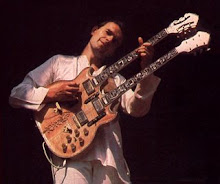
John McLaughlin has been my favorite musician for the past 35 years. He is one of the most accomplished and respected guitarists in the world. He is astoundingly proficient technically on both acoustic and electric guitar. He has a profound grasp of music and guitar theory. He can play world-class jazz, rock, blues, and world fusion music. His groups and compositions over the course of his career show remarkable creative diversity. To my mind, he's an indubitable genius who has given me and countless others innumerable hours of joy and inspiration.


And at no time did I feel more joy and inspiration from his music than I did at a concert at the Warfield Theater in San Francisco on a Saturday night in December of 1980, when he, Al DiMeola, and flamenco guitar legend Paco DeLucia put on an acoustic guitar concert for the ages. In fact, it, or, rather, the previous night's showing has been preserved for the ages in one of the most popular guitar albums of all time--Friday Night in San Francisco . But I saw them the next night, and, if anything, they were even better. Never have I attended a concert that swept me and the rest of the audience away with so much impassioned virtuosity. It was magical and one of the greatest experiences of my life.


I have just discovered video from that concert on YouTube, and I'm in heaven when I watch it and relive the bliss of that night. Here is a video of a McLaughlin solo from that night. I'm looking forward to seeing more of that concert on YouTube or somewhere else if and when it becomes available.

Wednesday, January 10, 2007

The Discussion Continues

The discussion of Catholicism I've reported in previous entries has continued. Here is what I posted to the message board today:

You keep saying that when I express my misgivings about
Catholicism, I don't know what I'm talking about and am arguing
against straw men. You say that I need to spend at least several
months intensively studying and meditating on its key teachings before
I'm qualified to challenge them or the faith from which they issue. I
admit that I don't know reams of facts about the finer details of
Church teachings and history, but I don't concede that this makes the
arguments I've posed here against Catholicism unsound. Furthermore,
if these arguments are sound, I contend that they provide ample reason
not to waste my time engaging in the kind of intensive study of
Catholicism you say I should.

Let us take just one of my arguments for now. I argue that if the God
worshiped by the Catholic Church really existed and wanted us to know,
love, and serve him with total devotion in this life and join him for
blissful eternity instead of suffering apart from him for eternity in
the next, it's legitimate to assume that he would make sure we know
that he exists from the very outset instead of requiring us to seek
out what seems like a fairy tale to many of us; therefore, he probably
doesn't exist and there is no compelling reason to seek him out.

You counter-argue that God transcends such "simple logic" and that he
doesn't make us certain of his existence because that would compromise
our free will. I counter-counter argue that my faith that a real God
who wants us to embrace him would make us certain of his existence is
at least as sensible as your faith that he wouldn't, and I ask why we
still couldn't have the free will to obey or disobey God even if he
made us certain that he exists.

Now you can dismiss my argument, counter-counter argument, and
question as ignorant and "sophomoric," but I don't believe that they
are, and I think they provide ample justification in themselves for my
not spending months or years poring over scripture and Catholic
theology before I further challenge Catholicism in places like this
with this and many more arguments and questions. And if I'm wrong
about this, then surely a wannabe Jesuit like yourself can do a better
job of addressing my comments and questions than you have so far so
that I might begin to see enough of the light that I'll want to
investigate further to see more of it.

Sunday, January 07, 2007

A Skull Full of Mush?


Earlier, I posted something about my discussion on a religious message board concerning my skepticism over the ambiguities of interpreting implausible scripture. I've continued to have a discussion with that gentleman, and the crux of his reply to my objections is that I need to do my "homework" in terms of open-mindedly studying scripture and the teachings of the Catholic Church before I engage in further straw man arguments against the Church in particular and Christianity in general.

This is how I recently responded to him:


I confess that I take it on faith that a real God would not
require us to "do our homework" in order to make clear sense of the
sacred texts that speak for him, or, if he did, he would first make us
indubitably aware of his existence and of the fact that the Bible,
among all so-called sacred texts, and the RCC, among all religious
institutions, are the only sacred text and religious institution that
bear his official seal of approval. This way we could do our homework
fully confident that our efforts, guided by the divine authority of
the RCC, would yield worthwhile results rather than, to paraphrase
Professor Kingsfield from "The Paper Chase," a skull full of useless
theological mush.

Why would someone do his homework or join the Church and take the
Church as his spiritual guide if he has strong and legitimate doubt
that the biblical God exists, much less that the Church and Bible
speak for him, and how could a supremely loving, just, and merciful
God require that someone do this or suffer eternal, excruciating
torment if he doesn't?

My faith tells me that he wouldn't. My faith tells me that such a God
does not exist and that any scripture or institution that teaches
otherwise is to be viewed with a healthy dose of profound skepticism.


What do you think?

Saturday, January 06, 2007

The Kosmos in a Single Sentence


Once upon a time, one of my philosophy professors asked the class if we could think of one sentence that did a good job of summarizing the essence of any great philosopher's philosophy. The one that came to my mind immediately was Spinoza's, "The better we understand particular things, the better we understand God." I was too shy to say this in class. But I ended up writing a paper that purported to show how the essence of Spinoza's metaphysics, ethics, theology, and politics could all be inferred from this one little quote. I say my paper "purported to show" this, because, in retrospect, I'm sure it was comically crude and didn't come even close to accomplishing its lofty task.

Yet, I think tremendous wisdom is nevertheless distilled in that pithy quote. So when I recently encountered, by way of Bill Harryman's blog, a blog article that asked its readers to post a single sentence that captures the essential knowledge or wisdom they have gained from their field of expertise or interest, I thought of Spinoza's quote and a couple of others and fused them into one compound sentence: "All is One and One is All; the better we understand particular things, the better we understand God; and in this life, we cannot do great things, we can only do small things with great love."

Actually, I posted the first two parts of this sentence in the comments section of Bill's and the other blog and have subsequently added the third part, courtesy of Mother Teresa, here to distill my essential metaphysics, ethics, theology, and politics. That is, I believe that we would do well to understand, not only with our intellects but also with our hearts, that "God" is the unified totality of existence in which every particular part of It exists and functions only in relation to the Whole, that the person who understands this deeply is overflowing with love for the divine Oneness and Its ostensive parts and conducts his or her life accordingly, and that the best political system is one that benevolently and effectively fosters this understanding, feeling, and conduct.

Thursday, January 04, 2007

Saddam's Execution Revisited

In a previous post, I expressed my mixed thoughts and feelings about Saddam Hussein's execution. This was before more recent and vivid revelations surfaced of how Saddam was vindictively taunted by his gleeful executioners as his death sentence was being carried out. Let me be clear that I am unequivocally opposed to the undignified manner of his execution. I believe that if capital punishment must be inflicted on anyone, it should be carried out with an utmost formality and grave solemnity that conveys the message, "All human life is precious, and we regretfully take this one as a last resort and in the hope that the day is soon coming when we will never need to do it again."

However, in response to what I posted originally, someone named Mireille said:

Yes, Steve, I also am very against death as a penalty. This penalty does not make any sense to me. To kill someone because they have committed the heinous crime of murder. If this crime is so heinous why do we also do it when giving the punishment?
To me it is like punishing a little boy who has defaced a public building by going around to his house and defacing his bedroom.

This is how I replied:


Mireille, I agree with you that it generally seems paradoxical to kill people for killing. It seems even worse to do it in the most cold-bloodedly methodical manner typical of state-sponsored execution. However, as today's entry explains, I feel ambivalent about the execution of Saddam Hussein. As much as I deplore capital punishment in general and even though I felt no elation over Hussein's execution, it is "beyond a shadow of a doubt" that Saddam and his government did such horrible things from a position of such prominence and power that if anyone deserves to die the way Saddam did, it was Saddam and his underlings.

And at least now, precious resources needn't be spent and worry exercised over keeping him secure from rescue attempts, and there can be no rallying hope among his supporters that he might someday emerge to lead them back to former days of ignominious glory. Though I'm skeptical that his death will do much to bring peace, order, and progress to a devastated and chaotic Iraq, I feel some glimmer of hope that it might contribute to this worthy cause. I hope because, frankly, I don't know what else to do at this point.


I may now, in the wake of all the ensuing controversy, be even more skeptical that Saddam's execution will do more good than harm. But I still hope that it will.

Wednesday, January 03, 2007

A Tribute to Gerald Ford


I was in my early 20's when Gerald Ford was president. In those days, I hated the Republican Party, despised politics in general, and paid as little attention to either as I could. But I used to laugh at Chevy Chase's merciless mockery of Ford on Saturday Night Live, and I didn't approve of Ford's pardoning of Richard Nixon. Yet, I never felt the animosity if not hatred toward him that I later did for Ronald Reagan and George Bush Jr. Gerald Ford was a man you just couldn't hate.

I never thought much about why at the time. But in the wake of his recent death and with what I would like to think is at least a little more maturity than I had over three decades ago, I've thought about it quite a lot. I've come to the conclusion that Gerald Ford was one of the most unassuming, genial, straightforward, commonsensical, and just plain decent men to serve in high political office during my lifetime. As Dick Cheney pointed out in his eulogy, Ford was no philosopher-statesman, but he was exactly what our nation needed when circumstances forced him into a position he hadn't anticipated and probably never really wanted. And if he didn't perform his duties with dazzling oratory and brilliance, at least he did so with genuine modesty and integrity and without the Machiavellian artifice so characteristic of politicians. He did what he thought was right. Not "right" in terms of political ideology, but right in terms of solid moral sensibilities.

In retrospect, I believe that he not only thought he was but also that he actually WAS morally right to pardon Nixon rather than allow this country, already bruised and demoralized by the Vietnam War, Watergate, and a faltering economy, to glumly wallow in a protracted trial that would, at best, have proven what we already knew and what the pardon itself implied. Ironically, doing the right thing may well have cost Ford victory in the 1976 election, and cynical politicians would no doubt cite this as good reason to elevate personal expediency over selfless rectitude in one's political acts. But am I naive to think that if we had more politicians at every level who are more intent on doing right than on getting re-elected, we and our children and they and their children might inhabit a better nation and world than we all do? And isn't it likely that Gerald Ford was able to look back on his life when he came to its end and feel a sense of glowing satisfaction and pride over the essential integrity and goodness with which he conducted his private and publicly political life that few politicians will ever know?

I don't mourn the death of Gerald Ford. He lived a remarkably full life of 93 years as high-school and college football star, Yale Law School graduate, valiant naval officer during World War II, distinguished congressman and House Minority Leader, Vice President, President, elder statesman, and loving and devoted family man. But I have great admiration and respect for the kind of man he was, and I believe that the world of politics and the world at large is diminished by his passing. He may have been a "Ford, not a Lincoln," but what a rugged, reliable, and quietly capable old Ford he was.