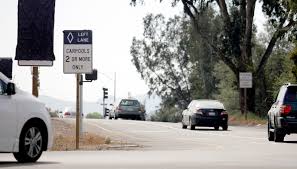
My wife didn’t sleep well last night, so I drove her to work this morning. And after I dropped her off and waited my turn in the metered lane of the onramp to get back on the busy freeway, I saw several cars whiz past me in the unmetered carpool lane, none of which contained the required two occupants or more for that lane.
I felt resentful and wished there were a CHP unit stopped somewhere nearby monitoring these blatant violators and preparing to sock one of them with a costly ticket that would, henceforth, deter them and others from taking advantage of highway amenities for which they didn’t qualify while the rest of us dutifully abided by the law.
Of course, if all those drivers who disregarded the law obeyed it instead, the metered lane would have backed up even more than it did, and my wait would have been even longer. So was it really such a bad thing that some drivers illegally took advantage of the carpool lane? Was that really so different from infractions I commit all the time such as breaking the speed limit?
My first inclination is to think improperly using a carpool lane violates Moral Foundation Theory’s principle of fairness in a way that exceeding the speed limit doesn’t. And, being the political liberal I am, I’m purportedly more insistent on people treating each other fairly (and caringly) than are my more conservative fellow humans who are said to place equal if not greater value on other innate foundational values such as liberty, even when I arguably benefit from some people acting unfairly and using the carpool lane when they shouldn’t, thereby decreasing the traffic and wait time in the metered lane for those of us who act fairly.
Yet, how is it really being unfair to me if I’m actually being helped by it, and, if it is unfair, why don’t I think it’s unfair of me and others to exceed the speed limit when others don’t? Why don’t I stay at or under the speed limit and feel angry when others fly past me?
Am I maybe just resentfully envious of drivers who improperly use the carpool lane when I don’t have the nerve to do it, although I do have the (less) nerve required to speed?
Maybe if I spend more time thinking about all of this, I’ll be able to discern a significant difference between speeding and misusing the unmetered carpool lane of a metered freeway onramp that justifies my indifference to the former and aversion to the latter. Or, failing that, maybe I’ll either stop speeding, or I’ll stop feeling upset and self-righteous about carpool lane violators and go on about my driving with greater equanimity.
I felt resentful and wished there were a CHP unit stopped somewhere nearby monitoring these blatant violators and preparing to sock one of them with a costly ticket that would, henceforth, deter them and others from taking advantage of highway amenities for which they didn’t qualify while the rest of us dutifully abided by the law.
Of course, if all those drivers who disregarded the law obeyed it instead, the metered lane would have backed up even more than it did, and my wait would have been even longer. So was it really such a bad thing that some drivers illegally took advantage of the carpool lane? Was that really so different from infractions I commit all the time such as breaking the speed limit?
My first inclination is to think improperly using a carpool lane violates Moral Foundation Theory’s principle of fairness in a way that exceeding the speed limit doesn’t. And, being the political liberal I am, I’m purportedly more insistent on people treating each other fairly (and caringly) than are my more conservative fellow humans who are said to place equal if not greater value on other innate foundational values such as liberty, even when I arguably benefit from some people acting unfairly and using the carpool lane when they shouldn’t, thereby decreasing the traffic and wait time in the metered lane for those of us who act fairly.
Yet, how is it really being unfair to me if I’m actually being helped by it, and, if it is unfair, why don’t I think it’s unfair of me and others to exceed the speed limit when others don’t? Why don’t I stay at or under the speed limit and feel angry when others fly past me?
Am I maybe just resentfully envious of drivers who improperly use the carpool lane when I don’t have the nerve to do it, although I do have the (less) nerve required to speed?
Maybe if I spend more time thinking about all of this, I’ll be able to discern a significant difference between speeding and misusing the unmetered carpool lane of a metered freeway onramp that justifies my indifference to the former and aversion to the latter. Or, failing that, maybe I’ll either stop speeding, or I’ll stop feeling upset and self-righteous about carpool lane violators and go on about my driving with greater equanimity.