Friday, March 31, 2006

The Supreme Light

Here is a passage from something I posted today in a Yahoo message forum:

I've always believed that Christianity taps into the same wellspring of divine wisdom that vitalizes all the great religious traditions. But I've allowed my disdain for Christian convention to overshadow my love and respect for Christianity's divine essence, which, for me, is not the God of the Bible but the God who transcends all bibles and speaks to us most clearly not from the pulpit but from the depths of our own unified being. But it is my hope that the light of my love and respect for the living God will grow so bright that nothing can overshadow it.

Wednesday, March 29, 2006

Real Immigration Reform

I despise the Republican Party. I believe that it’s dominated by the disgustingly greedy and the hypocritically religious. I know that if any Republicans see this, they will call me a raving liberal who’s speaking nonsense, but what I’m saying is true no matter what they call me. Republicans as a whole want to grab and keep everything they can for themselves and let the rest of us “eat cake,” or they espouse primitive religion whose principles they don’t even begin to follow for the most part. And these same Republicans are now using illegal immigrants as scapegoats in a Machiavellian ploy to rally people around their embattled party.

So, it pains me, it really pains me to say this, but I commend the Republican led campaign for immigration reform. I don’t believe for a moment that they’re really serious about it, because too many of their number exploit cheap illegal immigrant labor to want to do away with it. But even if what they’re REALLY doing is just putting on a show to strengthen their appeal to mainstream voters, I commend them for it, because it’s about time that somebody do something against the swelling tide of illegal immigration into this country and the sense among illegal immigrants, as they have made only too clear in their recent demonstrations, that they are entitled remain here and reap the rewards of legal residence without being legal residents.

I say issue every verifiably legal resident a national ID card, deport everybody who doesn’t have one, and jail everybody caught employing anybody without one. And then let’s pay livable wages and provide decent health insurance to American citizens and other LEGAL residents who do the jobs that illegal immigrants have been doing and see if they really won’t do those jobs as illegal immigrants allege. And then humanely let people continue to come here in controlled numbers from other countries by going through LEGAL channels the same way that my wife did from Thailand.

I am really pissed off over illegal immigrants and those they have duped into misguided sympathy for them demonstrating here in Sacramento, LA, and elsewhere for their “right” to thumb their noses at our nation’s immigration laws. If they want to live here, let them go back to Mexico or wherever they came from and then petition like my wife to come, stay, and work here legally.

Tuesday, March 28, 2006

Sports and "Artificial" Enhancements

This morning’s excellent episode of "Century City" was about a young man denied entrance into professional baseball because of an eye implant he had to correct a severe loss of vision in one eye. He sued to be allowed to play, and the legal issue was whether professional baseball’s rules against allowing players with unfair advantages to compete applied to him. His attorneys argued that his artificial eye was tuned to normal visual acuity, while opposing counsel argued that the implant’s bypassing the optic nerve and connecting directly to the brain gave the young man an unfair advantage in reaction time for hitting and fielding.

As I watched this, I thought about the baseball scandal involving steroid use and, more specifically, Barry Bonds. Many people are saying that Bonds’ achievements are tainted by his alleged steroid use. But if that’s so, how many other players’ achievements are also tainted, and who makes the call and how do they make it? And should steroids be banned because of the unfair advantage they give their users, or because of the harm they can do in conferring that advantage? Suppose steroids were perfectly safe. What would be wrong with everyone using them who wanted to? Because only those who could afford them could use them and gain a huge advantage over everyone else? How is this different from only those who can afford the best legal dietary supplements and state-of-the-art athletic training having a big advantage over those who can’t? It seems to me that the real issue is not the advantage the haves possess over the have-nots, but the dangers incurred by the haves to gain their advantage. If there are no significant dangers, why shouldn’t they gain every advantage they can, provided that advantage is available to a significant number of other people and not just to one or two?

Some might say that this would make it impossible to compare the stats of players of the modern era with those of earlier eras, such as Barry Bonds’ home run totals or slugging percentages with those of Hank Aaron or Babe Ruth. But it seems to me that we can’t legitimately compare these stats anyway, with or without steroids. For, even without using steroids, aren’t modern players in baseball and many other sports reaping the benefits of progress in dietary sciences and training methods that make them such significantly stronger and better athletes than their predecessors that no meaningful comparisons are possible between them and athletes of earlier eras?

Monday, March 27, 2006

Subpersonalities, Lost, Masturbation, and Virtual Rape

Bill Harryman posted an interesting piece on subpersoalities. Personal development counselor Adrian Longstaffe defines a subpersonality as "a complex of thoughts, feelings and even body sensations which is capable of acting as a complete person for shorter or longer periods of time" and says virtually all of us have them and can benefit from becoming mindful of them and working with them by having them dialogue with one another. In a recent blog entry, Harryman describes the development of some of his own subpersonalities, including the “Little Boy” that arose when he repressed the carefree young teenager in himself in order to prematurely assume adult responsibilities after his father died and that now causes him problems when ignored. Not only does the idea of subpersonalities or Internal Family Systems seem promising as psychotherapy, but it also underlies a fascinating new spiritual practice called Big Mind Process. I believe that I could benefit from both the psychotherapeutic and spiritual approaches.

Beliefnet features an
article by Dean Sluyter about seeing the popular TV series Lost as an ongoing metaphor for Buddhist practice in quest of enlightenment:

“To plunge into lostness is to plunge into mystery, to run off the narrow rails of reason into the wide realm beyond, where one hand can clap and jungles can harbor polar bears. It’s a setting forth, out of the insulated palace of the comfortable and familiar, into the (initially) scary actual world, where nothing is permanent or certain. This is what, in another tradition, is called the fear of the Lord and the beginning of wisdom.”

I watched a couple of early episodes of Lost while my wife and I and my cat were hanging out in an extended stay motel waiting to move in to our house here in Sacramento, but I wasn’t exactly up to giving the show the attention it deserved at the time, and I never got into it from there. I think I should rent the first season on DVD and give it a real chance.

Another Beliefnet
article is by conservative Rabbi Shmuley Boteach titled “It Takes Two.” In it, Boteach argues that people shouldn’t masturbate because it saps the sexual drive that makes abstinent single people want to get married and keeps the passion alive in married relationships. My first thought was that this is a ridiculous argument. But then I thought about it some more, and it still seems ridiculous. Or is it? At least it’s a step above saying that masturbation is wrong because God says it is and reinforced his prohibition by slaying Onan, or because the male leaders of one’s church, temple, or synagogue say so. At least the good Rabbi, misguided as he might be by a dubious set of religious beliefs, is providing a practical and even testable reason for his counsel that can be accepted with or without belief in any kind of God.

This morning I watched another great episode in the short-lived legal drama set in the future called Century City. How I wish this show had stayed on the air longer! Today’s episode was about a woman suing a man for raping her in a novel way. This man furtively planted nanobots in the woman’s husband’s drink, these nanobots were able to vividly record the husband’s sensual and emotional experience of making love to his wife afterward, and this man was able to play back the recording of the husband’s experience for his own enjoyment and vicariously experience everything the woman’s husband did during the encounter. When the woman found out about it, she felt violated and retained counsel to sue the man. The trial raised the issue of just what constitutes rape. Is it actual sexual contact forced upon someone against her will, or is it very intimate carnal knowledge of someone without her consent? Counsel for the plaintiff ended up having to play the “tape” for the jury to show them just how intimate the defendant’s knowledge of the plaintiff was via the recording. It was a very thoughtful and well-crafted episode that explored not only the implications of ever more lifelike virtual reality, but also the definition and emotional consequences of rape.

Friday, March 24, 2006

#53

It happens every year on this date. I celebrate a birthday. And each time I do it, the odds of my doing it again the following year diminish by some indeterminable amount. As I wrote a year ago today, I never expected to make it this far or even get close to it. I expected to be dead before I was thirty, and there have been times when I wished I were, more times than I care to remember. But I’m extremely grateful that I’m here today to post this message, to read and reflect, and to spend the latter part of this special day with my wife and sister-in-law bowling in league and coming home tonight to eat Thai food and birthday cake and go to bed and fall safely asleep in my wife’s loving arms. I’m incredibly fortunate to be blessed with such abundance, and I hope to find a way of giving back more to a world that has given me so much more than I could ever deserve. I’ve always wanted to give at least as much as I take, and the older I get, the less I want to take and the more I want to give out of the sheer, glowing delight of giving. Yet, I’m still struggling to find the best ways to do this and to develop the confidence I need to move forward with them.

I’m determined to make this the year of a great breakthrough, and I hope to be here next year on this date to celebrate it along with another birthday.

Friday, March 17, 2006

I Want What We Want

My wife asked me last night if I want us to have a baby. I told her I want what she wants. She didn’t like that answer. She wanted to know what I want. I told her that if she wants a baby, I want one too because her happiness is my happiness. This still didn’t satisfy her, and she concluded that I don’t want a baby. She’s certainly right that if I considered only myself, I wouldn’t want one. I’ll turn 53 next week. I’m learning disabled--more profoundly than anyone but I can possibly appreciate. I have no job or decent job prospects. When I finally do find work and come home from a long day at the office, I’d rather come home to a quiet sanctuary and relax with my wife, work on my book, and watch a little TV than tend to a child and worry constantly about how we’re going to support and raise one properly in this mad, mad world.

Yet, when I married my wife, I became more than just me. I’m still me and she is still she, but we are now also a “we” who do things as a couple, a single unit. We live for each other, make sacrifices for each other, and obtain happiness from each other. When she asks what I want, in a very significant sense, it comes back to what she wants, because her wants are our wants. Yet, we could turn that around and say that my wants are also her wants and our wants, and if I don’t want a baby, then neither does she. Yet she still does when she takes only her own desires into account. And I still don’t when I take only mine into account. And I could get a headache if I keep thinking like this and trying to figure out the perfect answer to a question that doesn’t seem to have one.

I don’t know what more to tell her. So I guess I won’t tell her anything unless she asks. I should just do what needs to be done to give her and, therefore, us another chance at happiness. And if that means going through another miscarriage after weeks of “morning sickness” or coming home from work to a nursery instead of a sanctuary someday, that is what I will do for our sake and happiness. And then I will still be I, but I will also be we, and we will be three (at least I hope it’s three and not more). And we will do the best we can.

Wednesday, March 08, 2006

Tomorrow

Tests confirm that my wife's pregnancy hormone levels are rapidly declining. This confirms that her pregnancy has aborted. But rather than wait for the non-viable tissue to leave by itself, we've decided to have it removed. There is a slight risk of infection. But the procedure should virtually eliminate the possibility and the risk of having to make a hasty trip to the emergency room in the middle of a dark and stormy night. She goes in for preop today, and will undergo the procedure tomorrow. And then will it truly be over? Is something like this ever truly over, or does it continue, if only at the margins of consciousness, to haunt those involved, especially if it respresents the loss of their one and only chance of having a child?

I guess there will be other chances if we choose to take them. But I doubt that we will.

Friday, March 03, 2006

It's Over

In January I reported that my wife was pregnant, and I had a few things to say about my hopes and fears for the future. I didn’t want to say too much, because I knew that there was a significant chance of a miscarriage in the first trimester. I didn’t want to tell my wife this and make her worry needlessly. Yet, it was also difficult for me not to remind her of it when she talked too enthusiastically about what we were going to name “our baby,” and what “our kid” was going to grow up to be, and what our future with “our child” was going to be like.

Yet, as I watched her body change and rubbed her back as she vomited her way through interminable weeks of morning (and afternoon and evening) sickness, and we fretted about her diet and bought prenatal vitamins to supplement it, and I read all I could about dealing with pregnancy and childbirth, and we attended an orientation meeting for expectant couples at our local clinic and she took all the pertinent lab tests, and “our baby” became a literally and figuratively growing part of our lives, I began to let down my defenses against talking about it and began to believe that our parenthood was more of a rapidly approaching reality than a precarious possibility, and I think my wife and her family and friends began to do the same. Wednesday night, the night before my wife’s first prenatal exam, I lied in bed with her rubbing her slightly swollen belly and affectionately talking about and to “our child” and about how we would send “her” to Thailand when she was old enough to spend time with my wife’s parents and absorb Thai culture. The warmth that I felt in my heart for my wife and for the precious life she carried inside her overcame my doubts and fears and had me looking forward to seeing the nurse practitioner the next day and hearing that “our baby” was doing well, and to learning more about how to deal as well as possible with the six or so months that lie ahead.

But when the nurse positioned the ultrasound probe and we looked expectantly at the screen, we saw a little dark sac inside my wife’s uterus, but there appeared to be nothing inside it. The nurse asked my wife if she had noticed any recent bleeding or pain or suddenly begun feeling very different than before, and if she was sure about the time of her last menstrual period. Then she explained that it looked as though my wife had indeed conceived and that an embryo had begun to form but that something had caused it to stop developing and that sooner or later she would either miscarry or need to have a procedure done to remove the contents of the aborted pregnancy. The nurse then left to summon a doctor for his opinion and returned with a smiling, soft-spoken Asian Ob-Gyn who examined my wife and conversed with her in Thai. He seconded the nurse’s opinion, and, after he left, the nurse scheduled an appointment for next week to discuss where to go from there if subsequent blood hormone tests confirm what seems to be a foregone conclusion.

My wife tried to smile and act as if it were no big deal. But as we stood in line in the phlebotomy lab, she began to cry. And she cried many more times that day. She stayed home from school the rest of the day, and we went to Costco, ate lunch at a Chinese food buffet, and then went bowling and watched “American Idol” that night as she struggled valiantly to keep her mind engaged with something, anything that would drive away her grief. At first she was going to stay home from school today. She didn’t want to break into tears when her classmates asked her how the exam went yesterday. But she decided to go after all. She’s a strong woman, much stronger than me, and, as I saw her struggle to assert that strength over her pain and tears and I told her not to fight it but to let go and let the tears flow and I did my level best to reassure her, I felt my love for her growing larger and deeper than ever before.

But this morning while my wife was in school and I saw the optimistically large bottle of prenatal vitamins sitting on the dining room table alongside the packet of pamphlets the clinic gave us to help us through a successful pregnancy, my eyes welled with tears as I thought about my wife’s broken heart and about what our lives might have been and what might have become of “our kid” if only there had been something alive inside that little sac.

Wednesday, March 01, 2006

Heaven on Earth


"When all hostility, all resentment, all greed and fear and insecurity are erased from your mind, the state that remains is pure joy. When we become established in that state, we live in joy always...That state of joy, hidden at the very center of consciousness, is the Eden to which the long journey of spiritual seeking leads...The purpose of all valid spiritual disciplines, whatever the religion from which they spring, is to enable us to return to this native state of being--not after death, but here and now, in unbroken awareness of the divinity within us and throughout creation."--Eknath Easwaran, Original Goodness

I recently posted to an online forum this witty remark by Mark Twain:

"One of the proofs of the immortality of the soul is that myriads have believed in it. They have also believed the world was flat."

Someone replied with the following quote from C.S. Lewis:

"Creatures are not born with desires unless satisfaction for these desires exists. A baby feels hunger; well, there is such a thing as food. A dolphin wants to swim; well, there is such a thing as water. Men feel sexual desire; well, there is such a thing as sex. If I find in myself a desire which no experience in this world can satisfy, the most probable explanation is that I was made for another world."

This is how I replied in my own words:

Is it possible that this desire is for something that CAN be, can ONLY BE satisfied in THIS world, but that people have been duped by organized religion from the time they were children to believe that they have to find it in an afterlife that never comes?

I don’t believe in an afterlife. I believe that our personal consciousness dies when our body dies, but that our true nature--the unified totality of existence—continues. I further believe that if there is a heaven, it’s a condition of joy, bliss, or supreme fulfillment in THIS life rather than a place in an afterlife. Unfortunately, if I’m right about this, it would seem that religions that focus on the afterlife play a central role in leading those who embrace them away from true heaven or salvation by persuading them that the pie is in the sky when they die. Thus, religion could ironically be one of the greatest forces working AGAINST salvation rather than for it.

Tuesday, February 28, 2006

Surfing Life's Waves


In his book Conquest of Mind, Eknath Easwaran compares life to an ocean whose waves we can learn to surf with an expert’s skill acquired through experience tempered with meditation and other key elements of a viable spiritual practice. He writes in his introduction of watching two surfers. One is an expert who rides the waves with effortless grace. The other is a beginner who is awkward and keeps getting thrown from his board but gets back up and tries again and again, improving a little each time as he applies the lessons learned from his previous attempts. It’s a beautiful metaphor.

But I suspect that just as I would be the surfer unable to learn from his mistakes and prone to repeating those mistakes until I either gave up in frustration or was crippled or drowned before I could give up, so I fear that my efforts to surf the ocean of life would meet the same fate. Is this the primary reason why I don’t even try?

Monday, February 27, 2006

Does Life Have Meaning Without a God?


Over at Integral Options Café, William Harryman has written another beautiful entry, this time expressing his “existential angst” over feeling crushingly insignificant in the cosmic scheme of things if not for his Kierkegaardian (see picture above) “leap of faith” that life is not absurd but has meaning because it’s one “with an intelligence as vast as that whole amazing Kosmos…[an] intelligence [that] is in no way male, female, or anthropoid; that said intelligence is compassionate and loving--the embodiment of a divine Eros--rather than vengeful and motivated by jealousy and power.”

This is how I replied to him:

Is life truly "absurd" unless one believes in a loving and compassionate intelligence as vast as the Kosmos? I don't believe in such an intelligence, but I don't find life absurd. I DO believe in an Ultimate Reality, but It is simply the unified totality of existence--a Thich Nhat Hanhian "Interbeing" with conscious aspects--and not a kind of all-pervasive intelligence that cares what happens to me or this planet. Would I find life absurd without this belief? I don't think so. I think I would still find joy and meaning in everyday living and loving and in the quest to learn as much about this world and universe as I could, even if there were no heaven or nirvana at the end of my earthly existence.

William replied that he was referring to an intelligence not unlike the “unified totality of existence” to which I alluded and that, while he was expressing his feelings of the moment, he couldn’t be sure what or how he would feel in the future. I think I understand where he’s coming from. I too have sometimes felt the need to believe in a more personal divinity that actually gives a damn about me and the rest of humanity, even if it’s not “out there” but, instead, comprises the deepest essence of my own being. And I’ve tried like hell at times to embrace this belief. Today I happen not to feel it necessary to believe this way. But who knows how I’ll feel tomorrow or next month or next year, especially if I or my loved ones face extreme hardship. Besides, enough people, including some I respect a great deal, appear to believe in a benign Kosmic intelligence that I should not be too quick or decisive in dismissing the possibility of its existence.

Yet, how do I keep my mind open enough to perceive this intelligence if it actually exists without making myself too gullible to falsehood?

Friday, February 24, 2006

Bigorexia


I used to have a picture on my wall of a famous bodybuilder named Sergio Oliva. Beneath it, I wrote the caption: “In commitment, we dash the hopes of a thousand potential selves.” I don’t remember where the quote came from, but it often comes to mind when I see bodybuilders, Olympic athletes, and others who devote enormous amounts of time and effort to various pursuits, especially if they fail to achieve the success they desire.

Last night, I watched a program on
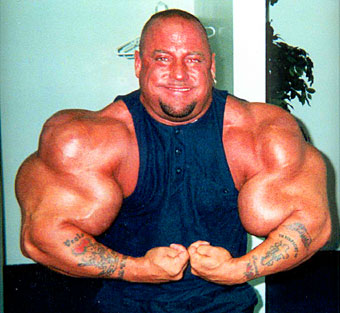
TLC about a bodybuilder named Gregg Valentino who used massive amounts of steroids to develop his arms to freakish extremes well beyond anything I’ve ever seen before. Compared to him, Arnold Scharzenneger had arms like toothpicks even at his biggest. It seems that Valentino and many bodybuilders may suffer from a psychological disorder that is virtually the exact opposite of anorexia. Even when they are bulging with rippling muscles, they look in the mirror and see themselves as pitifully small and weak looking, and they redouble their efforts (and their steroid consumption) to build bigger and better muscles. Valentino took this to the point of almost dying from massive infection from steroid injections and other serious health problems, and he developed a physique so monstrously malproportioned and ugly that not even a mother could love it.

I sometimes wonder if there aren’t a lot of Greg Valentinos walking around out there. Maybe they aren’t bodybuilders. Maybe they’re freakishly overdeveloped in their chess playing skill, their ability to do tricks with a yo-yo, or their skill at meditating themselves into trances amazingly impervious to pain or to the outside world. Maybe most of these individuals are involved in pursuits that don’t endanger their physical health the way Valentino did his. Maybe some of them will even reap fame and big paychecks from their accomplishments. But one wonders what their unbelievable level of commitment to one narrow pursuit has cost them in terms of overall development of themselves as human beings and, ultimately, in happiness.

Thursday, February 23, 2006

Manifesting the Higher Self

William Harryman has the kind of talent and motivation to produce the kind of blog I wish I had. His Integral Options Café is a remarkable combination of style and substance, beauty and sagacity. It’s one of my favorite blogs, and I try to read it every day. Yesterday, he posted the following quote from Ken Wilber that has resonated with me ever since:

One of my favorite exercises from Quaker prayer gatherings is: "Let the next sentence out of your mouth be from your very highest self." Everybody gets quiet at that point! But that's the kind of attitude we want to bring to these dialogues. New structures in consciousness are being laid down right now--they are just faint footprints on the face of the cosmos. So your behavior, to the extent that you live up to your highest, is actually creating structures that future humanity will inhabit. Therefore, choose your acts very, very carefully. Make sure that the next action you take comes from your highest self. Make sure that the next thing that you say comes from your highest self. Then there's hope for the future. Those structures are already being laid down. God is laying them down; Spirit is laying them down--through us. So we have to become appropriate vehicles for Spirit to lay down the very structures that humanity is going to inhabit. And if we don't, that is a guilt we will carry with us for eternity.

I left the following comment:

Make our next words and deeds come from our highest self. What a wonderful idea! It sounds so obvious and simple that you wonder why everyone hasn't been saying and doing it long before this. But maybe it's such an obvious and simple idea that it's been utterly elusive until a sage like Wilber comes along and expresses it aloud. Now that he has done so, let's see what we can do with it.


Yes, let’s see what I and all of you who read this can do with it today and every precious day and moment for the rest of our lives.

Wednesday, February 22, 2006

Iran and Nuclear Weapons


There’s a lot of talk in the media about stopping Iran by whatever means necessary from developing nuclear weapons. I can understand the international concern. Who wants a country with more than its share of influential Muslim fanatics and led by a president who says Israel should be wiped off the map making nuclear bombs and possibly selling or giving some to Osama & Company?

But, having said that, I wonder what right the USA or any other nuclear power has telling Iran that they shouldn’t or can’t join the nuclear elite. “We have ours, but you can’t have yours,” doesn’t strike me as being very fair or as carrying a lot of moral weight. I suppose we could say that we don’t want nuclear weapons in the hands of Muslim nutcakes, but why should the biggest and deadliest nuclear arsenal in the world be held by the only country that has ever used nuclear weapons against innocent people, and why should they lie under the command of a simpleminded Christian fundamentalist like George Bush?

What it seems to come down to is that if the world or some part of it has the might and determination to stop Iran from developing nuclear weapons, it will do so or spark a cataclysmic war trying. But as long as those who are trying to stop Iran from developing nuclear weapons already have them themselves, they lack a certain moral standing to take the action they do unless and until Iran threatens to use these weapons against others in unjustifiable ways. So far, I’m not aware of them having made any such threats. Of course, it’s pretty difficult to threaten to use weapons one says one doesn’t even have any intentions of developing.

Monday, February 20, 2006

Psychology and Free Will

I’ve long wondered how one could be Christian (or Muslim or Jew) and believe in psychology at the same time. For it seems to me that psychology is the science that studies mental processes--including volitions--and behavior and the conditions that cause them, whereas a cornerstone of Christianity (and Islam and Judaism) is free will. Thus, psychology says that every human choice is caused by antecedent conditions, whereas Christianity says that human choices are not caused by antecedent conditions. That is, no matter what interacting biological, social, cultural, and psychological conditions existed at the time someone made a particular choice, she could have made a different choice than the one she actually made, and if that same set of interacting conditions were to somehow recur, the person in question could choose differently than she did the first time.

This is how I expressed this idea in a recent
post to an online forum:
Psychology is the scientific study of mind and behavior. Science presumes that all events have causes which, in turn, have causes, and so on. Thus, psychology presumes that all human mental phenomena, including choices, and all behaviors are caused by something, which, in turn, are caused by something else. Now if choices and acts are caused, they are the inevitable effects of their causes and not free to be other than what they are given the causal conditions giving rise to them. Yet, Christians, on the other hand, believe in some kind of mysterious free or uncaused and uninevitable will that is not caused by anything other than a free--i.e., undetermined--agent. And uncaused human mentation and behavior is not amenable to scientific--i.e., psychological--study and therefore seems incompatible with the fundamental assumption of psychology that human mentation and behavior can be studied scientifically. Thus, I don't see how one can truly be Christian and truly believe in psychology at the same time.

In a subsequent post, I tried to express the argument above the following more concise, logical form:
(1) Science is the systematic study of phenomena and
their causes.


(2) Psychology is the science that studies the
phenomena and causes of the phenomena of mentation, including will, and
behavior.


(3) Free will is uncaused will.

(4) Therefore, psychology and free will are
incompatible.


(5) Christians believe in free will.

(6) Therefore, Christianity and psychology are
incompatible.


Again, I don’t understand how Christians can believe in psychology. Nor do I understand how so-called forensic psychologists can testify for the prosecution in court that someone could have chosen not to commit a crime but went ahead and did it anyway. How could any psychologist or psychiatrist worthy of the name testify to such a thing? As far as I’m concerned, the legal definition of “insanity” as not knowing right from wrong or as being unable to avoid wrongdoing would seem to apply to the psychological and psychiatric understanding of ALL criminal acts. That is, from a psychological or psychiatric perspective, how are ALL criminal acts not insane?

Sunday, February 19, 2006

Ethical Dilemmas


One of my favorite TV programs is 24. I know that it’s unrealistic that one organization, CTU, and one person, Jack Bauer, could succeed in saving the nation from diabolical terrorist plots so many times and all in a twenty-four hour period, but it’s still exciting TV about highly skilled people and an extraordinary hero triumphing over evil time and again.

In the most recent episode, CTU,
Jack Bauer, and the president of the United States are faced with a terrible ethical dilemma. Russian separatists, angry that their plot to use a deadly nerve agent against the Russian government and people has been foiled by elements in the U. S government, are determined to exact revenge by using the gas to inflict heavy casualties on the American people. They have many canisters of the gas, and they decide to use the first in a shopping mall filled with a thousand men, women, and children. Jack Bauer is working undercover with two of the terrorists preparing to unleash this gas in the mall. CTU, the president, and, ultimately, Jack Bauer must decide whether to allow the terrorists to kill the people in the mall with the gas so that these terrorists can maybe be followed back to the other terrorists and the remaining canisters of gas, or to stop them in their tracks. Of course, if they’re stopped, the other terrorists will be able to use those other canisters to kill perhaps hundreds of thousands of people.

What should the president decide? What would you decide if you were the president? The president decides to sacrifice the lives of the relative few for the lives of the many, and CTU concurs. But Bauer, who has seen the faces of the would-be victims of this attack up close and personal, is in a position to overrule the president’s decision or to go along with it and allow the terrorists to do their deadly deed. What should he do? What would you do?

I can think of an analogous real life situation that took place during World War II. Allied intelligence had broken the German code and knew when the Germans were planning to destroy ships carrying passengers and supplies from allied countries. The allies could have used this info to save those ships and many lives, but if they did, the Germans would know that their communications were being deciphered and greater harm could result than was prevented. The Allies decided not to tip their hat, and many innocent people lost their lives.

I would hate to be in a position of having to decide what to do in cases such as this, but I love to see fictional stories posing these kinds of
ethical dilemmas and to grapple with them in my mind and heart. Part of the attraction I find in this is that there seem to be no clear-cut answers. While part of us hungers for clarity and certainty, it would seem that part of us loves ambiguity and uncertainty. At least part of ME does.

Thursday, February 09, 2006

I Feel Offended


I usually like to post entries where I am the one doing most of the talking instead of just quoting or linking to others. But now that I’m becoming busier with school and other matters, I seem to have less time to write as much as I’d like. Yet, I still like to post something interesting to me and hopefully to you almost every day. So, today I’d like to post a satirical piece by Sonia Mikich that I think addresses the Muhammad cartoon controversy with delightful astuteness. To pique your interest, here is a brief passage from her article:

Zealots are nailing veils onto the faces of my sisters in Afghanistan and Pakistan and are busy hanging women, homosexuals, adulterers and non-believers.

But human rights, women's rights and the right to liberty are the most exalted in the history of humanity; this is the tradition in which I was raised. Values that make the world better and more peaceful.

I demand that the governments of Saudi Arabia, Palestine, Indonesia and Egypt apologise to me. Otherwise I am unfortunately forced to threaten, beat up, kidnap or behead their citizens. Because I am somewhat sensitive about my cultural identity.

I feel offended.

Fanatics are blowing up the Buddhas of Bamiyan, marvellous cultural monuments.

But art is an expression of universal beauty and innocence to me. It is a value that makes the world better and more peaceful.; this is the tradition in which I was raised.

I demand that Hamas, the spokesman of the French Muslims and the Director of the Al-Azhar-University apologise to me. Otherwise I will never spend a holiday at the Taj Mahal, I will call for a boycott of Palestinian fruit and I will set the embassies of Tunisia, Qatar and Bangladesh on fire.

I expect understanding for this at the very least – my feelings are absolute and must be expressed globally.

I feel offended.


Wednesday, February 08, 2006

Christianity's Impotence

One of my many criticisms of Christianity has been that most people who call themselves Christian do such a lousy job of living up to the principles of their faith that it casts the truth and power of their faith in serious doubt. When I stated this recently in a message forum, someone replied:

No Christianity is not flawed at all. It is the people that are flawed and refuse to give up their lives of sin to be a true Christian follower of God's.

This is how I replied:

I disagree. I believe that conventional Christianity--what most people worship from reading the Bible or going to church--teaches about a God who doesn't exist; a Jesus who wasn't what he's supposed to have been and still be; a posthumous heaven and hell that are fictional and, in the latter case, obscene; notions of human nature, will, and sin that are absurd; and countless other things that are either implausible or ridiculous. Thus, it's no wonder that Christianity fails to persuade modern non-believers to embrace it, and to inspire self-professed believers to live by its principles.

Monday, February 06, 2006

The Disgrace of Islam

Some European papers ran a cartoon of Muhammad wearing a bomb on his head and Muslims are on the warpath. Not all Muslims, mind you, but more than enough to strengthen my conviction that Islam is a sorry excuse for a religion. It isn’t just that so many Muslins all over the world are calling for wholesale jihad and beheadings when they’re not busy rioting or burning buildings. It’s also the fact that few prominent Muslim clerics have denounced the violence and that those who have appear to have been ignored by the raging masses.

Do these self-righteous zealots believe that this cartoon harms the great Allah? Wouldn’t that make Allah a pitifully weak excuse for a God? Do they believe it harms Mohammed? How so? They obviously see the cartoon as an insult to their faith. But why can they not see that they and the incredibly intolerant and unspeakably violent behavior they support or in which they engage directly are the biggest insults to their faith?

I try to respect everyone and everyone’s faith, but I struggle to restrain myself from holding Islam in utter and complete contempt. I see it as an essentially primitive and barbaric religion promoting primitive and barbaric behavior with built-in
barriers to its evolution into anything even faintly resembling a genuine wisdom tradition, its Sufi offshoots notwithstanding. If I’m wrong, let Muslims prove it by acting like people of God rather than bloodthirsty savages or de facto abettors of fanatical intolerance and savagery through their habitual silence.

Thursday, February 02, 2006

Diva


Jules is a likable young Parisian mail carrier who does his job on a moped. He’s a peculiar mixture of idealistic innocence and hard-boiled realism. He’s also an opera fanatic benignly obsessed with black opera star Cynthia Hawkins. His obsession is so powerful, in fact, that he surreptitiously makes a bootleg recording of one of her performances with a high quality tape recorder and then steals one of her gowns and later pays a black prostitute to have sex with him while she wears the gown.

But little does Jules realize that his already unconventional life is about to become wildly and dangerously complicated. For two Taiwanese businessmen happen to be sitting behind him while he’s taping the diva’s concert, and they make it very clear to him afterward that they WANT that tape and will go to almost any lengths to get it. Why? Because Cynthia Hawkins doesn’t believe in recordings. She believes that capturing her singing on tape robs it of something precious and constitutes a kind of “violation” tantamount to rape. So, Jules’ pristine recording is a priceless commodity for unscrupulous persons who, unlike Jules, want to exploit its commercial potential.

Yet, this is the least of Jules’ difficulties. For one day while he’s delivering the mail, a desperate woman drops a cassette tape in one of his moped saddlebags just before she’s murdered, and some very sinister characters are determined to get it back and make absolutely sure that young Jules never tells anyone what’s on the tape. When the police become aware of this, poor Jules finds himself pursued by crooks, cops, and murderers.

Fortunately, he befriends a beguiling Vietnamese waif and her mysterious boyfriend who has a thing for Zen-like reflection and real talent for ingenious subterfuge, and he also enjoys a wonderfully sweet romance.

When I first saw
Diva in the theater in 1981, I was bowled over by its mesmerizing music, visual style, unconventional storytelling, and quirky characters. I wasn’t bothered in the least by the fact that it was a French film with English subtitles. That just gave it more authenticity, as did real-life opera star Wilhelmenia Fernandez as the diva. I also liked Frédéric Andréi as Jules, Richard Bohringer as Gorodish and, especially, Thuy An Luu as Alba. I have seen the film several times since then and enjoyed it just as much if not more each time.

Diva is one of my favorite films of all time. I give it an A+.