Monday, January 09, 2006
Howard Stern
I say “with some trepidation,” because Howard Stern is definitely not considered “politically correct,” whatever that means, and there are probably precious few individuals expressing the interest I have in spiritual development and actualization who like or would ever publicly admit to liking Howard Stern. But, hey, this blog IS called “Naked Reflections,” and, even though I’ve recently admitted that I can’t afford to get totally naked here without inviting repercussions I’m unwilling to confront, I have decided that I CAN get naked enough to admit that I like Howard Stern.
Why do I like him? A lot of it has to do with nakedness, both literal and figurative. Howard Stern bares his soul on his show and invites his guests to bare theirs as well, along with their bodies if they’re willing. And nakedness deflates pretense and reveals that we’re all more alike than we might think under our literal or figurative clothes. I find this reassuring. Of course, we all know in a corner of our minds that we all fart, urinate, and defecate, masturbate (well, at least most of us do), fantasize about unorthodox sexual practices with our partners and with people outside our partnerships, and feel embarrassed or at least a little uneasy about aspects of our minds and bodies, especially around other people. But Howard Stern bludgeons us with these realities until they take a front and center position in our consciousness, and he practically forces his guests to drop their facades of celebrity superiority and perfection and get real about their humanity, their imperfections, and their vulnerabilities. They go to the bathroom, want and have sweaty sex, stink, and long for happiness and fear pain and death just like the rest of us. When I see other people in this light, I feel more connected with them. When I see Howard and others being unabashedly real about themselves, I feel freer to be more real about myself and less hung up about things I used to feel so uptight about. In short, I find listening to Howard Stern to be amazingly therapeutic.
Beyond that, I think he’s funny as hell. Even when I disagree with his takes on politics or religion or items in the news, I enjoy his witty cleverness and honesty. Even when he does his freakshows with microcephalic Beetlejuice the Dwarf, Crackhead Bob, Elephant Boy, High Pitch Eric, Elliot Offen, or Wendy the Retard, I never have the sense that he’s being hateful or malicious, and I find myself laughing along with them and with my own defects and disabilities rather than at them or regarding them with contempt. I have always had the sense that Howard Stern has a good heart and accepts the people who work with him or come on his show on their own terms and truly cares for them as human beings.
Beyond that, the teenaged boy in me feels aroused by some of his female guests, especially when they’re aroused by each other, and titters at farting contests and sex jokes and the antics of the Wack Pack. I know that there are “higher” pursuits to occupy my precious time, and “higher” stages for me to develop to and through, but it seems to me that an important part of becoming who we want to be is embracing who we are at the moment, as paradoxical as that may sound. Howard Stern has helped me to do that. Not that I ever watched or listened to him THAT much, and now I won’t be watching or hearing him at all. But I wish him the very best with his new show and the rest of his public and private life.
Sunday, January 08, 2006
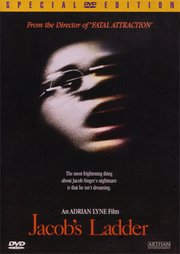
Jacob's Ladder

In the next scene, Singer awakens from a nap on a deserted New York City subway car hurtling along the tracks. He doesn’t know if he’s passed his stop. He walks into the next car and asks a woman where they are. She just stares at him creepily. As the subway comes to a stop, he looks down and sees a disheveled figure lying across some seats by the exit, and there appears to be a squirming, snakelike creature protruding from his body. Singer hastily exits the subway car to find himself locked underground with no one else around. There appears to be an unlocked exit on the other side of the tracks, but as he makes his way across the tracks, he has to dodge a train that comes racing out of nowhere, and as the train flies away from him, he sees grotesque faces staring out at him from the windows.
Singer goes home to his girlfriend Jezebel (Elizabeth Pena) and tries to carry on his life as usual. He’s an underachieving postal worker with a PhD living in a grimy New York apartment. But he’s plagued by more and more demon-like figures and frightening experiences and learns that others who served with him in Vietnam and were with him on that fateful day in the bush are having similar experiences and dying one-by-one in mysterious ways. He goes to sleep and wakes up to find himself in bed with his former wife (Patricia Kalember) in their old apartment, and one of his young sons (Macaulay Culkin), who was fatally injured by a car years ago, walks into the room complaining that he can’t sleep. Jacob tucks him into bed, bids goodnight to his other two children, and the next thing he knows, he’s back with Jezebel. He becomes increasingly disoriented and frightened by his nightmarish experiences and desperately seeks answers to what’s happening to him. A former Army chemist seems to have part of the answer, but his chiropractor friend Louis (Danny Aiello) may have a much bigger part of it when he quotes the great Christian mystic Meister Eckhart: “The only thing that burns in hell is the part of you that won't let go of your life: your memories, your attachments. They burn them all away, but they're not punishing you, they're freeing your soul."
Jacob’s Ladder was released in 1990. Its director was Adrian Lyne, who adapted it from a screenplay by Bruce Joel Rubin. A number of prominent reviewers panned the film as a pretentious exercise in heavy-handed symbolism and incoherent obscurity, but I don’t understand how they could have been addressing the same film I saw. I found Jacob’s Ladder to be a remarkable meditation on life and death and an extraordinarily compelling piece of filmmaking. If I had a top ten list of my all-time favorite films, Jacob’s Ladder would definitely be on it. I give it an exceedingly rare A+
If you see this film on DVD, I strongly recommend that you get the “Special Edition” version with a “Special Features” documentary on the making and meaning of the film. It features illuminating commentary by director Adrian Lyne and screenwriter Bruce Joel Rubin.
Friday, January 06, 2006
My Sister's Keeper?
I didn’t even know that she was smoking. I guess she decided that if there’s nothing she can do to save herself from certain early death, she might as well enjoy herself more in the time she has left. One problem with this is that it’s a selfish way to think that ignores the needs of her family and friends to have her around and in as good health as possible for as long as possible. The other problem is that she could incinerate herself and her family by smoking around all of the oxygen she has in her room. I doubt that she’ll pose that danger anymore after going through what she is now, but what if she does? Is there anything I can do to help make sure that doesn’t happen? And even if there is, what should I do?
As adults, we are supposed to choose our own actions instead of having them dictated to us by others. Generally speaking, I can’t make her do right, nor should I. But what if her actions endanger others? What responsibility do I and others have to try to compel her not to commit them? And what if her actions only endanger herself? How much should we try to force her to take care of herself? And how do we handle it emotionally and spiritually when we realize that there is essentially nothing we can do to stop someone from destroying herself and even endangering others?
I don’t know the answers to these questions. I don’t know if there are any. I guess we just have to learn to deal with these kinds of situations as best we can as we go along. But I don’t envy my friend’s boyfriend and daughter having to grapple with these problems every day. And God only knows how many others are in the same boat with relatives and friends who continue to indulge their self-destructive and sometimes dangerous desires and addictions.
Wednesday, January 04, 2006
Islamic Disgrace
My usual reaction to stories about religious intolerance and violence is one of predominate sadness. I am profoundly sad to see people fight with, harm, and kill others in the name of religion when their religion and understanding of God should be leading them to reach out to others with love, respect, and cooperation. But sometimes I encounter stories to which I react with far more anger than sadness. I have just read one such story about Taliban militants beheading a schoolteacher in Central Afghanistan while forcing his wife and eight children to watch. The teacher’s “crime” was that he taught at a high school that allowed girls as students. This was alleged to be against God’s law.
I feel extremely angry over this. Even more than anger, I feel disgust. I feel strong anger and disgust toward the particular individuals who carried out this reprehensible atrocity in the name of Allah. And I feel a more generalized anger and disgust toward a religion that does not unequivocally and strenuously condemn such barbarity. To his credit, one prominent Afghan cleric did say that there was no scriptural justification for the murder. But even he appeared to stop short of condemning the act or urging that its perpetrators be brought to justice. And I strongly suspect that we won’t be hearing other prominent or ordinary Muslims do these things either. Consequently, I become increasingly convinced that this is because Islam is essentially a religion rooted in hopelessly primitive thinking and violence and that it might be better if Islam were to disappear from the face of the Earth.
Maybe I shouldn’t be saying such harsh things about any religion, especially in the grip of anger. But when I read that a prominent Saudi Muslim cleric issued a fatwa not long ago authorizing the use of nuclear weapons against American cities, when I see Muslims throughout the world dancing joyously in the streets in celebration of 9/11, and when I see and read about countless other violent and murderous acts and celebrations of such acts committed in the name of Allah and Islam, and not only is there not widespread condemnation of these events from Muslim clerics and common people all around the world, but there is often even religious rationalization of them, how can a reasonable person not come to think that Islam, as a whole, is a terribly, perhaps hopelessly flawed religion that is close to being a disgrace to the word “religion”?
It seems to me that Muslims everywhere must either speak out loudly and clearly in unison against the wholesale violence and slaughter we’ve been seeing committed in its name, or they can reasonably expect more and more people such as myself to take an increasingly dim view of their religion and to oppose the spreading of its influence.
Tuesday, January 03, 2006
How Naked Dare I Be?
Last Saturday night, I posted an entry that questioned the purpose of life and presented a rather dim view of my own life. My wife read it and interpreted it to say that I was contemplating suicide. Needless to say, she was quite upset. I think I managed to largely reassure her that I entertained no suicidal thoughts. As the entry itself said, I am both too cowardly and feel too much responsibility to others to kill myself. Not only that, but I love my wife and others dear to me and don’t want to leave them until I must. Finally, I don’t want to go to my grave without at least trying much harder to live a life of wise discrimination and integrity. Discrimination is distinguishing between right and wrong or good and bad, and integrity is doing what I think is right and not doing what I think is wrong.
But this incident of my wife’s tearful reaction to my blog entry has me wondering just how nakedly I dare reflect on my thoughts, feelings, and experiences in a public forum such as this. I find it cathartic to be able to express myself openly about personal matters, and I sometimes find it even more helpful to share my personal thoughts and feelings with others. But what if my wife, other members of my family, friends, or other people important to me in some way read things in my blog that cause them distress or lead them to take action that could cause me distress? Suppose, for instance, that I write things in my blog that an employer or prospective employer reads, doesn’t like, and ends up firing or not hiring me over? This may be unlikely, but it’s conceivable to me that the wrong people could read things I write here, know that I’m the one who wrote them, and take some kind of harmful action against me as a result.
Sunday, January 01, 2006
The Artistry of Self-Transformation
As an irrigator guides water to the fields, as an archer aims an arrow, as a carpenter carves wood, the wise shape their lives.
– The Buddha
Eknath Easwaran agrees with the Buddha that we can shape our lives into a work of vital art with our consciousness being the wood and our soul or spirit being the woodworker who fashions the wood into “the responses and attitudes we desire: love, wisdom, security, patience, loyalty, enthusiasm, cheerfulness.” That is, we can remake our character and personality into whatever we want them to be.
I find pleasure and inspiration in the idea that I can rise above the limitations, bad habits, and bad deeds that have characterized too much of my past. Yet, I wonder precisely who or what is Easwaran’s metaphorical “woodworker” who can build a new “house or fine piece of furniture” out of the wood of consciousness. For isn’t the woodworker partly the very consciousness that is trying to reshape consciousness—i.e., itself? How does a consciousness fraught with negative attitudes, dispositions, and habits transform itself into one radiating positivity and motivating good deeds, especially if this consciousness appears to be generated by a profoundly defective and limited brain?
Saturday, December 31, 2005
Why Not Bother?
I’ve just seen “March of the Penguins.” It’s about emperor penguins in Antarctica. They endure incredible adversity each year in one of the harshest climates on Earth to survive and continue their genes and species through their offspring. In watching the starving males huddle against 100 MPH winds in –80 degree temperatures to keep themselves and the eggs they incubate alive while their starving female mates trek scores of miles across the ice to replenish themselves with food, I couldn’t help but wonder, “Why bother?” What is the point in struggling year after year just to suffer such terrible hardship and to procreate other penguins to suffer just as pointlessly as they do?
And how are we human beings so markedly different from the penguins? Even if a small percentage of us are fortunate enough to reside in places and circumstances where we can enjoy a modicum of happiness and help others to do the same, what does it all ultimately amount to, and why bother?
I do it because I’m too much of a coward to kill myself directly and because I don’t want to leave my wife and cat without the husband and caretaker they love and depend on. But here on the eve of a new year, I confess that I often believe that my wife, my cat, and the whole world would ultimately be better off without me. I look back on my life and think that it’s been a terrible waste of space and resources at best, and I honestly don’t believe that I have anything of real value to offer anyone or anything. I am too defective to the core of my being to be better than a burden.
Some might read this and think that I’m suffering some kind of holiday depression that many people go through this time of year. But I know depression intimately from past experience, and I’m not depressed. I’m just seeing myself and my life as they are without the usual adornments of platitudinous false optimism.
Friday, December 30, 2005
To Practice or Not to Practice?
Today, Eknath Easwaran tells us that if the spiritually gifted Saint Teresa of Avila “went through twenty years of doubt and struggle before becoming established in God,” we can hardly expect to do it in less time. Easwaran appears to be trying to motivate us to keep plugging away on our spiritual path with the understanding that it can’t deliver instant enlightenment but will amply reward us if we hang in there long enough.
However, I’m afraid that I find Easwaran’s attempt at encouragement to be something less than encouraging. For what of those of us who probably don’t have decades to devote to a spiritual path and who almost certainly lack Saint Teresa’s innate giftedness? What hope do WE have of “becoming established in God”? And if our chances are little to none, why should we even bother with any kind of spiritual path?
I raised this issue in a previous entry, and ebuddha addressed it in his blog by arguing that the goal is not so much the destination as the journey. That is, one can enjoy the pleasures and fruits, however modest, of the spiritual path in much the same way that one can enjoy the benefits of swimming, running, or working out with weights without needing or being able to become an Olympic champion swimmer, runner, or weightlifter.
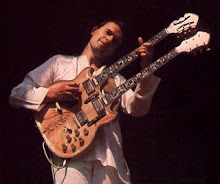
I think ebuddha makes a good point. Even though I don’t play guitar because I know that I’ll never come close to achieving the astonishing technical mastery of my favorite players John McLaughlin and Allan Holdsworth, I do still bowl and enjoy bowling even though I’ll never be another Earl Anthony or Walter Ray Williams, and I do still write and enjoy writing even though I’ll never be another Alan Watts or Eknath Easwaran. So, why shouldn’t I also adhere to a spiritual or integral path even if I could never become another Ramana Maharshi or Saint Teresa? Couldn’t my life still be enriched by a consistent practice the way ebuddha says his is?
I’m not sure bowling and writing are all that analogous to spiritual practice. I can bowl and feel instant rewards in the forms of exercise, enjoyment, competition, and even winning money that I’m much more hard pressed to experience meditating. When I write, I also have an immediate sense of accomplishment in the forms of crystallizing my thoughts and feelings and sharing them with others that exceeds anything I experience when meditating or repeating my mantram. I can’t help but wonder if, despite the admonitions of sages like Ken Wilber that we need to practice, practice, practice, I’d be better off using the untold hours I’d otherwise spend meditating to read, think, and write.
Yet if I like to read, think, and write about spirituality and enlightened living, how can I hope to do a credible job of it unless I actually practice the disciplines that ground my words in the genuine wisdom of actually knowing firsthand whereof I speak instead of merely spouting untested speculations or parroting other people’s words? But if I legitimately doubt that I have the talent and the time remaining to become enlightened, why should I bother with a spiritual path when I could be using that incalculably precious time to bowl, read, think, write, learn another language, work out with weights, or study the guitar? I feel as though I have little enough time to do all the things I want to do now, and when I finally start working full time, I will have almost no time for anything but working, eating, and sleeping. So why spend thirty minutes or more a day meditating and engaging in other so-called spiritual practices that seem to yield no tangibly positive results, when I could be doing something else that does? And if I don’t feel qualified to write about things I don’t know firsthand, then why not write about things I do?
Tuesday, December 27, 2005
Go With the Flow?
Today, Eknath Easwaran writes of how having someone close to us die can set us on the path to finding the security of that which “death cannot reach.” But what is the nature of this security? In other writings, Easwaran addresses the unchanging spiritual core of our being that is boundless love, peace, and bliss. But how can love, peace, and bliss or the spiritual medium in which they occur be unchanging? What’s more, how can this spiritual medium or its experience exist independently of a living body and thereby survive the death of the body? Many saints and sages speak of the eternal spirit or pure consciousness that comprises our deepest and truest nature and which goes on living after our bodies die. But what is it, and does it truly exist? Or is it merely wishful thinking? Is the surest way to happiness to seek unity or an awareness of unity with unchanging spirit, or to understand deeply that there is nothing permanent and unchanging to cling to and to simply let go and flow with universal change? Or is it possible to do both at the same time or in complementary alternation?
Sunday, December 25, 2005
Jesus of Nazareth
I spent Christmas day today watching all four segments of “Jesus of Nazareth.” I don’t know how many times I’ve viewed all or part of this miniseries since it first aired in 1977, but I do know that I never tire of its wonderful telling of the story of Jesus’ life or of Robert Powell’s mesmerizing portrayal of Jesus. Experts may tell us that the real Jesus looked nothing like the longhaired, bearded, fair-skinned, and blue-eyed Powell, but Jesus will always look, sound, and act like Powell in MY imagination. Powell’s performance is indelibly etched into my brain.
But why would a non-Christian like me enjoy this program and Powell so much? Christians would no doubt say that it’s because they resonate with the part of me that knows that “Jesus is Lord.” But I say that one does not need to be Christian and believe that Jesus was truly the one and only human incarnation of God and born of a virgin to sacrificially atone for our sins with his sinless life and rise bodily from the dead to find the story of Jesus’ life immensely entertaining and moving, especially as it’s told by Franco Zeffirelli’s masterpiece. One can fully appreciate “Jesus of Nazareth” for showing Jesus as a remarkably wise and eloquent teacher, and that is how I see him.
To those who would accuse me of sinfully denying the obvious facts of Jesus’ unique divinity and miraculous deeds, I point to the end of “Jesus of Nazareth” and Gospel accounts where Mary Magdalene tells the hiding disciples that Jesus “is risen,” and none but Peter believe her. If they who lived with Jesus, heard all his sermons, and supposedly watched him walk on water, heal the sick, feed a multitude of thousands by materializing bread and fish out of thin air, raise people from the dead, and utter numerous prophesies that came true did not believe Mary’s words, how in the world or heaven am I to be blamed for not believing in Jesus’ superhuman feats and nature?
Friday, December 23, 2005
The Death of Bowling?
Bowling is one of the great loves of my life. I’ve been watching professional bowling since the early 60’s and bowling myself almost as long. I’ve never been particularly good at the game, but I’ve managed to carry some decent league averages, shoot some decent scores, and experience the “thrill of victory and the agony of defeat” more times than I can count.
I’ve always wished that bowling were more respected and popular than it is. It is still not an Olympic competitive sport, despite the high level of skill required to compete at its top amateur and professional levels, and it now seems less popular with the masses than it’s been in decades, as evidenced by the fact that I saw many of my favorite bowling centers in the Bay Area recently close over the span of just a few years. Not only that, but most of the bowling centers remaining open have treated bowling more and more like a crass business where the objective is simply to make as much money as possible, and less and less like a sport to be honored and where excellence in the sport is valued and nurtured. Bowling prices have soared to the point where many of us can longer afford to bowl regularly or at all, and quality leagues and tournaments have increasingly given way to “Cosmic Bowling” with darkened lanes, blaring music, flashing lights, and beer sold by the pitcher at “happy hour” prices.
The women’s pro tour went bankrupt and folded several years ago, and the men’s tour came perilously close to meeting the same sorry fate until three ex-Microsoft guys clueless about bowling bought it for a bargain basement price and hired a hotshot CEO even more clueless about the game but intent on capturing the 18-25 year-old male viewing audience with flash and dash over refinement and substance, and whose changing the tournament format to “sudden death” matches tends to reward the bowler with the “hot hand” over the bowler with the best skills. As a result, many of the classy and consistently great bowlers of yesteryear are floundering or forced to retire while an invading army of anonymous, hard-throwing, high-revving, fist-pumping, peacock strutting young men parade across the lanes and my TV screen from week to week, or, at least, those weeks when I can force myself to watch after nearly a lifetime of missing bowling only when I was able to tear myself away from it for an exceedingly rare and special reason.
On a side note, a documentary about professional bowling came out last year that I can’t wait to see released on DVD, if it ever is. It’s called “A League of Ordinary Gentlemen” and has garnered a surprising number of favorable reviews for a film about a sport that would have made Rodney Dangerfield proud. It follows four professional bowlers through the unglamorous grind of the 2002-2003 season, focusing on two antithetical superstars and a rising star of the present and a superstar of the past who is struggling haplessly to regain his winning ways and salvage a life humbled and broken by hard drinking and gambling and, not surprisingly, three divorces. The latter now runs a pro shop in Sacramento, and it just so happens that I bought a bowling wrist brace from him the other day as a Christmas present for my wife. I’m also thinking of hiring him to give her a couple of bowling lessons to help her establish a solid foundation for her beginner’s game. I don’t know if this guy will be the best coach for my wife that $75 an hour can buy, but he’s one of the best bowlers of all time, and I’d like to give him back a little something for all the viewing pleasure he’s given me with his career. It’s a little unsettling to think that he’s considered an old “has been” when he’s four years younger than me.
Anyhow, it seems that bowling is cursed by the same plague that afflicts much of the rest of society. Understated and virtuous excellence has given way to dazzling lights, chest-thumping braggadocio, and in-your-face confrontativeness aimed at armlocking the ever-diminishing attention spans of America’s jaded consumer youth. If bowling can’t be repackaged with enough superficial glitz to keep the hearts of young men and women thumping madly away at an impressive pace, then it’s considered not to be commercially viable, and if that happens, it will unceremoniously disappear from television and from the local community as once flourishing bowling centers are converted into appliance or furniture stores or housing. Is there any way to save the sport? I don’t see what it could be. It really does seem as though the only way to attract enough people to keep bowling a viable spectator and participation sport is to turn it into something that is less and less worth watching and doing. It really looks as though I will need to find a new sport to be my hobby within the not-too-distant future. But I can’t think of any that are likely to bring me the pleasure that bowling has for such a long and wonderful time. Sages tell us that life is change and that we should embrace this change to maintain equanimity. But I’m not sure that this is a form of change I want to embrace. This is an instance where I might have to “rage, rage against the dying of the light.”
Thursday, December 22, 2005
Crash (2004)
“It's the sense of touch. In any real city, you walk, you know? You brush past people, people bump into you. In L.A., nobody touches you. We're always behind this metal and glass. I think we miss that touch so much, that we crash into each other, just so we can feel something.”
--Detective Graham Waters (Don Cheadle) in “Crash”
An Iranian shopkeeper feels insulted and enraged over being called an “Arab” and is so convinced that his neighbors and patrons are out to cheat and rob him that he buys a gun for protection. The white wife of the DA wakes up angry at the world every morning and takes it out on her ruthlessly ambitious husband and her ethnic minority hired help. A white cop, bitterly resentful toward a black woman HMO representative for refusing to authorize coverage for his father to see another doctor about his worsening urinary tract condition, humiliates an upscale black couple during a traffic stop. Two young black men rail against white racism and then carjack the white DA’s SUV at gunpoint, running down, during their getaway, an old Korean man who’s standing beside his van filled with Asian illegals he’s smuggling into the LA underground. A black detective keeps irritating his South American girlfriend by calling her Mexican and is asked to help the DA curry favor with the black community before reelection by turning his back on important facts about a homicide case he’s investigating.
Races and human beings clash in these and other incidents that comprise a vast, karmic web of tragedy and transformation, comeuppance and redemption in the movie “Crash,” a masterpiece of a film by director Paul Haggis and featuring an ensemble case including Don Cheadle, Matt Dillon, Sandra Bullock, Jennifer Esposito, Brendan Fraser, Thandie Newton, Tony Danza, and Keith David.
Not all the critics agree with my glowing assessment. Several have panned the movie for its implausible coincidences and pretentiously sagacious dialogue. But I agree with the reviewers, such as Roger Ebert, who applaud the film as a powerful parable of race relations and alienation, but also of the essential goodness that lies within all of us and which can lift us above our upbringings and prejudices to connect with those we ordinarily overlook or revile. I felt riveted to every scene and moment--deeply saddened by some, angry over others, exhilarated by some, moved to tears by others (especially a rescue scene of reconciliation)--but always spellbound, always completely alive, always delighted to be watching this movie unfold and reinforce the fundamental truth that “all is one.”
“Crash” is the kind of movie that can occupy your heart and mind long after the last frame has played out. It’s the kind of movie that can make you uneasily aware of your habitual attitudes and conduct toward people of other races and ethnicities and see beneath the outward differences to discover and embrace the core similarities, the human universals deep within. I’m not sure how this can change the way we live our lives. For the fact is, people DO demean, exploit, and even injure and kill those they perceive as racially or culturally different from themselves, and it would be foolish to blind ourselves to this and make ourselves too vulnerable. Yet, we can still cultivate mindfulness and allow its resulting lovingkindness, equanimity, empathy, compassion, joy, and wisdom to infuse and inform our actions and relations with others of all races, colors, and creeds and inspire others to do the same. For as Martin Luther King famously admonished us, ““We must learn to live together as brothers or perish together as fools.”
Wednesday, December 21, 2005
Gay Catholic Priests
As I understand it, the Roman Catholic Church officially teaches that all homosexual acts in all contexts are “gravely disordered” and sinful. I believe that this teaching is gravely erroneous. I can understand how some gay men might wish to enter the priesthood and try either to suppress their homosexual orientation in order to better conform to the Church’s teachings, or to influence the Church from within to change its teachings to accept their orientation. However, I believe that both approaches are misguided.
The former is misguided because it’s psychologically unhealthy to suppress such a fundamental aspect of one’s nature when there is no sound reason for doing so. The latter is misguided because it seems futile. The Church appears extremely unlikely to change its perspective on homosexuality within the next century or millennium, because that perspective appears to be symptomatic of a hopelessly archaic and broader general understanding of human psychology and of the nature and purpose of human sexuality to which the Church seems determined to cling indefinitely no matter what good modern evidence and reason is uncovered to prompt reconsideration of its position.
Thus, if a gay man should not injure himself trying or pretending to be what he is not or trying or pretending not to be what he is, and he cannot reasonably expect to become an openly gay priest and compel the Church to approve of homosexuality, why would he wish to become an official representative of such a flawed institution with such deeply ingrained, flawed, and harmful teachings on human psychology and sexuality?
For that matter, why would anyone who understands how profoundly defective these teachings are and how defective the Church is as an institution for stubbornly embracing them wish to be any part of the Church whatsoever, whether in the clergy or the laity?
Tuesday, December 20, 2005
I Don't Agree (2)
Yesterday, I posted my recent response to an e-mail forwarded to me that disparaged opposition to state-sponsored prayer in public government and school functions. I also received the following e-mail originating from the same person with similarly strident things to say about calling December 25 anything other than “Christmas” and its associated trees anything other than “Christmas Trees”:
This is a CHRISTMAS TREE.
It is not a Hanukkah bush,
it is not an Allah plant,
it is not a Holiday hedge.
it is not a Holiday tree
It is a CHRISTMAS TREE.
Say it... CHRISTmas, CHRISTmas, CHRISTmas
Yes.... CHRISTmas - celebrating the Birth of Jesus Christ!!!!
LET'S KEEP CHRIST IN CHRISTMAS
For some reason, I felt compelled to respond to this message as well, and so I asked its author why he cared what others called these trees so long as he and his family could go on calling them “Christmas trees.” He replied:
The origination of the Christmas tree is the issue.
In this world of gray that we now live in, where one chooses to keep certain issues black and white, certain people stand for other issues that they keep black and white.
So in keeping with the issues that are important to my family and I, I simply want the Christmas tree left to it's origination of being centered on Christ therefore we have the Christmas tree. It goes back to the Babylonian pagan rituals where a yule log was burned and then a full tree was placed in the house after. You in essence had a rebirth with the full tree. However when Rome was converted to Christianity the church fathers converted the Saturnalia Winter Solstice celebration to the birth of our Saviour, The Lord Jesus Christ and adopted many of the old rituals and symbols i.e. the Christmas tree.
To which I replied:
I understand that YOU want to call these trees "Christmas trees." But why do you care what other people call them? Perhaps more to the point, Why do you want to impose your idea of what they should be called on others? Why not practice the same tolerance of non-Christian viewpoints that you presumably expect non-Christians to accord Christian ones such as yours? And why not acknowledge that just as the Babylonian pagan tree became, as you explained, the "Christmas Tree" for Christians of the Roman Empire and afterward, it can become a more inclusive "Holiday Tree" in today's pluralistic world? Why can't Christians respect the fact that different people want to call it different things and accept formal or informal public policy that calls it a generic "Holiday" tree in state and commercial functions but allows private individuals and their families to call it whatever they wish?
To which he replied:
Well I suppose that if I was into relativism as you seem to direct, I would. You know reading your response brings us full circle back to paganism. I choose to keep the tradition of 80 % of Americans. If you are celebrating Kwanza you do not buy a tree. If you celebrate Hanukkah you do not buy a tree. So why would one need a holiday tree to begin with? As for me and my house we will serve the Lord!
To which I replied:
With all due respect, it doesn't seem to me that you’ve really answered my questions about why you care what other people call the tree when you and your family have the right to go on calling it whatever you wish. Not that you're under any obligation to answer me if you'd rather not or you can't.
And I don't understand why you would have to be into "relativism" to be tolerant of other people's opposing opinions, feelings, and desires regarding this matter. Why couldn't you believe that your faith embodies absolute theological truth while, at the same time, granting everyone else the freedom to believe as they do and not to have the government and businesses assail them with "Christmas trees" and "Merry Christmas"?
I don't have a tree. But if someone does have one and calls it a "Holiday tree," I have no problem with that. I also have no problem with government and businesses calling it a "Holiday tree" and calling the season a "Holiday" season in deference to non-Christians. You and your family can still call the tree and the occasion anything you want. What is wrong with that?
To which he replied:
I think the answer to " why do you care" is that the message of the Christmas tree is the time we celebrate Jesus's birthday. It ultimately brings one back to the Cross and Jesus dying for your and my sins. I care because as a christian, Jesus told us to be the salt of the earth and salt is the compound that preserves. Salt, back then, was rubbed onto meat to keep it from being spoiled. So I hope you can see the importance of what my responsibility is. I simply will remind people of God's great love for them by sending His Son to die for them so they can go to heaven. You see it is all tied together, Jesus is the panacea to all lifes problems. My responsibility is to only bring this great truth to those chosen to know him as their Lord and Saviour. If after I have shared the message of the Christmas tree they decide to shine it, then that is between them and God. I am not going to care any less for them based on their decision because I am called to love not to condone. Some people are never exposed to the Gospel message ( the good news). I would be remiss not taking the oppurtunity to share with them my faith. So once again the reason I care is because Jesus cared.
And this is how I replied:
You say that you have a "responsibility" as a Christian to "remind people of God's great love." That's all well and good. But I don't understand why this necessarily entails opposing those who want to say "Happy Holidays" instead of "Merry Christmas" or "Holiday Tree" instead of "Christmas tree." You can still testify to your faith. You and your family can still say "Merry Christmas" and "Christmas tree." But I don't understand why you appear to be insisting that everyone else do the same.
You say, "Some people are never exposed to the Gospel message." However, I suspect that virtually everyone in this country has been exposed to it repeatedly, and that some would prefer not to be exposed to it any more than they have to be. So they have made it known to the government and businesses that they would prefer that these institutions and organizations respect their wishes by using more inclusive language about the upcoming holidays, and some have honored their request. I don't see anything wrong with this.
Of course, you have a right to protest and oppose it, just as others have a right to protest and oppose what you and others like you are doing. But it seems to me, for what it's worth, that if Christians spent less time and energy worrying about prayer at public functions, the teaching of evolution in our public schools, and about what businesses, government, and private individuals call trees and holidays and did a much better job of 'imitating Christ' than they seem to do now, they wouldn't need to proselytize at all. Their shining examples would bring people flocking to the faith.
As it is, their conduct--including that of scorning, as Colonel Jack Fessender does with his "Fu*k the ACLU" comment and as you seem to with your apparent embrace of it--the feelings and wishes of people who view religion and religious propriety differently than you do appears to be repulsing many people from the faith and opening up a wider and wider divide between people of differing viewpoints at a time when we all need to respect each other and work together more.
The discussion continued awhile longer. When I read it, I shake my head and wonder how we can ever hope to come together in this country to promote the common good. There just seem to be such disparities in the ways different people see the world and in the ways they reason and communicate that it sometimes appears as though we are doomed. Yet, I don’t want to succumb to cynicism. I want to keep looking for a way to dialogue with others and to see the truth in what they say while helping them to see the truth in what I say, or, at the very least, encouraging mutual respect and civility between those who can never agree on anything.
Monday, December 19, 2005
I Don't Agree
One of my friends often forwards me e-mails from someone whose political and religious views seem very different from my own. This gentleman seems to believe that opposing state-sponsored Christian prayer in public government or school functions is unpatriotic to this country’s foundational principles. He also seems to believe that opposing such prayer OR saying “Happy Holidays” instead of “Merry Christmas,” or “Holiday Tree” instead of “Christmas Tree” is not only unpatriotic but also an evil assault on God Himself.
Here is the text from one of his messages:
If you look closely at the picture above, you will note that all the Marines pictured are bowing their heads. That's because they're praying.
This incident took place at a recent ceremony honoring the birthday of the corps, and it has the ACLU up in arms. "These are federal employees,” says Lucius Traveler, a spokesman for the ACLU, "on federal property and on federal time. For them to pray is clearly an establishment of religion, and we must nip this in the bud immediately."
When asked about the ACLU's charges, Colonel Jack Fessender, speaking for the Commandant of the Corps said (cleaned up a bit), "Screw the ACLU."
GOD Bless Our Warriors, Send the ACLU to France. Please send this to people you know so everyone will know how stupid the ACLU is in trying to remove GOD from everything and every place in America. May God Bless America, One Nation Under GOD! What's wrong with the picture? ABSOLUTELY NOTHING GOD.
Here is how I replied to this message:
Someone forwarded to me the following message that seems to have originated with you. This is what I wrote to the person who forwarded me the message:
I think the ACLU does go too far at times. But I also think that the same could be said of some Christians who seem to want to force their idea of God on everyone. The message you sent me appears to be from just such a Christian, and it has a tone of defiant disregard for the convictions and feelings of those who disagree with him or her that I find troubling and, ironically, quite un-Christian. I also question this individual's insistence that organizations such as the ACLU are trying to stop Christians from praying. I don't see how preventing government or state sanctioned praying to a Christian idea of God stops people from praying as individuals in private to whatever God they want to pray to as often as they want to pray to Him, Her, or It.
I feel quite sad to see messages such as the one you sent, because they seem to have no other purpose or, at least, consequence than to stir up ugly emotions of "us vs. them," we good, conservative Christians against the evil liberal atheists, heretics, and heathens when what it seems to me that we really need now is people of all religious and political persuasions respecting one another more and coming together to make this country and world more like the heaven it could be and less like the hell for countless numbers of human beings that it continues to be.
Saturday, December 17, 2005
Solipsistic Sagehood
Solipsism is the philosophical doctrine that nothing and no one exists or, at least, can be known with certainty to exist outside one’s own mind, since one cannot step outside one’s own mental experience to confirm that there is anything outside it. Ever since I took a college course in epistemology almost thirty-five years ago, I’ve been a solipsist in a purely philosophical sense, because it seems to me that solipsism is intellectually and empirically irrefutable. Yet, in a practical sense, I’ve always believed that there’s a whole world and universe outside my mind and experience along with other creatures with minds and bodies experiencing this world and universe for themselves.
However, great mystic-sages like Ken Wilber tell us that we truly are the universe and everything in it. Actually, they tell us that we are not in the universe but that the universe is in us. Or, to phrase it even more accurately: “I am in the universe, and the universe is in my Self.” In other words, the real and ultimate me is not my conventional body and mind, but a spiritual Self that manifests in a general way and in particular forms as matter, body, mind, soul, and spirit comprising a unified universe.
I don’t really know what any of this means. I feel mostly like a human parrot uncomprehendingly mouthing and paraphrasing the words of the mystic-sages. Yet, something tells me that I’m speaking profound truth, and sometimes, I can even fleetingly feel that it’s true.
Am I deceiving myself, or have I “touched the face of God”?
Friday, December 16, 2005
A Naked Response
1. In looking back over your life, what were some of the moments of greatest happiness? Give three examples.
One of my earlier happiest moments was when I was 12 and won the “outstanding athlete” award at a countywide track and field competition. I was extremely proud of what I accomplished that day, and all the more proud that my grandparents were there to see me bask in my young moment of crowning glory.
Another later moment of great happiness was when I had my first sexual experience with a woman. I was a painfully shy and awkward 27-year-old dying to overcome my prolonged virginity. When I made love with a very nice and understanding woman for the first time, it was a warm and wonderful experience, and I felt like a new man that night, as though a tremendous burden had been lifted from my soul. I felt like I was walking on air for the next day or two.
A third moment of great happiness was when I went to visit a dear friend who had transferred to a college and was living by herself up north in Arcata. I loved this young woman with all my heart and was so happy to see her after such a long time of missing her terribly. It was foggy and cold in her town when I arrived there on the bus around 10 at night. She met me at the bus station. Both of us were shivering from the bone-chilling cold as we walked back to her apartment. We quickly ate something, then went into her bedroom, took off our clothes, climbed into bed, and held each other close. I think that moment, as I lie in that bed with the woman whom I loved more than life itself, our naked bodies warming each other to our souls, may have been the happiest moment of my entire life.
2. In looking back over your life, what were the moments of greatest sorrow? Give three examples.
One very sorrowful moment came when my neighbor informed me that a cat resembling my cat had been run over and killed by a car the previous night. She led me to a plastic garbage bag lying in front of her house, and inside the bag was my Hypatia. I was devastated because I had become so attached to that sweet little cat!. She was young and so full of life and seemed as attached to me as I was to her. The very night she died, she was even more loving and devoted to me, following me around like my shadow, purring contentedly and nuzzling me when I stroked her, and meowing at me more than she ever had. I cried on and off for days after that as I missed her terribly and wondered how long and how much she may have suffered alone and helpless in the night by the side of the road as her precious life ebbed from her.
My most sorrowful moment was not really a distinct moment but a period of time lasting over a year when my days and nights were consumed with grief and depression after a girlfriend broke off all contact with me. I loved this woman more than I had ever loved anyone or believed it possible to love anyone, and when I knew that our relationship and even all semblance of friendship was likely over forever, my heart ached with so much sorrow and despair that I sometimes thought it would literally burst.
Another very sorrowful time came when my grandmother died after an extended decline, and a very dear friend who had come back from New York to help me with the memorial service we held for Grandma here at the house had to return to New York and I missed her miserably and felt truly and profoundly alone for the first time in my life.
3. In looking back over your life, what were the greatest disappointments? Give three examples.
My first great disappointment may have been when my mother remarried when I was seven. I had never known my father and was looking ever so forward to having a stepfather. But there was an incident where my stepfather angrily disciplined me soon after I left my grandparents’ house to begin living with him and my mom when I realized that he would not be the father I was hoping for and that my life would be very different and sadder than I could have imagined. The next eleven years confirmed that. Even though my stepfather never abused me in any egregious way, I always feared him and could never be close to him, and I went almost overnight from being one of the most gregarious little boys you might ever see to a very shy and introverted child who grew into an even more shy and introverted adult.
Another great disappointment was not a single incident but a realization that developed over time. I entered high school fully grown at 6’4” and had good leaping ability and could shoot a basketball exceptionally well. I had dominated play in elementary school and junior high and was looking forward to doing well in high school. But practices with the freshman team were a disquieting revelation to me when I was confronted with drills and plays that I couldn’t learn the way all the other boys could. I struggled to learn them, but I couldn’t, and I began to think I was stupid, and I’m sure my teammates did too. Those practices were a living hell that not only exhausted me physically but drained away most of my self-confidence and self-esteem. Despite this, I went on that year to be all-league at my position because of my raw ability and advantageous height. But when I was promoted to the varsity team the next year and encountered even more difficult and embarrassing practices along with talented seniors I couldn’t dominate with raw ability alone the way I could my younger peers, I progressively lost all my confidence and all my hope of being a productive high school player, and, awash with embarrassment and humiliation, I quit the team and surrendered my dreams of excelling in a game that my entire life had revolved around for the previous four years. My coach yelled at me and said he was extremely disgusted and disappointed with me. But my disgust and disappointment with myself was far greater and became a defining part of an enduring pattern in which my learning disability created one frustration and disappointment after another until I eventually stopped trying to do anything challenging for fear that I would fail.
My latest great disappointment is the terrible hurt and disappointment my girlfriend of almost six years suffered through when I couldn’t be to her what she wanted, expected, and needed me to be, and she finally decided to leave me and we bid our tearful farewells a few weeks ago. I think of her every day and night and wish that I could have been the man she once thought I was and spared her all the pain, sorrow, and disappointment she went through on my account.
4. What were your greatest fears in the past and what are your greatest fears now?
When I was very young, my greatest fear was probably the greatest fear of most young children—the fear of being unloved by and separated from the adults I loved and depended on. As I grew older and began experiencing numerous failures and disappointments, I developed a paralyzing phobia toward public failure and toward people looking down on me and thinking I was stupid and geeky. Now I’m mostly afraid of growing old and infirm alone, without someone to love and be loved by and to share the remainder of my life with. I’m also afraid of looking back on my life from my deathbed someday and realizing that I should and could have accomplished so much more with my life than I did and knowing that it’s too late to do anything about it.
5. If you could live your life over again knowing everything that you know now, what would you change?
A marvelous episode of the TV series “Star Trek: The Next Generation” has the leading character, Captain Picard, thrust against his will into this very situation. He is returned by a godlike being to his Starfleet Academy days knowing everything he’s learned since his first time through it, and, sure enough, he does things differently the second time around and profoundly alters the course of his life. Unfortunately, the change is not for the better but for the worse, and the lesson he learns from this is that our lives are a wonderful “tapestry” of inextricably intertwined events and experiences. Remove even one thread and the entire tapestry unravels into something likely far worse than it was before.
I’ve thought about this a lot, but I’m not sure I buy the lesson this episode was trying to teach. I’m inclined to believe that we—or at least I—could live much more fulfilling lives the second time around if we could bring to them the knowledge and wisdom we gained from the preceding alternate timeline. In fact, my greatest wish is that I COULD do it all over again, knowing what I know now. Of course, if I were a baby or young child again and knew what I know now, I would be supernaturally and even frighteningly precocious. But if I could return to my early teens or even early 20’s knowing what I do now, I’m quite convinced that I could live a much fuller, more vital, and more productive life of loving service to others and fulfillment of my own needs, desires, and nature instead of letting diffidence and fear cripple me and keep me locked away in a prison of my own making. More specifically, I know that I wouldn’t be the virtual recluse I’ve been for most of my life but would spend far more time enjoying the company and warmth of family and friends and being a more vital and, I hope, positive part of their lives.
6. How do you feel about being/becoming a senior citizen? (about old age?)
I just turned 50. Yet, although I now officially qualify for AARP membership, I don’t think of myself as approaching senior citizenship, even though I dimly realize, in the back of my mind, that it’s really not that far away. I must say that I don’t look forward to old age one iota. I don’t regard it with shuddering fear, but I do worry about it. Even more than worrying about losing my physical strength and health, I worry about losing my mental ability to not only care for myself but also to engage my mind and soul with the simple pleasures of reading, writing, and thinking; and, most importantly, I fear losing the comforting wisdom (or pseudo-wisdom) that I have spent so many long and often painful years cultivating. In short, I worry about becoming physically frail, senile, destitute, unbearably lonely, bored to tears, and totally dependent and burdensome on others for meeting even my most basic needs. I’ve seen enough people, including my beloved grandfather and grandmother, go through this geriatric hell to know that any of us could end up there, no matter how much we might try to guard against it.
7. What is your impression of college students? Of young people today?
I don’t know if my impression is accurate, but I see many young people today as being so swept up and rootless in the accelerating pace of life and social and cultural change, and so jaded by information overload and hedonistic over-stimulation, that they have become bored, indifferent, cynical, self-centered, and unhappy to an unprecedented degree.
8. Would you want to be a teenager in today’s world?
In light of my previous answer, this may sound strangely paradoxical. But if I had the same curious, contemplative, and shy temperament as a teenager in today’s world that I had as a teenager in yesterday’s world, yes, I think I would want to be a teenager today and have ready access to information, ideas, intercultural richness, and wisdom that I didn’t have in my teenage years. More importantly, I think I would revel in being able to reach out to others over the Internet from my teenaged prison of excruciating shyness and social awkwardness to share with them on an emotional, intellectual, and spiritual level. How different and, I think, better my life as a teenager might have been if there had been an Internet and I had been able to use it back then!
9. Were things better in the old days? If yes, explain. In what way?
I’m not sure what is meant by “the old days.” Times as relatively recent as my childhood years of the 50’s and 60’s, or times longer, perhaps far longer, ago than that? Times here in this country or elsewhere? Whatever is meant by “the old days,” I don’t have an easy answer to the question concerning them. In some ways, I think the 1950’s and early 60’s in America may have been more pleasant for a lot of white people than times today. They and their children may have found it easier to entertain comfortingly simple belief in God, country, economic opportunity and progressive prosperity, and in a better future through unlimited advancements in science and technology than they do today. On the other hand, minorities, especially African-Americans, faced more overtly racist oppression; science, medicine, and technology were not as advanced; a higher percentage of Americans were probably poor, hungry, illiterate, and ignorant of the rich cultural diversity of the world around them; and the overall quality of life may have been poorer for a higher percentage of Americans than it is now.
Today’s America seems less blatantly racist, and appears to offer a proportionately higher standard of living and more information, cultural richness, spiritual wisdom, and life choices than ever before. But the flip side of all this progress is, among other things, the insecure rootlessness and jaded disaffection and alienation among America’s young people to which I alluded previously. We also face the growing threats of environmental degradation, catastrophic terrorism, and global pandemics facilitated by the ease and rapidity of international travel.
In the final analysis, I don’t know if the good old days were better or not. I don’t know how to define and measure “better.” I can only say that I’m glad I was born when and where I was, that I have seen the spectacular events and changes I’ve seen over my 50 years, and that I’m alive and healthy in this special place and time and able to enjoy, at this time in my life, the privileged quality of life and the intellectual, social, cultural, and spiritual opportunities available to me here and now.
10. Share three memories from childhood.
One of my earliest memories is of lying in bed and listening to my mother’s music box’s tinkling rendition of a beautiful Japanese lullaby that I can still hear in my head and hum, albeit poorly, today. I believe that this little box with its exotic Japanese designs and music may have laid the foundation for my lifelong fascination with Asian cultures and peoples.
Another early memory is of my grandparents taking me to the hospital and leaving me behind to be filled with terror as I was doused with ether in preparation for a tonsillectomy, and of my clinging to my grandmother with an iron grip and never wanting to let go when she and my grandfather came to take me home.
Yet another memory is one that, in some version or other, haunts virtually every American who lived and was old enough to be aware of what was happening on that day. I remember that it was school recess in November of 1963, and I was out at the baseball diamond when a teacher came out and told us that President Kennedy had just been shot in Dallas, Texas. I was shocked with disbelief and later filled with tearful grief over the news of Kennedy’s death. I grew up a little too fast that day. On the following Sunday, I remember being taken to an aunt’s house on a stopover before accompanying her and her family to Sunday school, and on the TV I saw a replay of the shooting that had taken place just moments before of Lee Harvey Oswald as he was being escorted from his jail cell to the courthouse for his arraignment. More shock and disillusionment.
11. What has life taught you?
If I were asked what I learned in all my years of schooling, how could I begin to answer such a question? It’s even more difficult to distill the essence of what I’ve learned from life in a few short words, but I will nevertheless make a stumbling effort.
I have learned that everyone and everything in the world is ultimately interconnected and that the wise person understands this deeply and lives accordingly. I have learned that the purpose of life is to be happy, but also that true happiness comes only when we develop all aspects—physical, mental, psychological, social, and spiritual—of our being to their fullest and joyfully serve others as well as ourselves, and that we can do this only if we shake off the shackles of convention, heed the “still, small voice” deep within our consciousness, and follow its lead with supreme dedication and systematic effort. And I have learned that there is no greater joy in life than that of loving others unequivocally and unconditionally.
12. What advice would you give to someone in their 20’s?
I don’t feel well qualified to dispense practical advice, and I doubt that anyone in their 20’s would want or heed my advice anyway. About the only advice I’m inclined to give comes from combining the wisdom of Buddha and St Augustine in the following words, “Learn to love everyone and everything in the world as a mother loves her only child, and do what you will.”
13. What are some special songs that you remember from when you were younger?
I have loved music ever since I was very young. I enjoyed too many songs when I was younger to readily single out any of them. I suppose I will single out the unnamed Japanese melody I mentioned earlier. I also remember being moved as a young child by “Claire De Lune,” which I still regard as one of the most beautiful songs I’ve ever heard. From my church days there is the ever-popular “Doxology.” Simon and Garfunkle’s “Sounds of Silence” moved me greatly as a young teenager and still does today. “Good Vibrations” by the Beach Boys left me awestruck when it came out in 1966 and continues to do so. I could go on and on forever listing songs I remember and loved from my much younger days, but those above are some of the most memorable and beloved of them all.
14. Who were your favorite movie stars? TV/radio programs?
As a boy, I liked John Wayne, Kirk Douglas, Robert Mitchum, Gregory Peck, Charlton Heston, and a lot of the other American male stars of that era. Like most of my peers, I watched a lot of TV as a child and young adult and could assemble a list of favorite TV shows that could stretch on and on. Among my very favorite TV programs when I was growing up were: I Love Lucy, Superman, Leave it to Beaver, Ben Casey, Gunsmoke, Twilight Zone, Outer Limits, Lost in Space, Star Trek, All in the Family, and Kung Fu.
15. How did you meet your spouse?
I have never been married, but I think it’s fairly likely that I will meet on the Internet the woman I eventually marry.
Thursday, December 15, 2005
Holiday Giving
In today’s timely thought for the day, Eknath Easwaran addresses holiday giving. He says that there is nothing wrong with giving gifts during the holidays, but that if we give them expecting to receive gifts in return, we are not so much giving as we are entering into a “contract.” Furthermore, he suggests that instead of giving expensive gifts that the recipients may not even enjoy all that much, we should give more of ourselves. One way we can do this is to give up smoking, drinking alcohol, overeating, or some other unwholesome habit. We shouldn’t do this in the spirit of grim self-denial. We should do it joyfully out of love for our family and friends. Then we are giving the most precious of gifts.
I’m not sure just how this would work or how well it would work. Experts tell us that if we want to overcome an addiction such as smoking or alcoholism, we need to take it “one day at a time” instead of telling ourselves and others that we are giving up our addiction forever. The former breaks up our renunciation into psychologically manageable chunks, whereas the latter presents, for most of us, an impossibly large burden. I suppose that we could tell our loved ones during the holidays that we pledge to do our best to overcome a particular bad habit or addiction a day at a time and ask them to help us along the way.
Or, perhaps, we could simply resolve to ourselves that we’ll try our best to give up the habit or addiction not as a formal holiday gift, but as a year-round aspect of fulfilling one element of Easwaran’s Eight Point Program—putting the welfare of others ahead of our own selfish and destructive pleasures. And then, it’s vital that we faithfully practice the other seven elements of the program since they all complement and reinforce each other.