Sunday, December 02, 2007

The Freakish Robert Smith

"If there was one guy I'd want to watch it's Robert Smith. It's like watching John Daly rip a drive — it's fascinating. Robert Smith is like Marshall Holman on steroids. I love watching him bowl...he does things other people can't do."
--Marshall Holman


"Problem is, the nature of the current game doesn't allow Smith to be Smith for long. After a few games, sometimes even from the start of competition, the lane's oil breaks down under the power of the new equipment churning it up. This forces Smith to move first to the extreme inside part of the lane searching for fresh oil, then ultimately he begins lofting the ball way down the lane to avoid the dry early part of the lane. It is spectacular, but these moves ruin Smith's chance for consistency and sink his ship."
--USA Today


Now that I'm working full time and studying as much as I can, I've had to put my bowling on indefinite hold except for a very occasional practice session with my wife or a friend. However, I still regularly watch bowling on TV, as I have for over forty years, and last week I was thrilled to see one of my favorite bowlers of all time win his first championship in more than two years. That bowler was Robert Smith, and I guess the main reason I like him so much is because he can do freakish things with a bowling ball.


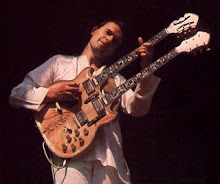
I don't exactly know why, but I'm very drawn to people with astounding physical or mental ability, whether it be in sports, intellectual or artistic endeavors, or music. Take guitar players, for instance. I am fascinated by guitarists with amazing technical skill such that they can play mind-bogglingly complex musical passages with blinding speed. Hopefully, they can also appeal to the mind and heart with their playing, but tremendous technique alone will grab hold of my attention. My two favorite guitarists, in large part because of their freakish technical skills, are John McLaughlin and Allan Holdsworth.

I guess one could say that Robert Smith is the bowling equivalent of an Allan Holdsworth. He's a freak. What makes him freakish is the amount of speed and revolutions--i.e., power--he's able to put on a bowling ball and do it with enough accuracy and control on challenging lane conditions to win PBA national tournaments. While the average professional bowler averages about 300 rpms with the balls they throw, Smith averages over 600, and does it with tremendous speed. In fact, I remember reading that he throws the ball with so much more power than other bowlers, amateur and professional alike, that he's the bowling equivalent of a baseball pitcher throwing a fastball around 140 mph while the other fastest pitchers are in the high 90's. Not only that, but when he has to do it because his ball is hooking too much, he will loft the ball way down the lane and still generate tremendous power with decent accuracy and consistency. For those who don't bowl, this may not mean very much. But if you bowl or know anything about bowling, you can't help but be impressed by this.

Anyway, after spending most of last year recuperating from a debilitating injury to a hip flexor muscle, he won a tournament on TV last week and did in in a way that only he could. Below are parts one and two of his victory match.


Saturday, December 01, 2007

My Reluctant Confession of Racial Prejudice

As I walked from my car to my workplace, a woman approached me. She was clearly in distress. She said she'd just learned that her mother had suffered a massive heart attack and was in the hospital somewhere, and could I help her with bus fare or any other way to get there. I'm new to my job. I didn't want to be late. I couldn't take her to her mom or even spend a lot of time questioning her about her situation and get to work on time. I could have quickly given her money. But I didn't trust her to be on the level.

A big reason why I didn't trust her was that she was black. I hate to admit it but have come to the conclusion that it's better to be upfront--at least in a blog boldly titled "Naked Reflections"-- than to hide or sugarcoat it: I'm prejudiced against black people as a group, which makes me suspicious of any particular black person if I see anything in that person's demeanor or behavior that reinforces this prejudice, such as manner of dress or speech.

Intellectually, I agree with Martin Luther King that we should judge people, to the extent that judging must be done, by the "content of their character" rather than by the color of their skin, but emotionally I tend to feel that a hugely disproportionate number of black people are of dubious character and trustworthiness. Not because the color of their skin or the genetics behind it makes them that way, but because a complex series of interacting social, cultural, psychological, and other factors have predisposed black people in this country to have poor character. Certainly, there are many black people of shining character and many others of at least no worse character than most of the rest of us, and I don't claim to have anything approaching unimpeachable character myself. But an awfully large percentage of black people in this country seem to me to be apathetic if not hostile toward improving themselves through education, and they also seem to be involved in crime, substance abuse, or other illegal and illicit behavior and to think that society owes them the right to continue indulging in this way of life.

I wrote that this was an "emotional" "feeling," but actually, as I read what I've just written, it seems to involve more than just the emotions. I am talking about my perception of reality and expressing it in a fairly rational manner, although a rational statement doesn't have to be a true one. I could construct a rational syllogism that says:

All dogs are cats,
Fido is a dog;
Therefore, Fido is a cat.

This syllogism or argument is rational or logical in the sense that if its premises were true, its conclusion would also have to be true. But it's ridiculously false in its first premise and; therefore, in its conclusion.

So, I wonder. Am I intellectually rationalizing, after the fact, an emotional feeling toward black people? And, if so, where does this feeling come from? Or does my feeling arise from experience and intellectual reflection of some kind upon my experience involving black people as a group? If so, is my conclusion or, at least, hypothesis that black people as a group are of dubious character true?

I wish I could say that it isn't. But, in my heart of hearts, I'm inclined to believe that it is, and I don't know what to do about it. I don't want to think what I do about black people as a group if I'm wrong or even if I'm right but have come to my belief without sufficient justification. Yet, first of all, how do I determine if my belief is true, and, second, how do I determine, in the absence of complete certainty, if I'm justified in thinking that it's probably true?

Anyway, I don't remember how this woman was dressed except that it seemed to be rather respectably, but I had the feeling that she might well be lying about her mom, and, given my prejudice toward black people, my determination to get to work on time, and my lack of faith in my ability to think quickly and effectively in situations requiring it, I more or less reflexively said, "I'm sorry, Mam, but I can't help you" and kept walking. As she walked on to approach someone else, I heard her say bitterly, "I'm sorry, Mam, but I can't help you, what is THAT?"

If that woman had been dressed the same way and acted the same way but had not been black, would I have given her money? I doubt it, but I think I might have been slightly more inclined to. The fact that she was asking for money in the way that she was and was black more or less sealed the deal. She did seem genuinely distressed. Her voice sounded desperate and her mouth had an odd contortion as she spoke, but I think I subconsciously made the snap judgment that she was more likely to be mentally ill than telling the truth about her mom and that her being black may have contributed to behaviors that plunged her into her current predicament and that my giving her money was not really going to benefit her but just further lighten my already uncomfortably light wallet.

Nevertheless, I felt guilty as I walked on. Had I done the right thing? Or could I have done better? What should I have done? In so many unexpected everyday situations, I don't know what to do and my mind just goes blank under the pressure of the moment, and I have little confidence in my ability to think on my feet and quickly figure it out. Even afterward, when I have the luxury of being able to take my time and reflect on what I should have done with no one watching me or waiting for my answer, I don't really know what I should have done. But that's another issue too large and complex to address at length here. I've already raised one issue that is more than sufficiently large and complex enough for one post. That issue is my prejudice toward black people.

I remember how I used to argue passionately against what I perceived as my grandfather's strong prejudice against black people. He would rail against the Black Panthers or the blacks rioting in Watts and say things like, "Most blacks are just no damned good," and I would angrily tell him that he's wrong, or I'd make fun of how he'd say that black people were bad except the ones and their families with whom he worked or bowled league. They were all nice people, but other blacks were bad apples. He'd reply that there were a few good apples in the barrel of mostly rotten ones, a few exceptions to the rule regarding black people. "You just keep your eyes open and wait," he declared. "You'll see that I'm right."

And now I see that I think all too much the way he did. I know black people, including my supervisor at work, whom I like a great deal and for whom I have nothing but deep admiration and respect. They're bright (far more so than I am) kind, decent, friendly, hard-working, and scrupulous. But, in my heart of hearts, I see them as "exceptions to the rule."

I'd like to overcome this way of thinking and feeling, because I want to believe that it isn't true, and that, in any case, expecting the worst of a group of people will do nothing to help them do their best. But I don't know how to overcome it except by, for starters, admitting my prejudices to the world and proceeding from there.

Sunday, November 25, 2007

Buddhism vs Wilberian Integral?

I've been working full time at my new job and seem to have almost no time left over for blogging or anything else. I truly wonder how anyone who works a full-time job can find the time to read or blog. And I am in total awe of anyone who can work full time, have a decent family life, read, and blog regularly. The only way I can see them accomplishing this miracle is by sleeping four or five hours a night at most. But how can most people do this for a long time and stay physically and mentally healthy? I don't think I can do it, and I'm not keen on trying to prove otherwise.

Anyhow, I did manage to read the following e-mail update from the Integral Spiritual Center. I found it an intriguing summary of some essential Buddhist teaching within a Wilberian Integral framework.

The goal of Buddhadharma, says Patrick Sweeney, is to transform ourselves into what we really are. Far from pumping ourselves up to obtain some egoic goal, the Buddhist path leads us in precisely the opposite direction–to dismantle the ways we defend against what we always already are.

This path by which this goal is accomplished is the unfolding of prajna. But what is the starting point? The basic Buddhist view is contained in the teaching of the “four seals of the view.” As Traleg Rinpoche teaches, it is difficult to overstate the importance of right view. With right view, one has a cognitive frame that tends toward realization, toward evolution of consciousness, and toward the deepening of state-stage experience. Without right view, the process of overcoming ignorance becomes very difficult, and more or less hit and miss.

The four seals of existence are impermanence, selflessness, suffering, and nirvana. Basically:

  1. all compounded things are impermanent
  2. all phenomena lack self-nature
  3. all dualistic emotions and experiences are intrinsically painful
  4. nirvana alone is peace, and is beyond concept.

These four seals of the view define all of Buddhist practice. They describe the truth of the actual situation that we find ourselves in, what happens when we contract against it, and what happens when we relax into it.

In truth, Buddhism maintains, the outer world is impermanent. The tradition provides extensive explanations of the manner in which different aspects of the world are changing. There is gross impermanence: the physical cosmos, the solar system, and the earth are constantly changing. There is subtle impermanence: we come together as a result of our parents’ union; we experience an outer world—and inner selves—that are continuously changing. Most of us have gone through several complete revolutions within our own lives. Within and without, we are constantly seeing this truth.

The Buddha taught that not only is the body changing; not only is the outer world changing; but, in truth, there is no permanent witness to these events. When we look at experience closely, we don’t find a permanent ego; we don’t find something independent from experience. There is nothing that stays the same through our experience, nothing unitary or of one nature, nothing special that is the center of the universe.

And yet, we behave precisely as if that were the case! As if “me” existed independently from the world. As if “me” was permanent. As if “me” was one thing….

Our experience now is different than, for instance, when we were twelve. Are we the same? Or are we different? The right answer, of course, is both. Reality is constantly showing us that our emotional reaction to reality is based on an imputation that simply isn’t true. Emotionally, we tend to behave as if we are the center of the universe, as if we are special, as if our needs, desires, goals, dreams and visions are more important than those of any other. When in fact, they are pretty much identical to everyone else’s….

I had some questions as I was reading this. Perhaps someone out there can help me answer them.

First, why do we defend against who or what we "always already are," and who or what does the defending? I can understand how we might be constituted to experience the world as a collection of separate things and events and ourselves as a permanent being separate from this collection, but Sweeney and the wisdom tradition he represents appear to assert that our ignorance of the true nature of the world and ourselves is actively and purposely maintained for some reason. But if so, who or what maintains it, and why? It's often said that the ego does this. But, in the same breath, the ego is said to be illusory. Well then, how can an illusion do anything, much less keep us ignorant of who we really are and what the world really is?

Second, Sweeney says, "When we look at experience closely, we don’t find a permanent ego; don’t find something independent from experience." Yet, if I understand Ken Wilber correctly, there is something--a spiritual Self or Atman--at the center of our consciousness that is separate from the objects of its experience, although, at the highest level of consciousness, this duality of object and subject somehow disappears. How is Wilber's view reconciled with the Buddhist view, or is it? Speaking for myself, I have a difficult time believing in some permanent spiritual essence or Self that experiences worldly impermanence. It seems much more evident to me that there is no Atman or spiritual Self, just an ever-changing constellation of interdependent physical and mental states through which objects are experienced.

I guess in this regard I'm more Buddhist as I understand the tradition than I am Wilberian, or do I not understand Buddhism or Wilber correctly?

Tuesday, November 20, 2007

Last Moments

Body lying flat on a last bed,
Voices whispering a few last words,
Mind watching a final memory glide past;
When will that drama come for you?
--7th Dalai Lama

Sunday, November 18, 2007

The Making of a Teacher


I am still an educator. But formerly it was education for degrees; now it is education for living.
--Eknath Easwaran

I'm reading a wonderful biography. The book is entitled The Making of a Teacher: Conversations With Eknath Easwaran. It was written by two of Easwaran's students, Tim and Carol Flinders, who lived with him at his ashram, The Blue Mountain Center of Meditation. Easwaran was a marvelous writer despite the fact that English wasn't even his native language. He grew up in the southwestern Indian state of Kerala and spoke Malayalam as his mother tongue, learning English as a second language in school and mastering it along with Sanskrit through his own diligence. In fact, he excelled so well in English that he became the leader of his high school debate team, fell in love with English literature, and became a very successful university professor of English in India.

However, he felt a higher calling over time to take up a spiritual path grounded in meditation and was transformed through his discipline and experience into a spiritual sage who came to the USA in 1959 on a Fulbright scholarship and ended up teaching, at U.C. Berkeley, what may well have been the first accredited meditation course in a major university anywhere in the country if not the world. He also founded the Blue Mountain spiritual center and retreat and the Nilgiri Press.

In the late 1980's, Tim and Carol Flinders, who lived at the Blue Mountain Center with Easwaran in a community of his devoted students from all walks of life, spent several months interviewing him for a biography they planned to write about him. The Making of a Teacher was the remarkable result, and I recommend it to anyone who is interested either in Easwaran in particular or in simply reading about the life experience of an enlightened and much beloved spiritual teacher.

Below is a passage from the book that deeply moved me. I read it in the wake of a recent oil spill in San Francisco Bay that has befouled water and beaches and killed and imperiled birds and other wildlife all along the area. In reading it, I also thought of my beloved Smokey and wished I had stayed with him until the very end. The passage illustrates beautifully how Easwaran looked at life and death and taught about them in his mindfully loving way.

Halfway up the beach, six teenagers stood in a huddle, scuffing the sand with their bare feet. They were looking down at something, and as we approached we saw that it was an immature harbor seal that lay just above the water line. It was panting heavily, its eyes wide open. Easwaran stopped and looked down at it. The trembling pup turned its eyes toward him, too weak to retreat. Carefully, Easwaran knelt on the sand and began to stroke the unresisting, doglike head, running his gloved hand back and forth over its damp fur. The seal did not turn away.

The teenagers watched with cautious interest. One of them was tall and slender, with quick, serious eyes and a headful of blond hair that moved with the breeze. He stepped forward from the group, then dropped to his knees beside the seal. He looked into its eyes, then looked long and steadily at the man who was stroking it.


Easwaran didn't look up but continued to stroke the seal's small, pointed head. For some time, the pup lay still, its wide, dark eyes fixed on Easwaran. Finally, the eyes dimmed and turned lusterless.


Easwaran turned to the boy.


The boy asked, "Is it dead?"
"His body is dead," said Easwaran, standing up and brushing the sand from his knees.

"You mean. . .?" The boy glanced at the group of friends standing nearby, then back at Easwaran, who smiled warmly at him. Encouraged, he stood up slowly and asked, "Did you see how that seal looked at you?"


"Perhaps he knew I was his friend," Easwaran answered.


The boy pushed the long hair out of his eyes and paused again. He appeared to be struggling to frame another question.


Easwaran waited, unhurried. His seriousness matched the boy's own--softened, though, by the transparent affection that young people always elicit in him. He returned the gaze of the young man who was asking him, wordlessly, what the death of the seal pup
meant. "It means that this same thing will happen to all of us," Easwaran said quietly, anticipating him. "To me, to you, to your friends here." He looked at the faces of the others, who stood watching with patient incomprehension. Then he turned back to the young man beside him. "But it will not be the end. Not for any of us."

Not a muscle moved in the young man's face, but the look of struggle was gone. His gaze was eager now, and searching.


Easwaran clapped him on the shoulder, gave him another smile, and said good-bye. Then, waving to the others, he took Christine's hand and started up the beach. Had the boy been a few years older, I guessed, Easwaran would have let himself be drawn out a little more. Later he confirmed my guess, recalling his favorite Upanishad, the Katha, in which a teenage boy boldly demands answers about the meaning of death from a sage who is as fierce as he is wise. "Teenagers can show tremendous spiritual potential," Easwaran said. "They have the passion, the desire, the idealism, the reckless daring to stake everything they have on an almost impossible goal. But these young people need time, you know. My way is terribly demanding. Before they take on meditation and these other disciplines, they need every opportunity to explore all the innocent pleasures of life--and they need to begin to see through them too!" Still, he added, if the young man on the beach were to turn up at one of his Tuesday night talks, he wouldn't be surprised. "I would be more than happy to see him."


More than happy
. Spiritual teachers in the Indian tradition keep ceaseless watch for that special light in the eye of the most gifted students--the glint of gold. When the teenage hero of the Katha has passed the tests placed before him by the teacher and proved himself worthy of spiritual instruction, the crusty sage breaks into an uncharacteristic smile: "Blessed are you, Nachiketa!" he exults. "May we find more spiritual seekers like you!" (133-135)

Saturday, November 17, 2007

An Unforgettable Movie Scene

I've watched more movies than I can count, and I've forgotten virtually all of most of them. But I just saw a scene in a movie tonight that I will never forget. In fact, it may be the most memorable scene of any movie I've ever watched.

Two thugs had just killed a guy and discovered that there was a canister strapped to his body. So, they took the canister and opened it and powder poured out onto a table. What did these murderous nitwits do? They rolled paper money into tubes and snorted reams of the powder, thinking it was cocaine. It wasn't. It was weapons grade plutonium. I shudder thinking about it and what it would feel like to be those two guys for real. I probably will for a long time.

Friday, November 16, 2007

Biden Has Style and Substance and No Chance


I watched the Democratic debate last night. At least, I more or less watched it. I haven't yet disciplined myself to pay full attention to things that don't reach out and grab my interest by the neck. And political debates have a very limited reach and weak grasp in that respect. So does almost everything else connected with politics. There just seems to be so much posturing involved. Mostly style. Little substance.

Now don't get me wrong. I love good style. But I want it to walk hand-in-hand with plenty of substance. Political debates don't seem to do that very well. It's probably more the fault of the formats than of the debaters. The formats force the debaters to give thirty minute answers in one minute soundbites, or less. The result is not real debate. I'm not sure what to call it so long as it isn't debate. An "exhibition" perhaps. An exhibition of oratorical skill and personality under pressure. And this is how they're judged by the media "pundits" after the fact.

Immediately after last night's debate, all the analysts talked about were how Edwards and Obama came out swinging, how Hillary gave it back and then some to them, how the crowd seemed behind her when they clapped and cheered for her and booed Obama and Edwards, and how Hillary seemed to "want it" more than Obama did. It was an analysis of style and crowd reaction to style, not of the substance or actual content of what anyone said. I turned it off. I had better things to do. It would have been different if there had been some strong, concise analysis of what the exhibitors (or exhibitionists?) proposed in their rushed soundbites.

Now maybe that's too much to ask of a medium obsessed with ratings involving an audience of people who, in general, would apparently rather hear mostly about style and little or nothing about substance. Or is this only appearance and not reality? And maybe we can't legitimately expect even "the best political team on television" to know enough about the subjects exhibited to analyze the soundness of what the exhibitors presented. Yet, I somehow think that some of them are capable of this. But they, like the exhibitors/debaters themselves, aren't allowed the opportunity to strut their stuff.

However, I believe that the person who came closest to strutting his stuff last night was Joe Biden. He might well be my pick for president if I were voting today. Why? Because he seems to me to have the best combination of what we desperately need in a president at this extremely urgent time including an unrivaled grasp of both foreign and domestic policy, obvious high intelligence, a potent blend of perspicacious realism and passionate idealism, unforced eloquence, and an intriguing mix of gravitas and not taking himself too seriously.

Yes, I know he has supported the war in Iraq, although he's also offered what may be the most realistic plan for getting us out of it:

1. Giving Iraq's major groups a measure of autonomy in their own regions. A central government would be left in charge of interests such as defending the borders and distributing oil revenues.
2. Guaranteeing Sunnis — who have no oil rights — a proportionate share of oil revenue and reintegrating those who have not fought against Coalition forces.
3. Increase, not end, reconstruction assistance but insist that Arab Gulf states fund it and tie it to the creation of a jobs program and to the protection of minority rights.
4. Initiate a diplomatic offensive to enlist the support of the major powers and neighboring countries for a political settlement in Iraq and create an Oversight Contact Group to enforce regional commitments.
5. Begin the phased redeployment of U.S. forces in 2007 and withdraw most of them by 2008, leaving a small follow-on force for security and policing actions. The plan named as The Biden-Brownback Resolution passed on the Senate floor 75-23 on September 25th, 2007, including 26 Republican votes. (from Wikipedia)


Yes, I know he can come off as almost egomaniacally self-promoting at times. So, he's not perfect. But he may be the least imperfect presidential candidate from either side of the political aisle. He seems to me to be the most complete package. If he were president, I would feel assured that we were in the best hands we could probably find. Perhaps we need Dennis Haysbert doing a political commercial for him reassuringly boasting, "You're in good hands with Biden."

Of course, Biden doesn't have a chance of getting the nomination. He's way down in the polls, although I don't know why, and that alone keeps him from receiving the media attention that might elevate his position. But one can only hope that a Democrat is elected president and that she or he appoints Biden Secretary of State.

So much for my post-debate commentary. I realize that it, like the "exhibits" and analyses I criticized earlier, is very short on substance. But then what do you expect? I'm not even a member of the best political team on television.

Playing Kooee With God

People see his pleasure-ground; him no one sees at all.
– Brihadaranyaka Upanishad

When I was a boy in my ancestral home in South India, the children used to play a game called kooee. One little boy or girl would run and hide in a room of the labyrinthine building. Then he would call out “kooee,” and we would hear “kooee” echoing from all corners. “Kooee” would be coming from upstairs and downstairs; from the ceiling “kooee” would reverberate. We would race through the halls, tear through each room in search of the one who was crying “kooee.” Then at last we would catch her, and the game would be over.

This is the game we are all playing. Some people hear the call coming from the bank. Others hear the call from the haunts of pleasure. Many hear it coming loud and clear from status and prestige. Still others, tragically, seek power that calls to them with a loud voice.

We need to open our ears, so that when we hear the elusive call we will say, “Oh, that is Krishna playing on his flute. That is Jesus beckoning to us to follow him. That is the Divine Mother calling us home. That is the Buddha trying to wake us up.” Finally, we learn how to trace the sound to its source and say, “Caught you at last!”

--Eknath Easwaran

Wednesday, November 14, 2007

Earthrise, Earthset

Here is some remarkable video of the Earth rising and setting as seen from the Japanese vessel Kaguya now orbiting 100 kilometers above the moon.

"What a wonderful world" indeed!

Monday, November 12, 2007

Changing the World Within and Without

You never enjoy the world aright, till the Sea itself floweth in your veins, till you are clothed with the heavens, and crowned with the stars; and perceive yourself to be the sole heir of the whole world, and more than so, because men are in it who are every one sole heirs as well as you.
– Thomas Traherne

In our relationship with the environment, the real power does not lie in the hands of technologists or politicians or directors of multinational corporations. It is individuals like you and me who make the final decisions about what is bought and sold in the stores, how much carbon dioxide is pumped into the atmosphere, and what is dumped into the sea. Each of us can begin to heal the environment right away by changing our daily habits.

And beyond that, there is another area which deserves our immediate attention: the world within. For each of us has an entire world within, an internal environment as real as the one we see around us. This internal environment has a powerful effect on the external environment: the way we think affects the way we treat the earth. When we purify this inner environment, we are not only making ourselves more secure and fulfilled, but we are also making an important contribution to the health of Mother Earth.

--Eknath Easwaran

Saturday, November 10, 2007

Reflections on Love and Marriage


I've continued to watch HBO's amazing dramatic series Tell Me You Love Me and to be struck by just how true-to-life it appears to be about intimate relationships. It seems to me that many couples, like those depicted in the series, are compelled more by their lustful attraction than by genuine love to rush into marriage, and before they know it, they're pregnant or have screaming kids running around, the thrill is gone, and little else remains to keep them together.

Each may finally see the other not through a hormonal haze but with enough objective clarity to realize that not only do they not really love each other, but they also don't really even like each other. Or perhaps one (or both) of the spouses changes so much over the years, for better or worse, that s/he no longer has the qualities that drew the other to her/him in the first place. And so some of these disenchanted couples simply get a divorce while others go to marriage counselors and try to patch things up and often end up divorcing anyway after all of the "therapeutic" revelations that dissolve what was left of any pretense of physical attraction or romantic love between them.

I'm grateful that I married as late in life as I did, without being heated to feverish folly by the flames of youthful passion that burned and scarred me in my more naive past, and that I didn't enter into my marriage with a rose-colored perception of my wife and with quixotic expectations that our marriage would ensconce us in a Utopian paradise that forever and completely fulfilled all of our personal needs and desires and deliver unflagging security and bliss while the world around us raged on. As silly as this sounds, I think many people do enter into marriage with these conscious or subconscious expectations and place so many demands on their spouses and their marriages that resistance to failure is futile.

I, on the other hand, believe that, rather than initially placing my wife on a pedestal from which she can't help but fall over time, the better I come to know her, the higher she rises in my esteem, the more I appreciate and love her, the more grateful I am to have her in my life, and the more I want to provide for her and please her in every way. It's not always easy, and I suspect that it's harder for her than it is for me, but I don't expect it to be easy, and, paradoxical though it may seem, that probably makes it a lot easier than it would be otherwise.

It may well be true, as has often been observed, that it takes hard work to keep a good marriage going, but it has to be some of the best kind of work there is.

Empathy Through Unity

You see, when you are continuously aware that all life is one, your awareness reaches out into the world like an open nerve. It registers both the pain and the joy of its creatures. It is the price to be paid for becoming aware of the underlying unity of life.

--Eknath Easwaran

Thursday, November 01, 2007

Any Advice On Our Dilemma?

My wife and I are faced with a serious dilemma, and we would dearly appreciate any advice you might have to offer.

My wife's cousin has a young son we're convinced falls somewhere along the autistic spectrum. I believed very early on that he exhibited signs of this, and my wife and her sister agree with me. He recently turned three, but he doesn't speak more than a word or two at a time and usually doesn't speak at all. Even more noticeable is his lack of responsiveness to people. When you speak to him, he doesn't look at you, or he does so only fleetingly. He directs his attention to the objects he's playing with rather than to the people around him, even if those people are trying to interact with him in his play. He's a very cute little boy and seems as though he may be quite intelligent in some respects. But his glaring unresponsiveness to people, lack of verbal communicativeness, repetitive play patterns, strong startle reactions to unexpected noises and other stimuli, and numerous other traits and behaviors definitely raise alarming red flags.

And this became all the more apparent to us in the wake of a recent recommendation, widely discussed in the media, from the American Academy of Pediatrics that all toddlers be screened for autism twice by the time they're two years old, and our viewing of some website videos contrasting autistic with normal childhood behavior at different ages. Seeing these videos completely erased any lingering doubts we may have had about our concerns. The boy in question exhibits in spades virtually all the telltale signs revealed by the videos.

Our problem is, where do we go from here? The boy's mother and grandparents have also expressed their suspicions at times that something isn't right with the boy and that this something could be autism, but they won't do anything about it, and they seem determined to deny that there's a problem severe enough that he won't "grow out of it" in time. They seize upon any little sign of intellectual or verbal development as proof that the boy is not autistic, that's he already growing out of any problems he may have, and that he's going to be just fine without any kind of intervention.

For instance, when they and the boy visited us yesterday, they proudly told us how he could now recite the alphabet from A to Z and read out the address numbers of houses including ours. To complicate things even further, his pediatrician allegedly hasn't said anything, and one of my wife's aunts and her pediatrician daughter came here from Thailand a few months ago and stayed with them for a week, and the pediatrician daughter reputedly told them that the boy was not autistic.

I don't believe her, and I don't think they, in their heart-of-hearts, believe her either. But they desperately want to, and so they won't take the boy to a specialist and have him expertly evaluated and get him the help he needs as soon as possible to afford him the best chance of living a relatively normal life.

My wife and I don't know what to do. I, for one, feel very concerned for this boy. My mother has told me that when I was very young, she feared that I was autistic. And this was in the mid- 1950's when autism didn't receive anything like the publicity it does now. And my life has been a mess ever since as I've struggled abnormally with life's normal tasks. I don't want to see this or worse happen to the boy. But how can my wife and I persuade his parents and grandparents to do anything about it? Whenever my wife has mentioned her concerns, they become defensive and upset, and we don't want to alienate them. Should we keep bringing up the subject anyway? Or should we simply throw up our hands and say, "It's not our place to do anything about it, or, even if it were, there's nothing we can do if they won't listen to us."?

Does anyone out there have any suggestions?

Wednesday, October 31, 2007

More On Ed Witten's Genius


I just posted an entry about Edward Witten, who is probably one of the smartest people on Earth and quite possibly the world's greatest living theoretical physicist. I just found some more material about him that I'd like to share with you.

In his bestselling book The Whole Shebang, acclaimed science writer Timothy Ferris says this about Witten:

In the high carrels of theoretical physics, where intelligence is taken for granted, Witten is regarded as preternaturally, almost forbiddingly, smart. A tall, boyish-looking man, he wears the habitual small smile of the theoretician for whom sustained mathematical thinking has something like the emotional qualities that mystics associate with meditation. He speaks in a soft, high pitched voice, floating short, precise sentences punctuated by witty little silences--the speech pattern of a man who has learned that he thinks too fast to otherwise be understood. Though he is the son of a theoretical physicist, Witten came to science in a roundabout fashion. He graduated from Brandeis College in 1971 as a history major, wrote political journalism for the Nation and the New Republic, and worked in George McGovern's presidential campaign. Primarily a mathematician, he picked up physics along the way, almost as a hobby. But colleagues who compare him to Einstein have something more specific in mind than his imposing intellect: Like Einstein, Witten is a geometer. "The great ideas in physics," he says, "have geometric foundations." String theory, he believes, provides a geometric basis for particle physics--which means, among other things, a way to make everything out of nothing. He calls string theory "part of the physics of the twenty-first century that fell by chance into the twentieth century." It caught his interest and kept him in physics. He published nineteen papers on strings in 1985 alone and has bustled on at a similar pace ever since, laying tracks on which mighty trains can run. (221-222)

And to quote from a web page dedicated to Witten:

He shows the direction for the rest of us," stated Institute physicist Nathan Seiberg, who collaborated with Witten on a series of groundbreaking papers. "His main strength is that he's powerful in everything. Both in math -- the most sophisticated math -- and physics … he has remarkable physics intuition as well as complete control over the math that is needed. And, in that respect, I think he's unique.

In the left-hand column toward the top of that web page in a box titled
WATCH THE VIDEO is a link to a fascinating and fairly lengthy interview with Witten about his work in superstring theory and his life as a mathematical physicist. If I've succeeded in piquing your interest in this mathematical and scientific genius, I highly recommend that you check out the video. You might also want to listen to this Witten lecture, aimed at nonspecialists, on the future of string theory.

Finally, below is another video segment featuring Witten talking about string theory.


Monster Mind Ed Witten

Yesterday, Bill Harryman at Integral Options Cafe speedlinked to an article reporting a poll in which 4000 members of the British public selected the "top 100 living geniuses." I agree with some of the selections. But not only were the "top 100" disproportionately British, but I think some very deserving people got left out. The two who spring most readily to mind are Ken Wilber and Edward Witten.

I would venture to guess that just about anyone reading this blog is familiar with Ken Wilber. It certainly seems to me that he belongs on the list. However, there's a theoretical physicist who didn't make it who surely belongs there as well.

Of course, Stephen Hawking is on it, possibly mostly because he's British, is an extremely well-publicized victim of ALS, has written a very popular book about cosmology, and has made some important contributions to astrophysical theory. It's also true that Hawking occupies Isaac Newton's chair as Lucasian Professor of Mathematics at the University of Cambridge and is popularly thought to be Newton's and Einstein's successor.

Yet, the person regarded by his fellow physicists and mathematicians to truly be the most likely successor to Einstein is an unassuming scientist at Einstein's old stomping grounds, Princeton's Institute for Advanced Study. His name is Edward Witten. He clearly possesses what the late, great physicist Richard Feynman called a "monster mind." Or as one prominent cosmologist said of Witten: "We all think we're very smart, but he's so much smarter than the rest of us."

Witten has won a MacArthur Grant, the National Medal of Science, and has the highest h-index of any living physicist. This is a measure that attempts to quantify scientific productivity and impact. He's renowned for his grasp of and contributions to both mathematics and physics and is a winner of the extremely prestigious Fields Medal, the mathematics equivalent of the Nobel Prize. The great geometer Sir Michael Atiyah said this of Witten:

Although he is definitely a physicist (as his list of publications clearly shows) his command of mathematics is rivalled by few mathematicians, and his ability to interpret physical ideas in mathematical form is quite unique. Time and again he has surprised the mathematical community by his brilliant application of physical insight leading to new and deep mathematical theorems.

Witten is probably most famous for his spectacular contributions to superstring theory, and the video below features theoretical physicist Brian Greene touching upon Witten's involvement in this area and also shows Witten briefly.

Tuesday, October 30, 2007

The Genius of Art Tatum

I'm inspired by Bill Harryman's post over at Integral Options Cafe of Georges Cziffra playing Lizst to post a video of of the incomparable Art Tatum playing jazz. It is said that awesome classical musicians such as Vladimir Horowitz would walk away from Tatum's performances astounded by his "genius,"that fellow jazz musicians called him "the eighth wonder of the world," that Russian composer Sergei Rachmaninoff proclaimed him the greatest piano player in any style, and that the great jazz pianist Fats Waller once introduced Tatum by saying: "I only play the piano, but tonight, God is in the house." It is even the case that, quoting Wikipedia, "In 1993, an MIT student invented a term that is now in common usage in the field of computational musicology: The Tatum. It means 'the smallest perceptual time unit in music.'"

Ladies and gentlemen, I give you Art Tatum playing Yesterdays.


And here is a clip from a documentary about Tatum.

How to Choose a Spiritual Teacher?

I had a very good discussion with someone in the comments section of one of my recent entries. Part of our discussion was about how to progress spiritually. This person suggested that one needs to find an authentic spiritual teacher and that Eknath Easwaran, although he seemed like a "nice" enough guy with some commonsensically sound things to say about religion and spirituality, was essentially just an "English teacher"and not a "genuine vehicle of the divine grace." When I asked how one knows an authentic teacher from a charlatan, this person replied:

it is so important to remain within orthodoxy, as these are guaranteed sources of grace. They have an established record, like a boring mutual fund that you know will appreciate over time, as opposed to some hot stock that may or may not grow.

To cite a banalogy, let's say you have a big social function coming up, and you want to look sharp. But like Gagdad Bob, you don't know anything about fashion. Whom do you trust? On the one hand, you could go to some cutting edge place on Melrose Avenue and get the latest style. You'll probably end up looking like an idiot. No, better to stay with a classic look, something timeless, something that will never go out of style. This is why Cary Grant always looks impeccable, while those who follow fashions look very silly five or ten years later.


This seems like excellent advice. If one selects a venerable teacher from within a time-honored wisdom tradition, one is largely "guaranteed" a legitimate teacher who can act as a "source of grace."

As a sideline comment on the clothing metaphor, I recently felt the need to purchase a sport coat for an important job interview for which wearing my one and only suit seemed "over the top," but anything less than a nice sport coat with dress shirt and slacks and matching tie seemed insufficient. My problem was that I have such dismal fashion sense that I hadn't a clue as to what to buy. I had the idea that I needed to get something more on the Cary Grant than Carson Kressley side of fashionability, but whom could I trust to show me what filled the bill? I decided on the Men's Wearhouse because I'm a sucker for those George Zimmer commercials where he earnestly boasts in a mellifluous tone, "You're going to like the way you look. I guarantee it." I believed that I could go to one of his stores and find something recommended by someone who knew what he (or she) was doing without having to pay what's left of my bank account for it. I'd like to think I made the right decision not only on where to shop but also on the sport coat I ended up buying, but I don't know for sure. It's not the coat I would have bought on my own by any means, and, as for trusting Men's Wearhouse, I could probably find people who know about clothes who would say that Men's Wearhouse is a good place to shop whereas others would say that it sucks big time.

In much the same way, I could probably find disagreement between even the most spiritually knowledgeable people about who, among even the most revered, is an authentic spiritual teacher and who isn't. For instance, some swear that Andrew Cohen is a great spiritual teacher, while others insist that he's an egomaniacal, cult-leading nutcase. It seems like, in the end, one just doesn't know for sure. Not only does one not know who's a genuine spiritual teacher in general, but one also doesn't know whether that teacher is right for him or her in particular. "Different strokes for different folks," and, perhaps, different teachers for different seekers. It seems to me that if one is really looking for a good teacher, one may need to find someone who not only has a sterling reputation among people who seem qualified to judge (whoever they are), which isn't always that easy to do, but also that he (or she) must strike a chord deep within oneself.

In their own ways, Spinoza, Alan Watts, Thich Nhat Hanh, Eknath Easwaran, Ken Wilber, and, yes, even Tony Robbins have come the closest to striking chords deep within me of anyone with whom I have any familiarity. All seem to have pieces of the spiritual puzzle, even though no one seems like a sufficiently complete teacher for me in and of himself. I know that Cousin Dupree would probably roll his eyes in disgust at my mention of at least two of these gentlemen, and he probably wouldn't think much of the remainder as spiritual teachers, but why should I trust Dupree's judgment about spiritual matters more than I do my own deepest instincts? Because he's far smarter and much more widely read than I am and has even had his own book about spirituality published and praised and has been interviewed in a leading magazine about spirituality? Some would say that this is reason enough, but is it?

In any case, I can't force myself to go against my instincts to embrace Dupree's or anyone else's conflicting judgments even if I wanted to. The best I can do is listen to and reflect upon what others have to say and then proceed to make my own choices based on what I think (or feel) is best. And I suspect that there's something to be said for following through with conviction and purpose with one's decision after one makes it instead of wavering diffidently from second-guessing.

What I'm trying to say is that it seems to me that I must make a choice of whom to follow or what path to walk and totally commit to that choice long enough to get a clear sense of where it leads. I can listen to other people's recommendations, but they can't make the choice for me. I must make it for myself.

Interestingly, Easwaran, who, incidentally, moved on (or up) from being a professor of English literature (Wasn't Aurobindo also an English professor for a time?) to becoming a world-renowned spiritual teacher and writer and the founder of the Blue Mountain Center of Meditation where he lived with and taught, in traditional Indian fashion, a devoted community of students or disciples, had the following to say about choosing the right teacher:

My advice has always been to select your teacher with great care. Use common sense and don't get carried away by personal appearance. You don't go to just any stockbroker and ask him to handle your accounts, do you? You study his record; you ask your friends about him. Now, if choosing a stockbroker can command so much attention, you must pardon me if I say that you should take at least as much care in choosing a spiritual teacher. Look closely at his or her life. That is the surest test. Talk to people who have been with the teacher, who have spent time with him or her. See whether he gets depressed when things go wrong, whether she can return good for ill, love for hatred--whether he can support those who offend him, whether she can forgive those who malign her. How consistent are his actions with his words? I give students years before I accept them fully. I watch them carefully, and I expect them to watch me carefully at the same time. And I ask them to give me a reasonable margin for human error. (The Making of a Teacher, Jim and Carol Flinders, 43-44)


That, too, seems like excellent advice, although it raises its own set of questions. Primary among them are: (1) How much "human error" should we accept in an enlightened teacher? and (2) Should we turn to a living teacher with whom we can be physically present, or can we "settle" for a teacher who has either passed on or whom we can never hope to meet much less study with on a continuing basis?

Sunday, October 28, 2007

The Thai Smile

My wife is now on a plane heading from Thailand to San Francisco.

Thailand is called the "land of smiles." The Thai people are renowned for their beautiful smiles. And my experience with Thai people both here and in Thailand tells me that their reputation is well-deserved. But some people take it a little too far.

Eric Plays Manhattan

I love great guitar playing. Few do it better than Eric Johnson. Here he is showcasing his impeccable tone and wonderful technique and throwing a bit of Wes Montgomery into the mix on a sweet, sweet song titled Manhattan.

What is the Self, and is it God?

As pure water poured into pure water becomes the very same, so does the Self of the illumined man or woman verily become one with the Godhead.
– Katha Upanishad

For some reason, it is very difficult for us to accept our divine nature. This has always puzzled me. We pay money for books about how destructive we are. We stand in line to see movies that emphasize our capacity for making trouble. Then, when Jesus comes to tell us that the kingdom of heaven is within us, we say, “There must be some mistake.”

It is to convince us that our real Self is always pure and eternal that men and women of God keep arising among us. More than anything, we need to hear their good news that the source of all joy and security is right within. In the Hindu scriptures there is a precise term for our real nature: the Atman. All it means is “the Self” – not the little self, the changing personality with which most of us identify, but the higher Self, our real, changeless personality.

--Eknath Easwaran

Is "God" only within me, or is It just as much outside as inside me?

If by "me," I mean my organism or body-mind, then God is both inside and outside me. If by "me," I mean the fullest and most real me, then I, in the fullest and most real sense, am God. And so, I might add, are you. At least this is what I understand many of the great or reputedly great sages to be saying, whether or not any of them happen to be Christian.

Is there such a thing as a Christian sage? If Christianity says that God and I are not the same, but the truth is that God and I are the same and that a sage knows this fundamental truth, can any true Christian be a sage?

Yet, do I understand these sages correctly, or am I distorting their message? And, if do understand them correctly, are they correct, and, if so, how do I know that they are? By doing what they do until I experience what they experience? If I try this and succeed, will I know that "I and the Father are One"? If so, how will my life be different? How will I be different? How will the world be different because I am different?

Saturday, October 27, 2007

She's Coming Home, And I Still Miss Him


My wife will be returning from Thailand Monday. I'll be picking her up at SFO in the afternoon and driving her back home here in Sacramento. She spent three weeks in Thailand at her family's home in Ayutthaya with brief stays in Bangkok and Hua Hin. I wish I could have gone with her. But I had to stay home and work and take care of our two cats.

We used to have three cats. But then I had to have my oldest cat, Smokey, put down recently. I still miss him, especially when I see photos like the one above that was taken a little more than a year ago in our backyard with my lovely sister-in-law. I've loved all of my cats, but Smokey was special.

I wish Smokey were still here. I loved him. And even though he was an old guy, he still took some great pictures. He lives on in those pictures and in my heart.

I'm glad my wife was able to spend these three weeks with her family in her beloved Thailand. But I also miss her, and I'll be happy to have her back here with me and our two "boys."

Fulfillment and Happiness

"The idea is to live a life in conformity with your essence. This is what leads to a sturdy sense of self and to fulfillment."
--Cousin Dupree

"Happiness is an activity of the soul in accord with perfect virtue."
--Aristotle

Friday, October 26, 2007

Can a Court Ruling Be Both Just and Wrong?


Genarlow Wilson, 21, has spent more than two years in prison for having consensual oral sex at a party in 2003 with a girl who was two years younger than him. He was convicted under a 1995 Georgia law that made his offense of "aggravated child molestation" a serious felony, and he was sentenced to ten years in prison without possibility of probation or parole.

There has been much publicity about this case, as many, myself included, believe that the severity of this sentence was an egregious miscarriage of justice. The Georgia state Legislature implicitly agreed by changing the law in 2006 to make consensual oral sex between two teenagers so close in age a misdemeanor rather than a felony. But the law was expressly NOT made retroactive, so Wilson languished in prison and his formal appeal and the public's protestations went unheeded by the courts. Even the Georgia Supreme Court upheld a lower court's ruling that the new law couldn't be applied retroactively to Wilson or anyone else convicted under the earlier law.

However, when a Monroe County judge decided to reduce Wilson's sentence to a year and release him and the state appealed his decision, the Georgia Supreme Court agreed to hear the case and ended up with a 4-3 ruling upholding the lower court judge's decision to have Wilson released. The minority judges expressed their disagreement by arguing that the ruling exhibited "unprecedented disregard" for the Legislature's constitutional authority. Nevertheless, the decision stands and Wilson is expected to be released this afternoon.

I'm delighted that he's going to be free, and I hope that being in prison for over two years hasn't seriously undermined his chances of making a good life for himself on the outside. He is reportedly "committed to talking and working with young people to spread the message that he made a mistake that night and doesn't want it to happen to anyone else." However, I'm not sure I understand the higher court's ruling. I agree wholeheartedly with its statement: "Although society has a significant interest in protecting children from premature sexual activity, we must acknowledge that Wilson's crime does not rise to the level of culpability of adults who prey on children." Yet, if the state Legislature does, indeed, have the constitutional authority to make laws that are not to be applied retroactively, and the Georgia Supreme Court itself court upheld that authority with respect to the very law in question just a short time ago, on what strictly LEGAL grounds could it turn around and negate that authority and its own previous ruling?

It seems to me that we have a rather clear case of, in Wilberian Integral terms, "second tier" or integral values overcoming "first tier" values, which, it seems to me, is what true justice often demands. That is, true justice often requires that we look beyond and rise above the mere letter of the law to embrace and manifest its motivating spirit. It would seem that four of the Georgia Supreme Court justices were able to do that, although one can't know for sure what really motivated each of them to decide as they did, and three justices could not. The latter and those who side with them are trapped in a conventional "the law is the law" mentality or worse, and they would have let Wilson spend another eight years in prison for being a seventeen-year-old boy who engaged in one documented act of oral sex with a fully consenting fifteen-year-old girl.

Again, it seems to me that justice triumphed over legal formality in this case. But I wonder if some court somewhere might just as easily violate legal formality to inflict injustice. For instance, might a court rule that a law can be applied retroactively to impose a much harsher sentence on someone than he originally received under the previous law he was convicted of violating, or could it even decide that someone can be tried for breaking a law that didn't even exist at the time he allegedly broke it? If it does, I hope there's a quick remedy for it and that justice ultimately and swiftly prevails.

Thursday, October 25, 2007

Renewed Memories


Five years ago I stood on my neighbor's front porch across the street watching flames and thick black smoke rise from my roof. When it was over, my garage and its contents (including my beloved and almost new Honda Goldwing motorcycle) were destroyed and my house was considerably damaged from fire, water, smoke, and holes firefighters had punched in the ceiling to fight the fire. These memories have been revived by viewing news media reports of the devastation left by the fires now raging in Southern California, and they likely enable me to empathize with the victims of these fires more than can someone who hasn't been similarly victimized to some degree.

However, I was much more fortunate than some of these recent victims probably are. Since my house was not destroyed, I was able to move back into it after three months. The Red Cross put us up in a motel and paid for our meals for several days afterward until we could move into a nice and nicely furnished apartment while my garage was being rebuilt and my house repaired. My insurance covered everything. And we eventually moved back into a house that was in far better shape than it was before the fire. I had a new and improved garage, a new roof, a new paint job inside and out, and new carpeting. All of this home improvement undoubtedly gained me tens of thousands of dollars more from selling the house less than a year later than I would have received otherwise. Unfortunately, my girlfriend at the time was not so fortunate. She lost cherished photos and family heirlooms that no amount of insurance money could replace.

But I can well imagine that some in Southern California are not as fortunate as I was. Some have lost everything but their lives, and it will take far longer than three months before they can move back into their homes. Some may never be able to move back in because they were either uninsured or underinsured.

I hear some, as always happens at times like these, blaming the victims for their misfortune. They should not have lived in the dangerous areas they did. They should have known that they were at serious risk for what ended up happening to them; therefore, they don't deserve any sympathy or help. Or so the argument goes.

But where should they have lived instead? Where can people live that is free of any threat of hurricanes, tornadoes, earthquakes, tsunamis, volcanic eruptions, rising seas, and other natural and man-made disasters, and what would these few-and-far-between places be like if everyone moved there?

I used to live in the San Francisco Bay Area. One of the reasons I left was to avoid the danger of catastrophic earthquakes. I moved to Sacramento thinking I was relatively safe only to find out, after hurricane Katrina devastated New Orleans, that Sacramento is universally considered to be the most flood endangered major metropolitan area in the entire country. I can't afford to move to anywhere else right now, and even if I could, where would I go that didn't present its own set of potential dangers?

My heart goes out to the people in Southern California displaced by fire. And those intrepid firefighters and dedicated Red Cross and other relief workers have my unbounded appreciation and admiration for their extraordinary public service.

Love Everyone No Matter What?

In every veil you see, the Divine Beauty is concealed, making every heart a slave to him. In love to him the heart finds its life; in desire for him, the soul finds its happiness. The heart which loves a fair one here, though it knows it not, is really his lover.
– Jami

It is very difficult for most of us to understand to what extent our love can be expanded. Everybody has a few people with whom he can be friendly, with whom she can be tender, but the Lord tells us, “That’s not enough. If you want to become whole and never be separate again, you should have love and respect for everyone.”

Jesus said, “What is the special achievement in loving those who love you? Even selfish people are prepared to do that. Bless those that curse you.” I can see the twinkle in his eye as the gathering gasps. This is the daring of Jesus. Today we talk about revolution, but I think there has never been a greater revolutionary than Jesus the Christ. He tells us that by loving those who hate us, we can win our freedom, because we will no longer be dependent on how others act towards us. The person who practices this can reach the summit of human consciousness, for it is only by loving people who oppose us and learning to bear with them that we can heal ourselves and heal them too.

--Eknath Easwaran

"Cousin Dupree" would no doubt disagree with Easwaran on this, insisting that it's further evidence of the man's foolishness. But I strongly suspect that Easwaran is right on the mark. This doesn't mean that I'll ever be able to love everyone, and I'm not going to wear myself out trying or beat myself up for failing. But I do see it as an ideal, and I believe that the older and wiser I get, the more closely I may be able to approximate it.

Monday, October 22, 2007

In the Beginning

1.1. Dhritarashtra said: O Sanjaya, after my sons and the sons of Pandu assembled in the place of pilgrimage at Kurukshetra, desiring to fight, what did they do?

In The End of Sorrow: The Bhagavad Gita for Daily Living, Eknath Easwaran begins his commentary on the great Hindu scriptural classic by quoting Mahatma Gandhi:

The Gita is not a historical discourse. A physical illustration is often needed to drive home a spiritual truth. It is the description not of war between cousins, but between two natures in us--the Good and the Evil.


Easwaran agrees with Gandhi and tells the story of how a train on which he was traveling once stopped at Kurukshetra, the field immortalized in the Gita as the site of a devastating battle between the evil Kauravas and the good Pandavas, and most of the passengers disembarked to wander the hallowed field while Easwaran remained on the train because he knew that Kurukshetra was actually a metaphor for the battle against "all that is selfish, self-willed, and separate in us." Easwaran continues:

The violence we see about us is a reflection of the anger and self-will burning deep within us. Most of us carry a conflagration around with us in the depths of consciousness, and many of us are skilled practitioners of guerilla warfare right in our own homes. The war the mystics of all the world's great religions talk about is not the one erupting in the Middle East or in Southeast Asia that makes newspaper headlines; it is the one erupting from the fierce self-will afflicting all of us, estranging individuals, familes, communities, races, and nations. (23-24)


Easwaran argues that we can win this battle and that a careful study of the Gita shows us how with its eightfold path of meditation and allied disciplines that Easwaran has adopted into his own spiritual system that he's spent much of his life sharing with the world.

I read Easwaran and don't know whether to believe him or not. Is the strife and violence we see inside and around us really simply the result of our egoistic selfishness and self-will, and can we really triumph over them by waging a skillful battle against them armed with meditation, mantram, mindfulness, training the senses, slowing down, putting the welfare of others first, reading spiritual literature, and enjoying spiritual companionship?

What's more, are Gandhi and Easwaran correct in arguing that we often need myths to convey truths that expository prose cannot? Isn't the world full of people--like Christian TV evangelists and their followers or the train passengers who wandered the field of Kurukshetra--who take the myths literally and, in so doing, never understand the real point of the myth and never become transformed by its truth?

I don't know the answers to these questions, and I'm tired of reading other people's opinions and speculating. I want to find out for myself. I want to read, reflect, and blog on the Gita and Easwaran's commentary while I follow Easwaran's eight-point program within the wider context of an integral life practice and see where it all leads.

It is said that a journey of a thousand miles begins with a single step. My journey begins here.

A Beautiful Smile

I deposited a check at my bank this morning. The teller was a very pretty young woman who smiled as though she meant it. She always does that. She couldn't have been smiling like that because she saw me as a handsome young man she wanted to attract. I'm several decades older than her and not at all handsome. And, besides, she smiles at everyone the same way: with a kind of bashfully warmhearted radiance . She smiles as though it comes from the depths of her soul.

I wonder if it's all a marvelous act and nothing more. I hope not. I hope she does it because she sees and loves what Eknath Easwaran calls the "original goodness" in everyone.

Wherever it comes from, I hope she never loses that smile or that life's hardships and betrayals don't steal it from her. There are few things that can warm the heart and brighten a person's day as much as that teller's beautiful smile. How I wish we could all smile like that. It would bring us all closer to heaven on earth.

Sunday, October 21, 2007

HBO's Remarkable New Series

One young couple is planning their wedding until the woman overhears her fiance confiding to someone that he'll "deal with" the fallout of his inevitable unfaithfulness when it comes. A young man feels turned off by his wife's constantly pressuring him for sex so she can get pregnant. A man approaching middle age loves his family, but he and his wife haven't had sex in over a year, and the thrill of any kind of real intimacy between them has given way to weariness and numbing routine that she can no longer tolerate. An older woman (Jane Alexander), who happens to be a marriage counselor conducting therapy with two of the aforementioned couples, says to her husband of 42 years that they have worked their way through the very problems she's assisting the other couples with.

I'm writing about a startlingly realistic new HBO dramatic series about intimate male-female relationships titled Tell Me You Love Me. This series, with its extremely revealing glimpses of marital accord and discord and its graphic simulations of sexual intercourse, oral sex, and masturbation complete with visible ejaculation, is like nothing I've ever seen on TV or at the movies before, and, judging from the first three episodes that I saw today, after recently subscribing to HBO for a six month discount, may well end up numbering among the small handful of TV shows that have made me genuinely and profoundly wiser about life.

Almost everything about this series--except, perhaps, the invariably fast and furious sex scenes--shines with extraordinary authenticity delivered by exceptional scripts and acting. Virtually every act, gesture, and spoken and unspoken word is ripe with meaning and intensity, so much so that it can often make one squirm in one's chair with the discomfort of self-recognition, and fill one with apprehension over how any marriage or intimate relationship, one's own included, can reasonably be expected to avoid or surmount the obstacles that beset the troubled couples in the series. Indeed, after watching a few episodes, one marvels that the national divorce rate isn't significantly higher than the 50+% that it's reported to be

Yet, if experience can enable one to live more wisely, avoiding the pitfalls one has encountered or seen others encounter before, then watching this HBO series all the way through and reflecting on the issues it raises may be a shortcut to wisdom and an antidote to failed relationships. Because the intimate revelations of these four couples are so powerful that they sear themselves into one's brain and consciousness. The scenes are so effective that one vicariously experiences and is changed by the relationships he observes on the screen. It's almost like they become one's own personal experiences supplementing and complementing one's actual personal experience.

Maybe I'm just swept away by excessive enthusiasm and hyperbole in the wake of today's viewings and will come down to earth or even indifference after I see a few more episodes. But I doubt it. I think this is truly an extraordinary series, and if you get HBO and haven't seen it, you might want to give serious thought to checking it out. Or renting it after it comes out on DVD. Just be prepared to squirm a lot.

Thursday, October 18, 2007

Quitting One Job For Another

I quit my job today for five reasons: (1) I wasn't any good at it and probably never would be; (2) It was an on-call, part-time job; (3) Somebody could die if I messed up; (4) I've already been offered another job that seems better suited to my aptitudes and career aspirations, and I'm now just waiting for HR to complete the paperwork so I can get started; and (5) The new job is full-time with regular weekday hours.

Having said this, I feel uncomfortable and even a little ashamed over leaving a job I had only barely begun, especially when my supervisor and co-workers have been so decent and accommodating and have invested so much time and effort and the agency that hired me has invested so much money in my training . And I also wonder if I'm going to be able to do my new job all that much better than I was able to do the old one. That is, will I be merely jumping from one frying pan into another, or, worse still, straight into a blazing fire?

Reservations and questions aside, I sincerely believe that I'm doing what's best for everybody, and I suppose that this is the best I or anyone can do.

Easwaran on Learning How to Fly

He that loveth, flieth, runneth, and rejoiceth. He is free, and cannot be held in. He giveth all for all, and hath all in all, because he resteth in one highest above all things, from whom all that is good flows and proceeds.
– Thomas a Kempis

This spring I watched six baby swallows learn how to fly. They were huddled on the telephone wires observing their mother, who came flying slowly by in front of them, doing the easier turns and showing them the basics of flying. There was no need for these baby swallows to read books or attend lectures on how to fly. They have an inborn instinct for it. Learning to fly may not be easy, but this is what birds are born to do.

The Lord sees us sitting on a perch made of pleasure, profit, power, or prestige, quaking with every variation in our bank account and every critical comment that comes our way; and he asks us if we would not rather forget our failings and learn to fly.

This is what we are born to do: to leave our perch of selfish interests and soar aloft. To soar to union with God means that all the faculties and resources which have been hidden in us can come into our lives, to the great benefit of those around us.

--Eknath Easwaran

Wednesday, October 17, 2007

Linking to a Great Review of a Great Movie

"I turned to my companion and said, 'I think that is the best movie I ever saw.'"
--William F. Buckley

I've just finished watching a wonderful movie. I don't have time to review it here, and, besides, I've just read a review of it that is leaps and bounds beyond anything I could muster even if I had all the time in the world. But I agree with everything it says. So, if you're curious and are able to access it in Salon, here is a virtually perfect review of one of the best films I've seen in a long, long time by someone who has become one of my favorite movie reviewers. The film, set in the repressive bleakness that was East Germany in the mid 1980's, is titled The Lives of Others, and the reviewer is Stephanie Zacharek.

Wednesday, October 03, 2007

New Job


Later this morning, I begin training for a new job as telephone operator for a local health care system. My supervisor assures me that the job is "a piece of cake," and for him it probably is. It remains to be seen what it will be for me. I have a book written by, for, and about people with nonverbal learning disorder and Asperger syndrome that says we shouldn't be telephone operators. I hope it's wrong about me and this particular job.

Time will tell.